

AP Syllabus focus: 'For a curve defined parametrically, dy/dx can be determined by dividing dy/dt by dx/dt, provided dx/dt does not equal zero.'
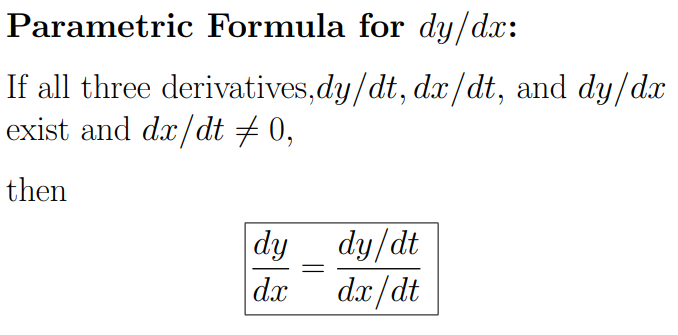
This slide presents the parametric differentiation rule together with the key restriction that . It emphasizes that the slope with respect to is obtained by comparing how both coordinates change with the same parameter. Source
When a curve is given parametrically, the key derivative is found by comparing how and change with the same parameter. This converts a two-function description into a familiar rate of change.
Understanding the setup
A parametric curve is described by giving both coordinates as functions of a third variable, usually .
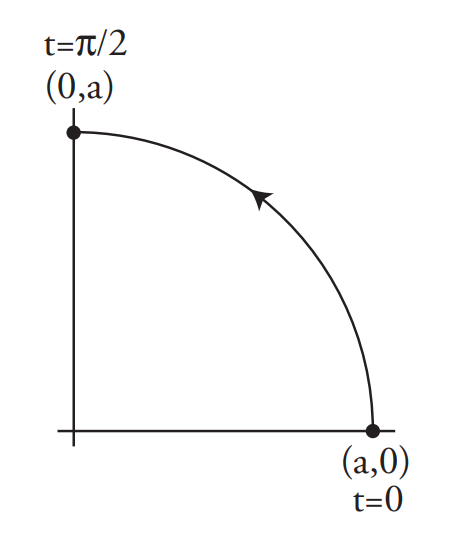
This figure illustrates a circle parameterized by and , with specific points labeled by their parameter values (e.g., and ). The arrow indicates the direction the curve is traced as increases, highlighting that parametric equations encode both the geometric path and its orientation. Source
Instead of writing directly as a function of , you write separate expressions for and .
Parametric curve: A curve described by equations and , where both coordinates depend on the same parameter .
Because both coordinates depend on , you usually cannot find by taking an ordinary derivative of with respect to right away. The derivative must be built from the way each coordinate changes with the parameter.
Why ordinary differentiation is not enough
For a parametrically defined curve, the quantities and tell you how and change as changes. If is changing and is also changing, then the rate of change of with respect to is found by comparing those two rates.
This is the essential AP Calculus BC idea: differentiate both coordinate functions with respect to the parameter, then divide. The formula is valid only when the denominator is not zero.
= derivative of with respect to
= derivative of with respect to the parameter
= derivative of with respect to the parameter , where
This formula is a chain-rule result, not just a shortcut. It tells you how fast changes compared with how fast changes at the same parameter value.
How to find
The standard process is short but must be done carefully:
Write the parametric equations clearly, such as and .
Differentiate with respect to to get .
Differentiate with respect to to get .
Form the quotient .
Simplify if possible.
If the problem asks for the derivative at a specific value of , substitute that value only after finding the derivative formula unless there is a clear reason to do otherwise.
In many problems, the final derivative is left in terms of . That is normal. You do not need to eliminate the parameter unless the question specifically requires the answer in terms of or .
Interpreting the quotient
The sign and size of come from the relationship between the two parameter derivatives.
If and have the same sign, then is positive.
If they have opposite signs, then is negative.
If is very small while is not, the value of can become very large in magnitude.
So the derivative is not telling you how changes as time passes or as the parameter changes. It tells you how changes per unit change in .
Conditions for using the formula
The most important restriction is that cannot equal when you divide. If it does, the quotient formula does not produce a valid value for at that parameter value.
This restriction matters because parametric equations can behave differently from ordinary functions. A single curve may:
pass through the same point more than once,
reverse direction as changes,
have different behavior at different parameter values that produce the same location.
That means the parameter value matters. If a problem asks for at a given point, you may need to identify which value or values of correspond to that point before evaluating the derivative.
Reading AP-style questions carefully
On the AP exam, prompts often vary slightly. You may be asked to:
find in terms of ,
find at a specific parameter value,
determine where ,
determine where is undefined.
Each version uses the same core idea. The difference is what you do after forming the quotient.
If , then the numerator must be while the denominator is nonzero. If is undefined by this formula, then the denominator is . These distinctions are easy to lose if you rush.
Common errors to avoid
Students often know the formula but lose points through small mistakes. Watch for these issues:
Switching the order of the derivatives: is , not the other way around.
Using different parameter values: both derivatives must be evaluated at the same value of .
Forgetting the denominator restriction: a quotient is only valid when .
Confusing with : they measure different kinds of change.
Substituting too early: differentiating first usually reduces algebra errors.
Ignoring multiple parameter values for one point: the same rectangular point can sometimes come from more than one value of .
What your final answer should look like
A strong AP response is usually concise and algebraically clean. It should:
show both and ,
form the correct quotient,
simplify correctly,
include any needed evaluation at a specified value of ,
respect the condition that .
Practice Questions
A curve is defined parametrically by and . Find at .
1 mark for finding and , or for correctly setting up .
1 mark for evaluating at to get .
A curve is defined parametrically by and .
(a) Find in terms of .
(b) Find all values of for which .
(c) State the value of for which the formula for is undefined.
1 mark for .
1 mark for .
1 mark for .
1 mark for solving correctly to get and .
1 mark for stating that the formula is undefined at because .
FAQ
Yes. If two different parameter values produce the same rectangular point, the curve may pass through that point in different directions.
In that case, you must check each relevant value of $t$ separately. The point may have:
two different derivative values,
the same derivative value twice,
or one value where the formula does not apply.
This is one reason AP questions sometimes give a point and require you to find the corresponding parameter value first.
The expression $ \dfrac{dy/dt}{dx/dt} $ becomes $ \dfrac{0}{0} $, which does not determine a derivative value by itself.
That does not automatically mean the derivative does not exist. It means the basic quotient formula is inconclusive at that parameter value.
To analyse the behaviour, a problem may require more advanced algebra or another method. On AP Calculus BC, the main point is that you should not claim a value for $ \dfrac{dy}{dx} $ from $ \dfrac{0}{0} $ alone.
No. In many cases, eliminating the parameter makes the algebra harder rather than easier.
For AP work, the standard method is usually:
differentiate $x$ and $y$ with respect to $t$,
divide,
then simplify.
Eliminating the parameter is only useful if the question specifically wants the derivative written in terms of $x$ or asks you to compare the parametric curve with a rectangular equation.
A valid reparametrisation should describe the same geometric curve, so the local derivative with respect to $x$ should agree at matching points, provided the new parameter behaves smoothly.
However, the intermediate derivatives $ \dfrac{dx}{dt} $ and $ \dfrac{dy}{dt} $ may look completely different after reparametrising.
So:
the formula you compute may look different,
the parameter values may change,
but the resulting $ \dfrac{dy}{dx} $ at the same point should be consistent when the reparametrisation is legitimate.
The sign of $ \dfrac{dy}{dx} $ depends on how the coordinates are changing, not on whether the coordinates themselves are positive or negative.
For example, you can be in the first quadrant with $x>0$ and $y>0$, but if $y$ is decreasing while $x$ is increasing, then $ \dfrac{dy}{dx} < 0 $.
Always focus on:
the sign of $ \dfrac{dy}{dt} $,
the sign of $ \dfrac{dx}{dt} $,
and their quotient.
Coordinate location and derivative sign are related only indirectly.
