

AP Syllabus focus: 'For a curve defined parametrically, the value of dy/dx at a point on the curve is the slope of the line tangent to the curve at that point.'
A parametrically defined curve still has the familiar local behavior of a graph. At any point where a tangent exists, the derivative gives the slope needed to describe that line.
Understanding tangent lines on parametric curves
In a parametric curve, both coordinates depend on a parameter, usually . Instead of writing directly as a function of , the curve is described by functions such as and . Even though the curve is generated differently, the geometric meaning of a tangent line stays the same.
A tangent line shows the direction the curve is heading at a specific point.
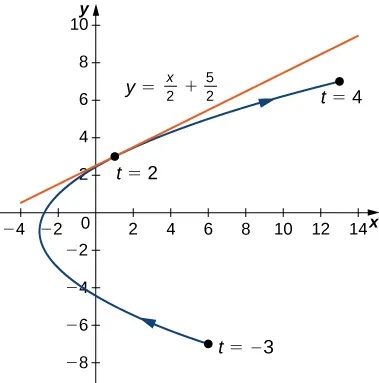
A parametric curve is shown together with its tangent line at a marked point, making the “local direction” idea concrete. The tangent line represents the instantaneous direction of motion along the curve, and its slope corresponds to the value of at that point. Source
For AP Calculus BC, the key fact is that the slope of this line is the value of at that point on the curve.
When you are asked for a tangent line, there are always two essential pieces of information:
the point of tangency
the slope at that point
Without both, the line is not completely determined.
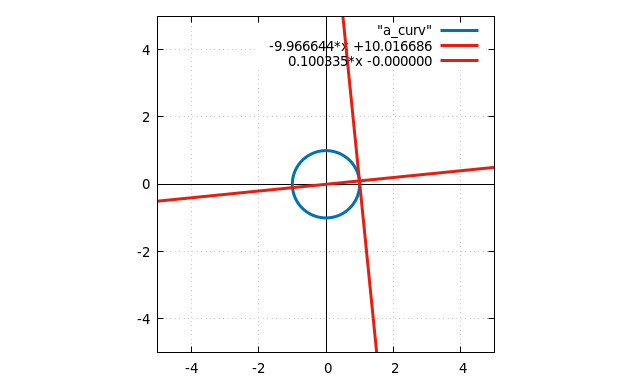
A parametrically defined curve is drawn with the tangent line (and the perpendicular normal line) at a specific point. Visually, this reinforces that the tangent line is tied to a particular point of contact, and the slope at that point determines the unique tangent line through that location. Source
Tangent line: A line that touches a curve at a point and has the same instantaneous slope as the curve at that point.
For parametric equations, it is important to keep the parameter value and the point on the curve distinct. A problem may give a specific value such as , but the tangent line must be written using the corresponding coordinate point , not using the parameter itself as a coordinate.
Using as the slope
The central idea of this subsubtopic is that the derivative plays the same role here that it does for ordinary rectangular functions. If you know the value of at a point on a parametric curve, then you know the slope of the tangent line there.
This means that once the slope has been found, the rest of the task is geometric: write the equation of the line through the correct point.
= -coordinate of the point of tangency
= -coordinate of the point of tangency
= slope of the tangent line, equal to at the point
This point-slope form is usually the most efficient way to write a tangent line to a parametric curve. If needed, the equation can then be rearranged into slope-intercept form, but that is not always necessary.
A common source of error is mixing information from different parameter values. The slope must be evaluated at the same parameter value that gives the point of tangency. If the problem states “find the tangent line at ,” then both coordinates and slope must come from .
A reliable process
When finding a tangent line to a parametric curve, use a consistent method:
Identify the required parameter value or locate the parameter value that corresponds to the given point.
Find the point on the curve by evaluating both coordinate functions.
Determine the value of at that same point or parameter value.
Use the slope and point together in point-slope form.
Check whether your final equation actually passes through the point you found.
This process helps prevent a very common AP mistake: computing a correct slope but pairing it with the wrong point.
Why the point matters
A tangent line is attached to a specific location on the curve. Two different points can have the same slope, but they will usually have different tangent lines because the lines pass through different places.
That is why a statement such as “the slope is ” is incomplete if the question asks for the tangent line. A slope alone describes a whole family of parallel lines. The point selects the exact one.
Interpreting the tangent line geometrically
The sign and size of the slope tell you how the curve behaves near the point of tangency:
If , the tangent line rises from left to right.
If , the tangent line falls from left to right.
If , the tangent line is horizontal.
If the slope is undefined, the tangent may be vertical, in which case its equation is written as .
These interpretations are useful even when a problem does not ask for a full line equation. Sometimes AP questions ask for the slope of the tangent line, whether the line is horizontal, or whether the tangent is increasing or decreasing.
It is also helpful to remember that the tangent line is a local idea.
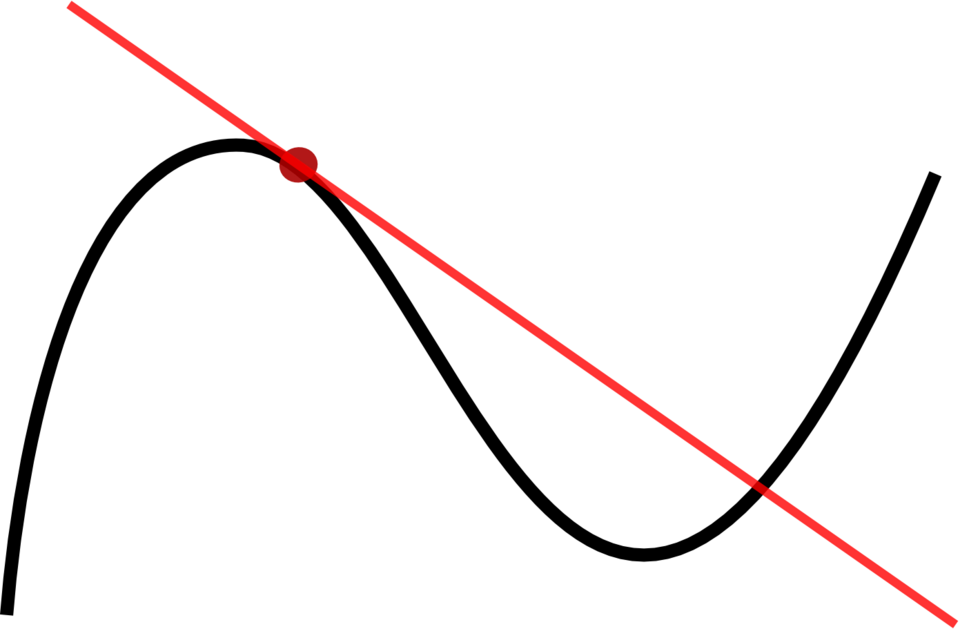
A curve is shown with a tangent line drawn at a point, illustrating tangency as a local linear approximation. The picture emphasizes that “matching the curve” is an instantaneous, near-the-point property, even though the line may separate from the curve away from the point of tangency. Source
It describes the curve only near the point of tangency. A line may touch the curve there and still fail to match the curve farther away.
Common mistakes to avoid
Students often lose points on tangent-line questions because of small but important misunderstandings.
Using the parameter value as though it were a coordinate.
Finding a point on the curve but not evaluating the slope at that same parameter value.
Reporting only the slope when the problem asks for the equation of the tangent line.
Writing a line that has the correct slope but does not pass through the point of tangency.
Forgetting that a vertical tangent is written in the form , not in slope-intercept form.
AP exam focus
On AP Calculus BC, tangent-line questions about parametric curves often test whether you can connect three ideas smoothly:
the parameter value
the point on the curve
the slope at that point
Strong responses use precise language. If you are asked for the tangent line at a particular parameter value, make sure your work clearly identifies the point, the slope, and the final equation of the line.
Practice Questions
A curve is defined parametrically by and .
Find the equation of the tangent line at .
1 mark for finding the point on the curve:
1 mark for finding the slope: , so at ,
1 mark for a correct tangent line, such as
A curve is defined parametrically by and .
(a) Find all values of for which the tangent line is horizontal.
(b) Find the coordinates of the corresponding points.
(c) Write the equation of each horizontal tangent line.
1 mark for setting by using , so
1 mark for solving to get
1 mark for finding the point at :
1 mark for finding the point at :
1 mark for correct equations of the tangent lines: and
FAQ
This can happen at a self-intersection. In that case, you must treat each parameter value separately.
Each parameter value may produce a different slope, so the same coordinate point can have two different tangent lines. The geometry depends on how the curve passes through the point, not just on the point itself.
Yes, sometimes it can, but it is not automatic.
If both rates are zero, the usual derivative expression may be indeterminate. You may need further analysis, such as simplifying first or using a limiting argument. On an AP course, this is a sign to be cautious rather than to assume there is no tangent.
Not exactly. The tangent line is a geometric line, while the direction of motion depends on how the particle moves as $t$ increases.
A particle can travel along the same tangent line in opposite directions at different times. So the tangent line gives orientation of the curve, but not by itself the sense of travel.
Eliminating the parameter can hide important information about the path of the curve.
For instance:
different parameter values may lead to the same rectangular point
the rectangular equation may combine multiple branches
the parameter may make it much easier to identify the exact point being traced
So even if elimination is possible, the parametric form is often the clearer choice.
Use two quick checks.
First, substitute the point of tangency into your line equation. If the point does not satisfy the equation, the line is wrong.
Second, compare the line’s slope with the local shape of the curve near that point. A steeply rising curve should not produce a shallow negative-slope tangent. This kind of sense check often catches sign errors.
