AP Syllabus focus: 'The second derivative d²y/dx² can be calculated by dividing d/dt(dy/dx) by dx/dt.'
When a curve is defined parametrically, the second derivative shows how the slope itself changes. This idea extends ordinary differentiation by using the parameter as an intermediate variable.
Interpreting the second derivative
For a parametric curve, both coordinates depend on a parameter, so the curve is written as and .
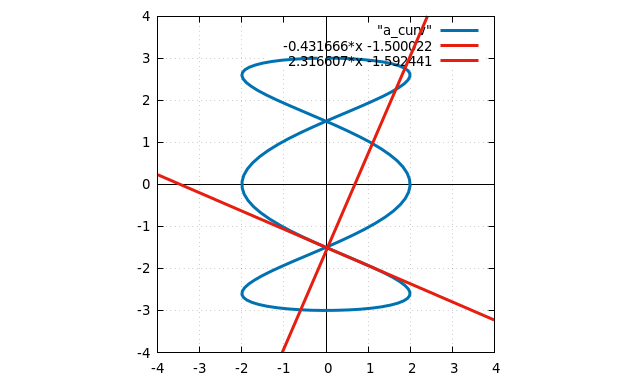
A parametrically defined curve is shown with its tangent line at a marked point (and the corresponding normal line). The picture makes the key geometric idea explicit: is the slope of the tangent line in the -plane, even though both coordinates are generated from the parameter . Source
Because and are not given directly as functions of each other, finding the second derivative requires a different approach from ordinary rectangular equations.
The second derivative of a parametric curve measures how the first derivative changes with respect to , not with respect to . That distinction is essential. In parametric form, you usually first find as a function of , and only then find how that slope changes as changes.
Second derivative of a parametric curve: the quantity , which measures how the slope changes with respect to when both and are functions of a parameter.
For parametric equations, this quantity is not found by differentiating twice with respect to . Instead, the parameter acts as a bridge between derivatives with respect to and derivatives with respect to .
The formula
Assume and are differentiable, and assume also that at the point of interest. After finding the first derivative , the second derivative is obtained by differentiating with respect to and then dividing by .
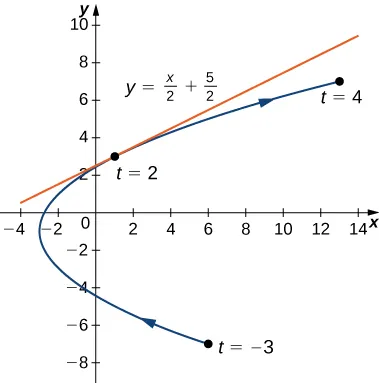
This figure graphs a curve defined parametrically and marks specific parameter values along the path, highlighting how motion in traces the curve in the plane. The tangent line drawn at a particular emphasizes that differentiation produces geometric information in the -plane, with giving instantaneous slope at that parameter value. Source
= second derivative of with respect to
= first derivative of the parametric curve
= parameter
= derivative of with respect to
This is the core formula for the topic. If the first derivative has already been written as , then the second derivative can also be written as . This form is often the most practical on AP problems.
Why the formula works
The formula comes from the chain rule. Think of the first derivative as a new function of the parameter, say . Then the second derivative is the derivative of with respect to .
Because depends on and also depends on , the chain rule gives , provided .
That is exactly why the second derivative formula involves two steps:
differentiate the slope with respect to the parameter
convert that rate of change into a rate with respect to by dividing by
A common misconception is to write . This is generally not true. First derivatives can be related by a quotient, but second derivatives do not behave that way.
A reliable calculation process
A careful procedure helps avoid algebra mistakes.
Step 1: Find the first derivative
Start by finding and . Then form using the parametric first-derivative rule, as long as .
Step 2: Differentiate the first derivative with respect to
Treat as a function of the parameter. Differentiate that expression with respect to . At this stage, you are not finished.
Step 3: Divide by
Take the result from Step 2 and divide by . This converts the derivative from “with respect to ” into “with respect to .”
Step 4: Simplify only after the structure is correct
Algebraic simplification is helpful, but it should come after the derivative structure is set up properly. Losing the final division by is one of the most frequent errors.
If a problem asks for the second derivative at a particular parameter value, it is usually best to keep everything in terms of until the formula is complete, then substitute the value.
Restrictions and what to watch for
The formula requires . If at a given parameter value, the expression for in this form is not valid there. That does not automatically mean the curve has no second-derivative behavior at the point, but this formula cannot be used directly.
Keep these points in mind:
Differentiate with respect to first. The numerator is , not computed directly.
Do not stop too early. After differentiating with respect to , you must still divide by .
Do not confuse first and second derivative rules. The first derivative is a quotient of derivatives, but the second derivative is not just a quotient of second derivatives.
Track domain restrictions. Any value that makes must be checked carefully.
Keep the parameter visible. On AP questions, the second derivative is often expected as a function of , not rewritten in terms of and .
Mastering the formula means understanding both its structure and its conditions. The main idea is simple: find how the slope changes with the parameter, then scale that change by how changes with the parameter.
Practice Questions
For the curve defined by and , find for .
1 mark: Finds .
1 mark: Differentiates with respect to and divides by , giving .
A curve is defined parametrically by and .
(a) Find .
(b) Hence find .
(c) Evaluate at .
(d) State the values of for which the formula for is not valid.
1 mark: Part (a) .
1 mark: Differentiates with respect to , for example .
1 mark: Divides by to obtain or any equivalent form.
1 mark: Part (c) substitutes correctly to get .
1 mark: Part (d) states that the formula is not valid when , so .
FAQ
If the new parameter traces the same curve smoothly and preserves a valid relationship between the variables, the geometric value of $d^2y/dx^2$ at a point does not change.
What changes is the algebra. A different parameter can make the derivatives look much more complicated or much simpler.
If the reparameterisation is not smooth, or if it collapses multiple parameter values together awkwardly, then using the formula may become harder or even invalid at some points.
Yes. This can happen at a self-intersection, where different parameter values produce the same point in the plane.
Each parameter value may correspond to a different branch of the curve, with a different slope and a different second derivative.
So the point alone may not determine a unique value. You may need the specific parameter value, or enough information to identify which branch of the curve is being followed.
This is a special case. The usual formulas for $dy/dx$ and $d^2y/dx^2$ may become indeterminate.
In that situation, you often need a more detailed local analysis, such as:
factoring derivatives
using series or expansions
examining the behaviour of the curve near that parameter value
On an AP-style problem, such a case is usually signalled clearly. If it appears, do not assume the standard formula works automatically.
Not usually. If you replace $t$ with a smooth parameter that runs in the opposite direction, the curve is the same geometric object.
The first derivative and second derivative as functions of the new parameter may look different during the calculation, but the final value of $d^2y/dx^2$ at the same point on the same branch should agree.
What changes is the description of motion along the curve, not the curve’s local shape in the $xy$-plane.
Yes. A quick check is to look for structural features:
The result should usually still involve the parameter.
A factor of $dx/dt$ should appear in the denominator after the final step.
If your answer is simply $ \dfrac{d^2y/dt^2}{d^2x/dt^2} $, it is almost certainly wrong.
Values where $dx/dt=0$ should stand out as places requiring caution.
You can also differentiate your expression for $dy/dx$ mentally: if its complexity increased and then was scaled by another division by $dx/dt$, that is usually a good sign.