

AP Syllabus focus: 'The second derivative d²y/dx² of a parametric curve is calculated by dividing d/dt(dy/dx) by dx/dt, which allows concavity to be determined.'
Parametric curves can bend in ways that are not obvious from and alone. To analyze that bending, AP Calculus BC uses the second derivative with respect to , rewritten in terms of the parameter.
Understanding concavity
Concavity describes how a curve bends as increases.
For parametric equations, the geometric meaning is the same as for ordinary graphs, but the calculation is different because both and depend on .
Concavity: A curve is concave up where and concave down where .
This interpretation is with respect to , not simply with respect to the parameter. A curve may be traced quickly, slowly, leftward, or rightward as changes, but concavity still depends on how the slope changes along the curve itself.
On AP questions, a change from concave up to concave down, or from concave down to concave up, indicates an inflection point. A second derivative equal to zero only identifies a possible location, not a guaranteed one.
The second derivative for a parametric curve
To study concavity, first find the first derivative . Then differentiate that expression with respect to and divide by . This converts a derivative with respect to the parameter into a derivative with respect to .
= second derivative of with respect to
= parameter
= first derivative of the parametric curve
= derivative of with respect to the parameter
This formula comes from the chain rule. Since and are both functions of , differentiating with respect to can be done by differentiating with respect to and then accounting for how changes.
What the sign tells you
The first derivative tells whether the curve is rising or falling at a point. The second derivative tells whether that slope is increasing or decreasing. This interpretation matches the usual second-derivative test for a graph .
If , the slope is increasing, so the curve bends upward.
If , the slope is decreasing, so the curve bends downward.
If or is undefined, the value of is only a candidate for a change in concavity.
A slope can be negative and still be increasing, which would make the curve concave up. Likewise, a slope can be positive and decreasing, which would make the curve concave down.
A standard AP process
A reliable method helps prevent algebra and interpretation errors.
Step-by-step method
Find and .
Form wherever .
Differentiate with respect to .
Divide that result by to obtain .
Determine where the second derivative is positive and where it is negative.
Check values where the second derivative is zero or undefined, since those values split the sign chart into intervals.
Concavity should be described on intervals of the parameter, not from a single test value alone. A complete answer identifies the relevant parameter intervals and the corresponding concavity on each one. A sign chart is often the clearest way to organize this reasoning.
Why interval language matters
A parametric curve is traced as changes, so two nearby points on the graph may come from very different parameter values. Because of that, sign analysis must follow the interval structure of . If the problem restricts the parameter, only that restricted interval should be used when deciding concavity.
This is especially important when the same plotted point is reached more than once. Concavity belongs to the branch associated with the chosen parameter interval.
Common AP Calculus BC cautions
Students often know the formula but lose points in the interpretation.
Do not confuse increasing with concave up
A positive value of means the curve is increasing at that moment. It does not tell you the curve is concave up. Concavity depends on the sign of , not the sign of the first derivative.
Pay attention when
If , then may be undefined, and the second-derivative formula may also fail there.
This theorem summarizes when parametric curves have horizontal tangents ( with ) and vertical tangents ( with ). It supports the idea that can become undefined when , so sign/interval reasoning must treat those parameter values carefully. Source
Graphically, this often corresponds to a vertical tangent or another point where horizontal motion momentarily stops. That value of may separate intervals for sign testing, but it does not automatically create an inflection point. You still need to examine the sign of on each side.
Simplify carefully
Algebraic simplification is useful because it makes sign analysis easier. Factoring numerators and denominators can reveal where the second derivative is positive, negative, zero, or undefined. However, any cancelled factor must still be remembered if it creates a restricted value of .
Concavity is geometric, not about speed
Changing how fast the curve is traced changes and , but it does not change the actual shape of the curve. The second-derivative formula compensates for the parameter so that the final sign still describes the curve’s geometric bending.
What a complete response should include
On AP Calculus BC, a strong concavity answer usually includes:
the correct expression for ,
the critical parameter values where sign changes might occur,
interval statements such as concave up or concave down,
and, when asked, a justification for whether an inflection point exists.
When different parameter values trace the same coordinate point, the response should still follow the requested interval of . The most common scoring issue is stopping after differentiation instead of connecting the derivative to the curve’s behavior.
Practice Questions
For the parametric curve and , find at and state whether the curve is concave up or concave down there.
1 mark: Correctly finds or obtains at .
1 mark: States that the curve is concave up because .
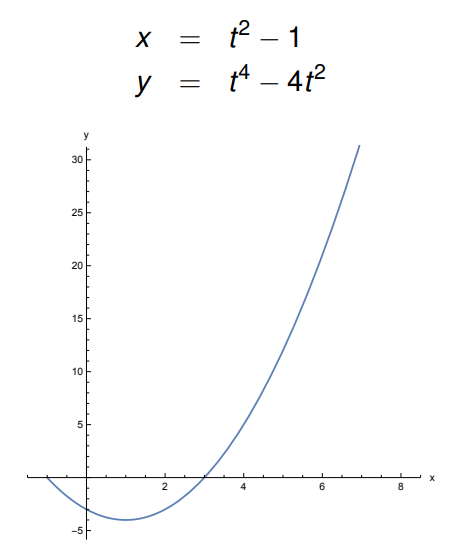
For the parametric curve and , for :
(a) Find in terms of .
(b) Determine the intervals of on which the curve is concave up and concave down.
(c) State the parameter values at which the curve has inflection points.
1 mark: Finds .
2 marks: Correctly finds .
1 mark: States concave up for and concave down for and .
1 mark: Gives inflection points at with justification that the sign of changes.
FAQ
Usually, no. If you replace $t$ with a smooth, one-to-one parameter that traces the same curve in the same order, the geometric concavity stays the same.
What changes is the algebraic form of the derivatives. If the new parameter reverses direction, the order of tracing changes, but the curve’s shape does not. If the reparametrisation is not one-to-one, the curve may be traced multiple times, so concavity must then be interpreted branch by branch.
This usually means the usual formula for $ \dfrac{dy}{dx} $ is indeterminate at that value, so the standard second-derivative formula may not help immediately.
In that situation, you may need to:
examine nearby parameter values,
eliminate the parameter if possible,
or use higher-order derivative reasoning.
On AP-style problems, such points are often handled by analysing the behaviour on either side rather than forcing the formula at the exact value.
Yes. This can happen at a self-intersection or when a parametric curve retraces part of itself.
The key idea is that concavity belongs to a branch of the curve, not just to a coordinate pair. If two different parameter values produce the same point, the curve may arrive there with different slopes and different bending behaviour. In that case, you should describe concavity using the relevant interval of the parameter.
Concavity is usually stated on open intervals, because the idea depends on behaviour around nearby points.
An endpoint can still lie on a branch that is concave up or concave down, but it is not normally called an inflection point unless there is a change in concavity through the point, which cannot happen at a one-sided endpoint. So on a restricted parameter interval, focus on the interior when identifying changes in concavity.
A graph can appear visually smooth while still having an undefined derivative with respect to $x$. This often happens when the issue is not a sharp corner, but a vertical tangent or a parameter value where horizontal motion pauses.
So a smooth appearance is not enough. You still need to check the analytic conditions:
whether $ \dfrac{dx}{dt}=0 $,
whether $ \dfrac{dy}{dx} $ exists,
and whether $ \dfrac{d^2y}{dx^2} $ can be formed.
