AP Syllabus focus: 'The length of a parametrically defined curve can be calculated using a definite integral.'
Parametric curves describe motion or shape through a shared parameter, so their length must be measured through that parameter as well. The key AP skill is setting up and interpreting the correct definite integral.
Understanding Arc Length
When a curve is written parametrically as and , both coordinates change together as the parameter changes. Because of that, the curve is not naturally measured by moving only along the -axis or only along the -axis. Instead, its length is found by tracking the tiny changes in both coordinates at the same time.
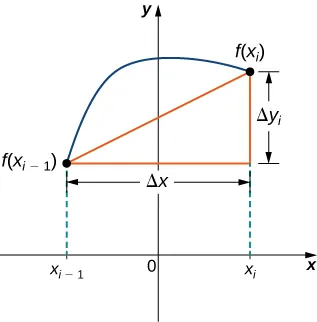
This figure illustrates the differential geometry idea behind arc length: a small step along the curve can be approximated by a straight segment whose length comes from the Pythagorean combination of horizontal and vertical changes. In parametric form, this becomes accumulating using both and rather than measuring change in only one coordinate. Source
Arc length is the quantity that measures how far along the curve a point travels over a given parameter interval.
Arc length: The total length of a curve traced over a specified interval of the parameter.
The interval matters. A parametric curve may trace only part of a geometric path, or it may trace the same section more than once. Arc length is attached to the specific parameter interval .
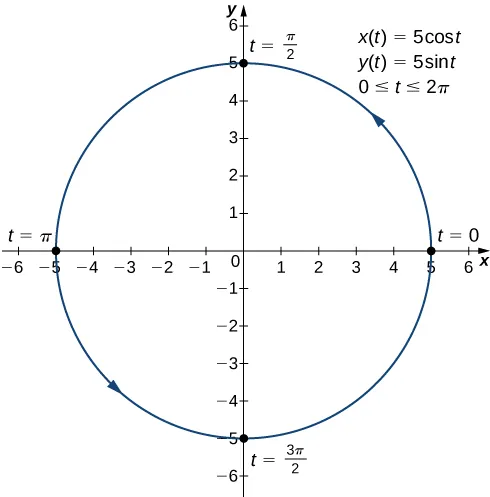
This parametric graph of a circle labels key parameter values (e.g., ) and shows the tracing direction along the curve. It helps connect the arc length integral to “how far the point travels” as runs over a specified interval. Source
The Arc Length Formula
For a differentiable parametric curve on , the length is found by combining the horizontal and vertical rates of change into one expression.
= length of the curve, in units
= initial and final parameter values
= coordinate functions of the curve
= derivatives of the coordinate functions with respect to the parameter
This formula is the parametric version of the distance idea from geometry. Over a very small change in the parameter, the curve behaves like a short line segment. That segment has approximate length , where . Rewriting and in terms of leads to the integral formula.
Why the Formula Makes Sense
If changes by a tiny amount, then and . Substituting those into the distance expression gives . Adding all of these tiny lengths from to produces the definite integral for total length.
This viewpoint is important on AP problems because it explains why both derivatives appear under the square root. A curve can move horizontally, vertically, or in both directions at once, and the formula accounts for the combined motion.
Conditions for Using the Formula
The formula is most reliable when the coordinate functions are smooth enough on the interval being used. In AP Calculus BC, the usual expectation is that and are differentiable on and that their derivatives are continuous enough for the integral to make sense.
Keep these points in mind:
The parameter interval must be stated or inferred.
You need both and .
The square root applies to the sum of the squares of the derivatives.
Arc length is always found with a definite integral, not an indefinite integral.
The final answer represents a length, so it should be nonnegative.
If either derivative changes sign, the formula still works because the squares remove direction. Arc length measures distance along the curve, not signed change. If a curve has corners or breaks, the interval may need to be split into smaller pieces before the total length is found correctly.
How to Set Up the Integral Correctly
A large part of success with parametric arc length is careful setup. On many AP questions, earning full credit depends on writing the correct integral even before evaluating it.
A standard process is:
Identify the parameter interval.
Differentiate to find .
Differentiate to find .
Substitute both derivatives into the arc length formula.
Simplify the integrand when possible before integrating.
Simplifying matters. Expressions under the square root often reduce neatly if common factors are pulled out or if algebraic identities are recognized. Cleaner algebra makes the integral easier to evaluate and reduces calculator or sign errors.
What the Integral Represents
The integrand tells you the instantaneous rate at which length is being accumulated with respect to the parameter. Even if the parameter is not time, it still measures how quickly the point moves along the curve as changes.
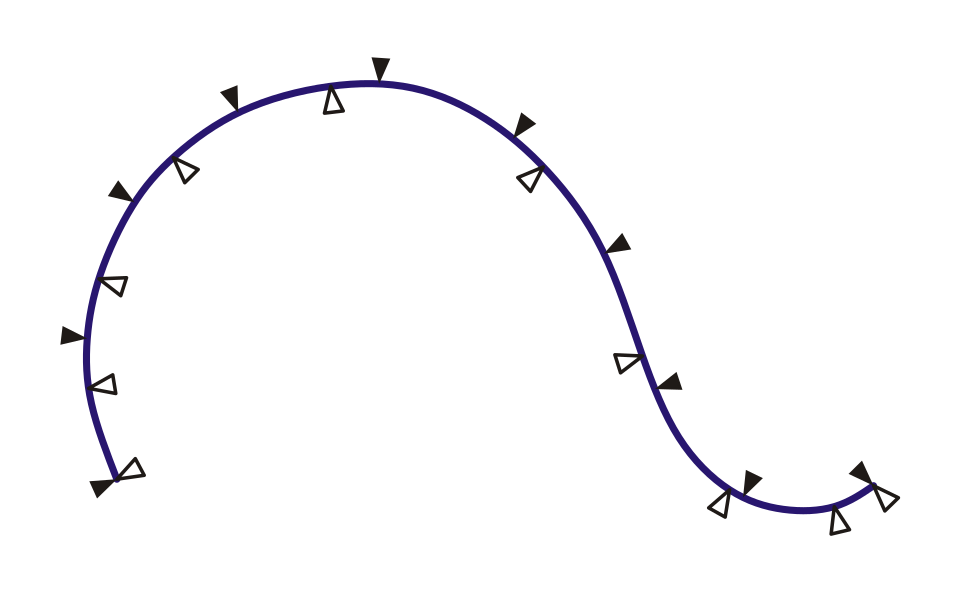
This diagram contrasts equal increments of the parameter with the actual arc length traveled along the curve, emphasizing that the parameter is not automatically a measure of distance. It visually motivates why arc length must be computed by integrating the instantaneous rate over the chosen interval. Source
That interpretation helps with reasoning:
A larger integrand means the point is covering more curve per unit change in .
A smaller integrand means the point is covering less curve per unit change in .
If the integrand is constant, equal parameter changes produce equal amounts of arc length.
This is why a rapidly changing parameter does not automatically mean a longer curve; what matters is how the coordinate functions respond to that parameter.
Connection to Other Arc Length Ideas
If a parametric curve comes from an ordinary function, the parametric formula agrees with the familiar rectangular-coordinate arc length formula. Since , the parametric integrand can be rewritten in a form involving . When is increasing on the interval, this reduces to the usual arc length setup with respect to . So the parametric formula is not a separate idea; it is a more general version of the same geometric principle.
Common AP Errors
Students often lose points on arc length questions because the formula is remembered only partially. Watch for these mistakes:
Using instead of the sum of the squares.
Forgetting the square root.
Integrating with respect to or instead of .
Omitting the interval endpoints.
Treating arc length like displacement and allowing a negative result.
Failing to simplify appropriately on a restricted interval.
On free-response questions, clear notation matters. Writing the bounds, the square root, and the variable of integration neatly can preserve method points even if later algebra goes wrong. A good self-check is to look at the structure before evaluating. If your integral has one square root containing two squared derivatives and is integrated over the parameter interval, the setup is probably on the right track.
Practice Questions
For the parametric curve , , , write but do not evaluate an integral for the arc length.
1 mark for finding and
1 mark for
A curve is given by , , .
(a) Set up an integral for the arc length of the curve.
(b) Evaluate the integral to find the exact length.
1 mark for and
1 mark for
1 mark for simplifying to
1 mark for a correct substitution, such as
1 mark for the exact answer
FAQ
If two parametrisations trace the same geometric path over corresponding intervals, the curve itself has not changed, only the way it is described.
Using the chain rule and a change of variable in the integral shows that the extra factor from reparametrising cancels correctly. That is why arc length is a geometric quantity, not something that depends on a particular parameter choice.
A definite integral taken from a larger value down to a smaller one is negative by convention, but a length cannot be negative.
So, for arc length, you should rewrite the integral with the lower bound first and the upper bound second. The geometric length stays the same even though the direction of tracing has been reversed.
Find the length of each piece on its own interval, then add the results.
This is especially useful when:
the formula changes at a breakpoint
the curve has a corner
one interval is easier to handle separately than the whole path at once
You should make sure the pieces actually connect if they are meant to form one continuous curve.
The expression under the square root may simplify poorly, and many such integrals do not reduce to elementary functions.
In those cases, the important AP skill is still the correct setup. If evaluation is required, you may need a numerical approximation. A correct integral with appropriate bounds often earns substantial credit even when the exact evaluation is difficult.
Use it only after setting up the integral correctly by hand.
A good approach is:
differentiate the parametric functions yourself
substitute into the arc length formula
simplify the integrand first
enter the full definite integral carefully with parentheses
report the numerical answer to the required accuracy
Always check that the bounds are correct and that the calculator is in the expected angle mode if trigonometric functions appear.