

AP Syllabus focus: 'The length of a parametrically defined curve is calculated using a definite integral involving dx/dt and dy/dt over an interval.'
When a curve is given parametrically, its length is found by integrating the combined horizontal and vertical rates of change across the relevant parameter interval.
Using the arc length formula
A parametric curve is described by and on an interval . To apply arc length correctly, the main task is identifying the correct interval and building the integrand from the two derivatives.
Arc length is the distance measured along the curve itself, not the straight-line distance between its endpoints.
Arc length: The total distance traced along a curve over a specified interval.
For a parametrically defined curve, arc length is accumulated as the parameter moves from its starting value to its ending value.
= arc length of the curve over the interval, in units
and = starting and ending values of the parameter
= rate of change of the -coordinate with respect to
= rate of change of the -coordinate with respect to
This formula works directly from the parametric description. The needed information comes from the derivatives of the coordinate functions together with the interval of the parameter.
What the integrand means
The quantity inside the square root combines the horizontal and vertical changes of the curve.
It tells you how much length is being traced for a small change in . If either coordinate changes quickly, the curve accumulates length more rapidly. If both change slowly, the length accumulates more slowly.
Because both derivatives are squared, the expression under the radical is never negative. That matches the idea that arc length is a distance and should not be negative.
Choosing the correct interval
The interval is part of the problem, not a minor detail.
In many questions, the curve is traced only over a specific range of parameter values, and the arc length must match that range exactly.
When applying the formula, check these points carefully:
The interval should correspond to the part of the curve named in the problem.
The curve may change direction as changes, but that does not change how the formula is used.
If the same geometric path is traced more than once on the interval, the integral counts all of that travel.
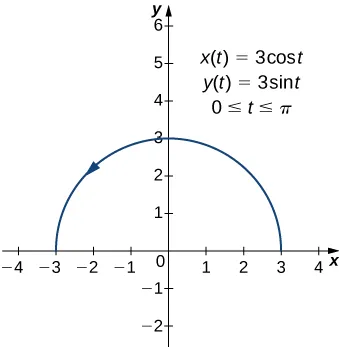
This OpenStax figure depicts a semicircle traced by and over , with the tracing direction marked. It reinforces that the arc length integral measures total distance traveled along the curve for the stated -interval, so repeating or extending the parameter range would change the computed length. Source
If the question asks for the length of a single tracing of a curve segment, the parameter bounds must reflect one tracing only.
A common error is choosing bounds by looking only at the rectangular coordinates. For parametric curves, the limits belong to the parameter, not directly to or .
Reversing direction
A curve can be traced from end to start or from start to end. Its geometric length is the same either way, but the definite integral must be written with care. In practice, arc length is reported as a positive value, so it is safest to write the integral over the interval in increasing order unless the problem specifically requires another form.
Simplifying and evaluating the integral
After finding and , square each derivative, add the results, and simplify before integrating. Careful algebra can turn a difficult-looking expression into a manageable one.
One subtle point is especially important: , not automatically . If the integrand simplifies to the square root of a square, you must check whether an absolute value is needed. On a restricted interval, it may be possible to replace with either or , but only after determining the sign of on that interval.
Some arc length integrals can be evaluated exactly. Others do not have elementary antiderivatives and must be approximated numerically. On the AP Calculus BC exam, that may mean using calculator technology when instructed. Whether the answer is exact or approximate, include units when the problem provides them.
Conditions for using the formula
The formula is applied on an interval where the coordinate functions are differentiable and the integrand is defined. If the expression is not well behaved over the entire interval, it is often helpful to split the interval into smaller pieces and add the lengths.
In many standard AP problems, the curve is smooth enough that the formula can be applied directly. Even so, checking the derivatives before integrating is a good habit, because a correct formula with an incorrect interval or undefined expression will not give the intended length.
Common mistakes to avoid
Using instead of the square-root formula
Forgetting to square both derivatives before adding
Mixing up parameter limits with coordinate values
Dropping an absolute value during simplification
Reporting a negative value for length
Treating a repeated tracing as if it happened only once
Leaving an answer as an indefinite integral when the problem asks for length over an interval
A reliable check is to ask whether the final answer makes sense as a distance: it should be positive, tied to the stated interval, and based on the full parametric behavior of the curve.
Practice Questions
The curve is defined parametrically by and for .
Write, but do not evaluate, a definite integral that gives the arc length of the curve on this interval.
1 mark for finding and
1 mark for a correct arc length setup:
The curve is defined by and for .
(a) Write an integral for the arc length of the curve on the interval.
(b) Show that the integrand can be simplified to on .
(c) Find the exact arc length.
1 mark for
1 mark for
1 mark for a correct setup:
1 mark for simplifying inside the radical to
1 mark for using and concluding on
1 mark for the exact value
FAQ
If one parameter is a smooth monotonic reparameterisation of the other, substitution changes the variable but not the geometric distance.
The formulas for $x$ and $y$ may look different, but the change in parameter is absorbed into $dt$, so the total length stays the same.
That gives an integrand value of $0$ at that point, which does not automatically make the arc length formula invalid.
If it happens only at an isolated point and the curve remains well behaved nearby, the formula often still works. If the parametrisation becomes irregular around that point, the interval may need to be split.
A self-intersection does not by itself cause a problem. Arc length depends on the path traced as the parameter changes, not on whether the curve crosses itself.
The main issue is interpretation: decide whether the question wants the whole traced interval or only one branch of the curve.
Yes. A closed curve may be traced once, partly traced, or traced more than once, depending on the parameter interval.
So the geometric shape can stay the same while the accumulated arc length changes. For a full perimeter, the interval must correspond to exactly one complete tracing.
Different antiderivatives can be algebraically equivalent. For example, a logarithmic expression and an inverse hyperbolic expression may represent the same exact value.
On an exam, equivalent exact answers are acceptable if they come from a correct arc length setup and simplify to the same numerical result.
