

AP Syllabus focus: 'Vector-valued functions use components that are real-valued functions of a parameter, and methods used for real-valued functions extend to vector-valued functions.'
Vector-valued functions let one parameter control several coordinates at once, making them a powerful way to represent curves, positions, and motion while still relying on familiar ideas from ordinary single-variable calculus.
What a Vector-Valued Function Is
A vector-valued function assigns a vector to each input value. In AP Calculus BC, the input is usually a parameter, often written as . Each coordinate of the output is an ordinary real-valued function of that same parameter, so one input can determine an entire point in the plane or in space.
Vector-valued function: A function whose output is a vector made from coordinate functions that depend on a parameter.
This means a vector-valued function packages several related real-valued functions into one object. Instead of listing coordinates separately, we can write them together in vector form. That notation is compact, but it also emphasizes that the coordinates describe one point moving as the parameter changes.
Component Functions and Notation
The coordinate functions inside a vector-valued function are called its component functions.
Component functions: The real-valued functions, such as , , and possibly , that form the coordinates of a vector-valued function.
A common notation is . In two dimensions, gives a point in the plane. In three dimensions, it gives a point in space. The domain of the function is the set of parameter values for which every component is defined.
= vector output in the plane
= horizontal component as a real-valued function
= vertical component as a real-valued function
In space, the same idea becomes .
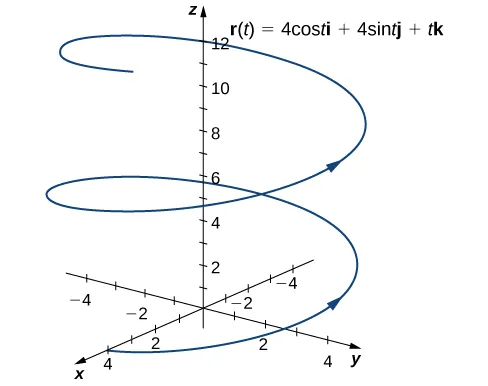
A space curve arises when the vector-valued function has three components, . In this example, produces a helix: the – projection cycles around a circle while the -coordinate increases steadily, creating a spiral in 3D. Source
The notation changes, but the principle stays the same: each coordinate is a real-valued function of the same parameter.
Connection to Parametric Equations
A vector-valued function in the plane is closely related to a pair of parametric equations. If , then the same curve can be described by the coordinate equations and .
Vector notation is useful because it keeps those coordinate functions connected. Rather than thinking of and as separate pieces, you view them as parts of one changing position. This is especially helpful when a problem describes a point moving along a curve or when three-dimensional motion is involved, because the same notation extends naturally to an added -component.
A vector-valued function does more than describe where points lie. It also describes how the curve is traced as the parameter changes. Different parameter values may produce the same point, and the same geometric curve can sometimes be represented by more than one vector-valued function.
Domain and Geometric Meaning
The domain of a vector-valued function is found by checking where all component functions are defined at the same time. For example, if one component is defined for all real numbers and another is not, the overall domain is restricted by the component with the narrower domain.
The range is not just a set of numbers. It is a set of vectors, or equivalently, a set of points traced in the plane or in space. Geometrically, you can imagine the output vector starting at the origin and ending at the point determined by the component functions.
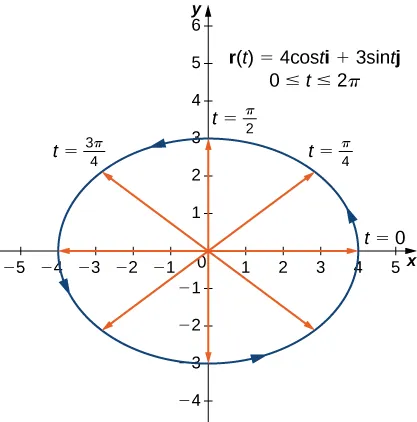
A planar vector-valued function can be visualized as a moving position vector whose tip traces a curve. Here, traces an ellipse, with arrows indicating the direction of increasing and labeled points showing specific parameter values. Source
As changes, the tip of that vector traces a curve.
Tracing a Curve
When you evaluate a vector-valued function at a specific parameter value, you substitute that value into each component. The result is one point on the curve. As the parameter increases, the point moves through the outputs in order. That order matters because it gives the curve an orientation, even when the graph itself looks familiar.
This interpretation makes vector-valued functions especially natural for describing motion. The parameter is often time, but it does not have to be. It can be any variable that controls position.
How Familiar Calculus Ideas Extend
The syllabus emphasizes that methods used for real-valued functions extend to vector-valued functions. The main reason is that each component is an ordinary function, so many ideas from single-variable calculus are applied component by component.
For an introduction, the most important extensions are conceptual:
Evaluation: plug the parameter value into each component.
Domain analysis: combine the restrictions from all components.
Limits: a vector-valued function has a limit when each component approaches its own limit.
Continuity: the function is continuous when all components are continuous.
These ideas do not require entirely new calculus rules. Instead, they rely on the same rules you already know for real-valued functions, used in a coordinated way. This is why vector-valued functions feel new in notation but familiar in method.
For AP Calculus BC, it is important to see that the vector notation does not replace the component functions; it organizes them. If you understand the behavior of the components, you can understand the behavior of the vector-valued function.
Common Interpretation Points
Students often confuse the function itself with the curve it traces. The function is the full rule , including its parameter. The curve is the geometric path formed by the outputs. These are related, but they are not identical.
Another common issue is ignoring the parameter interval. A curve may be traced only partially if is restricted, or it may be traced more than once if the interval is large enough. Because of this, the parameter and its interval are part of the description, not just extra information.
Finally, remember that vector-valued functions are not limited to motion problems. They provide a general way to describe points changing together, and that makes them a bridge between algebraic functions, geometric curves, and later calculus operations.
Practice Questions
Let .
(a) Write the component functions.
(b) Find the point on the curve when .
1 mark for identifying and
1 mark for the point
A particle has position vector for .
(a) State the three component functions.
(b) Find the initial position and the final position.
(c) Describe the geometric path traced by the particle.
(d) Explain why methods for real-valued functions can be used to study this vector-valued function.
(a) 1 mark for , , and
(b) 1 mark for initial position
(b) 1 mark for final position
(c) 1 mark for describing a helix of radius around the -axis
(d) 1 mark for explaining that each component is a real-valued function of the same parameter, so familiar methods apply component-wise
FAQ
Yes. This happens when one function is a reparameterisation of another.
For example, two functions may trace exactly the same set of points but:
move at different speeds
start at different places
travel in opposite directions
So the geometric curve can stay the same even though the parameter description changes.
These are different notations for the same idea.
$\mathbf{r}(t)=\langle x(t),y(t)\rangle$ emphasises coordinates directly.
$x(t)\mathbf{i}+y(t)\mathbf{j}$ writes the same vector using unit vectors.
In three dimensions, a $z(t)\mathbf{k}$ term is added.
You should be comfortable recognising that they describe the same vector-valued function.
A reparameterisation changes the parameter without changing the underlying path.
It is useful because it can:
simplify the component functions
make the starting value of the parameter more convenient
describe the same curve with a different orientation or speed
This matters because the parameter controls how the curve is traced, not just where the curve lies.
This happens when two different parameter values give the same output vector.
That often occurs with periodic component functions such as sine and cosine.
Geometrically, it can mean:
the path loops back to an earlier point
the curve is retraced
the particle returns to a previous position at a later parameter value
So repeated points are a feature of the parameterisation, not necessarily of the equation’s appearance.
You must examine how the components behave over that interval.
Useful checks include:
whether the components repeat values
whether the interval covers one full cycle of any periodic terms
whether the starting and ending points match
whether all intended points are reached
A curve may look complete algebraically, but a restricted interval can still trace only one section of it.
