

AP Syllabus focus: 'Methods for calculating integrals of real-valued functions can be extended to parametric or vector-valued functions by integrating each component.'
Integrating a vector-valued function follows the same idea as integrating ordinary functions: work component by component. This lets you find antiderivatives and evaluate definite integrals for curves and motion described in vector form.
What Integrating a Vector-Valued Function Means
A vector-valued function outputs a vector rather than a single real number.
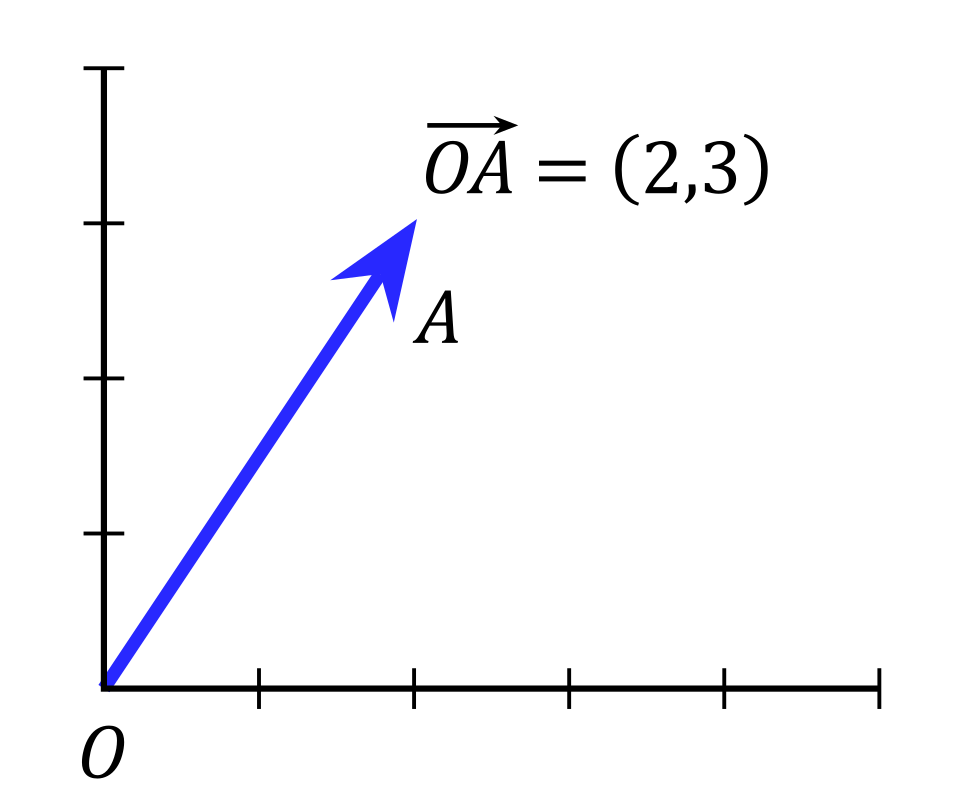
A position vector drawn from the origin to a point in the plane, labeled with its coordinates. This matches the interpretation of a vector-valued function as “the arrow to the point” at parameter value , which is the geometric object whose components you integrate component-by-component. Source
Vector-valued function: A function whose output is a vector, such as , where each component is a real-valued function of .
Because each component is an ordinary function of the same parameter, integration is done componentwise. You do not need a new kind of antiderivative rule just because the output is a vector. Instead, you integrate each coordinate separately and then keep the results together as one vector.
This is why methods from real-valued integration extend naturally to vector-valued functions. If you already know how to integrate powers, exponentials, trig functions, and other standard expressions, then you already know the main computational idea for this topic.
Indefinite Integrals
An indefinite integral of a vector-valued function gives a family of antiderivatives. Each component receives its own antiderivative, and the overall answer remains a vector-valued function.
= vector-valued function
= component functions
= constant vector
The constant of integration is written as a constant vector because each component may differ by a constant. In full form, that constant could look like . Writing it as is shorter and emphasizes that the antiderivative is still one vector-valued function.
A correct indefinite integral must preserve the original component order. The first integrated component stays first, the second stays second, and so on. Rearranging components changes the vector itself, so order matters.
You can also check an antiderivative by differentiating componentwise. If differentiating your result gives back the original vector-valued function in every coordinate, then the integral is correct.
Definite Integrals
A definite integral of a vector-valued function is also computed componentwise over the same interval. The answer is a vector, not a scalar.
= bounds of the parameter interval
= vector-valued function on
= component functions
Each coordinate is integrated across the same bounds. You do not choose separate intervals for separate components. The interval belongs to the parameter, so it applies to the entire vector-valued function.
The Fundamental Theorem of Calculus still works in this setting. If , then . This subtraction is done componentwise, just like the integration itself.
For AP Calculus BC, a standard condition is that each component is continuous on the interval. When that happens, the definite integral exists and can be found with the same real-valued techniques you already know.
Common Notation
Vector-valued functions may be written in angle-bracket form or with basis vectors.
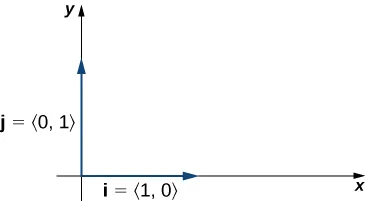
A diagram of the standard basis vectors and on the coordinate axes. It clarifies how the basis-vector form encodes the same component information as , which is exactly what makes componentwise integration in either notation straightforward. Source
For example, and represent the same idea.
In either notation, integration is still componentwise. In form, you integrate the coefficient of each basis vector and keep the basis vectors attached to those integrated coefficients.
Careful notation helps prevent mistakes. A definite integral should still look like a vector when you finish. An indefinite integral should still include vector structure and, when appropriate, a constant vector.
Properties to Remember
Because integration is performed one component at a time, familiar integral properties remain true.
Linearity:
Constant multiple rule:
Additivity on intervals:
These properties are not new formulas to memorize separately. They come directly from the fact that each component behaves like an ordinary real-valued integral.
Common Mistakes
Forgetting the constant vector on an indefinite integral.
Integrating only some components and leaving another unchanged.
Changing the order of components after integration.
Using different bounds for different components in a definite integral.
Giving a scalar answer when the integral should produce a vector.
Dropping angle brackets or basis-vector notation, so the result no longer clearly represents a vector-valued function.
Checking only one component when verifying an antiderivative.
Practice Questions
Find .
for correct componentwise antiderivatives: 2 marks
, where is a constant vector: 1 mark
Let .
(a) Write as a vector of definite integrals. (2 marks)
(b) Evaluate . (4 marks)
Part (a): : 2 marks
correct componentwise setup: 1 mark
correct bounds and vector notation: 1 mark
Part (b): : 4 marks
first component : 1 mark
second component : 1 mark
third component : 1 mark
final vector written correctly: 1 mark
FAQ
You should include $+\mathbf{C}$ when finding the most general antiderivative.
It is usually omitted only when:
the question asks for one specific antiderivative
you are working with a definite integral
a later condition will determine the constant vector
If you are unsure, include it.
Treat that component honestly and separately.
If a component cannot be expressed with standard elementary functions, you may:
leave that component in integral form, if allowed
use a numerical approximation, if the task permits technology
recognise that on AP questions, the integrals are usually chosen to avoid this issue
The other components can still be integrated normally.
Yes.
This can happen if the positive and negative contributions in each component cancel over the interval. Since the definite integral is computed componentwise, the final vector can be $\left\langle 0,0\right\rangle$ or $\left\langle 0,0,0\right\rangle$ even when the function itself is not zero throughout the interval.
So a zero vector result does not mean the original function was identically zero.
No.
$\int_a^b \mathbf{r}(t),dt$ gives a vector result.
$\int_a^b |\mathbf{r}(t)|,dt$ gives a scalar result because $|\mathbf{r}(t)|$ is the magnitude of the vector.
These two integrals measure different things and should not be interchanged. A common mistake is to treat magnitude as if it were automatically built into vector integration. It is not.
The method is still componentwise, but you must respect the intervals where each formula applies.
That means:
split the integral at any point where a component’s rule changes
integrate each piece on its correct subinterval
combine the resulting vectors carefully
For indefinite integrals, piecewise antiderivatives may be needed as well. Clear notation matters more in these problems, because the vector structure and the interval structure must both stay correct.
