

AP Syllabus focus: 'Methods for calculating integrals of real-valued functions extend to vector-valued functions and can be used with initial conditions to determine a particular solution.'
Vector-valued initial value problems combine antiderivatives with conditions at a specific parameter value. The key idea is simple: integrate each component, then use the given vector condition to determine the constants.
Core Idea
A vector-valued function is built from component functions, such as and , grouped into a single vector.
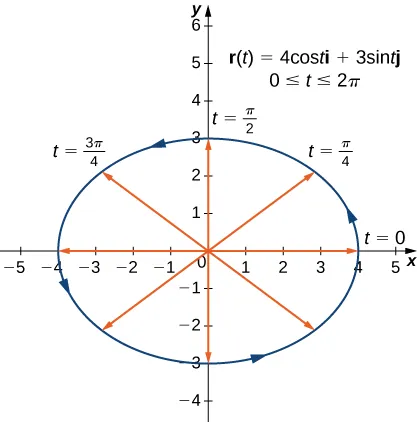
A plane vector-valued function can be viewed as a moving position vector whose terminal point traces a curve in the -plane. This example shows an ellipse traced by with arrows indicating the direction of motion as increases. Source
When you integrate a vector-valued derivative, you use the same antiderivative rules from single-variable calculus on each component separately.
An initial value problem for a vector-valued function asks for a specific function, not just a family of possible functions. Integration usually produces arbitrary constants, so the answer is initially a general solution. The given initial condition removes that ambiguity and identifies one particular vector-valued function.
Initial value problem: A problem in which a vector derivative and enough information about the function at a specific parameter value are given so that the constants of integration can be determined.
This process works the same way whether the function has two components or three. The main difference from a real-valued problem is that each component may need its own constant.
Integrating Component by Component
If a vector-valued function is written as , then integrating means integrating and separately.
The result is still a vector-valued function.
= integrand vector
= parameter
= constants determined by initial conditions
The constant term is best viewed as a constant vector. In two dimensions, that means one constant for the -component and one constant for the -component. In three dimensions, there would be three constants.
This matters because different components can shift independently. A single scalar constant added after integration does not usually capture all possible antiderivatives of a vector-valued function.
Using the Initial Condition
After finding the general solution, substitute the specified parameter value into the vector function and match it to the given vector. This creates equations for the unknown constants.
If the condition is written as , then you evaluate your general antiderivative at . The -component must equal , and the -component must equal . Solving those component equations gives the constants and therefore the unique function requested.
Particular solution: The single vector-valued function obtained after using the initial condition to determine all constants of integration.
A common AP Calculus BC setup gives and one initial condition on . However, some problems require more than one integration. If a higher derivative is given, each integration step introduces new constants, and each condition must be applied at the correct stage.
When More Than One Integration Is Needed
If a problem gives , first integrate to obtain . That antiderivative will contain constants. If a condition on is provided, use it before integrating again. Then integrate once more to get , which introduces another set of constants.
The order matters. Applying a condition too early or too late can lead to missing constants or incorrect values. Keep track of which function each condition refers to.
In these problems, it is helpful to think in layers:
Derivative information tells you what to integrate.
Initial conditions tell you when to stop with arbitrary constants.
Each condition belongs to a specific vector function, such as or .
Component equations are solved separately, but they come from the same parameter value.
What AP Students Should Watch For
Several common mistakes appear in vector-valued initial value problems.
Using only one constant after integrating both components. In general, each component needs its own constant.
Forgetting that the initial condition is a vector. You must match all components, not just one.
Applying the condition to the derivative instead of the original function, or vice versa. Read notation carefully.
Dropping angle brackets or mixing vector and scalar notation. Your final answer should still be a vector-valued function.
Not checking the result. Differentiate your final function to confirm it matches the given derivative, and evaluate it at the stated parameter to confirm the initial condition.
Useful Habits for Setup and Verification
A strong solution usually follows a consistent structure:
Write the given derivative or higher derivative clearly.
Integrate each component with its own constant.
Apply the initial condition by substituting the parameter value.
Solve for the constants component by component.
Rewrite the final answer as a single vector-valued function.
Verification is especially valuable because it checks both parts of the problem at once. If your derivative matches but your initial condition fails, the integration was likely correct and the constants were not. If the initial condition works but differentiation does not, the antiderivative step likely contains an error.
On the AP exam, clean notation can prevent lost points. Keep the vector form visible throughout the work, and remember that the goal of an initial value problem is not merely to integrate, but to determine the one specific vector-valued function that satisfies all given information.
Practice Questions
A vector-valued function satisfies and . Find .
1 mark for integrating correctly to get
1 mark for using to find and , and stating
A vector-valued function satisfies , , and . Find .
1 mark for integrating the first component of correctly
1 mark for integrating the second component of correctly
1 mark for using to obtain
1 mark for integrating again to get a correct general form for
1 mark for using and stating
FAQ
Yes. That happens when the given conditions are inconsistent with the antiderivatives.
For instance, after integrating, you may get a family of vector functions, but no choice of constants makes all the stated conditions true at once. In that case, the data are incompatible.
On AP Calculus BC, problems are usually designed so that a solution does exist, but it is still worth recognising that inconsistency is possible in principle.
A solution is unique when the derivative information is fixed and there are enough independent initial conditions to determine every constant introduced by integration.
For a two-component function integrated once, you usually need one vector condition, because it gives two scalar equations. If you integrate twice, you typically need two vector conditions, or equivalent information.
If there are too few conditions, you will have infinitely many solutions rather than one particular solution.
A vector initial value problem determines the function of the parameter, not just the geometric path.
Two functions can pass through the same set of points in the plane while using different parameter values, moving at different rates, or tracing the curve in opposite directions. Geometrically, the curves may look identical.
As functions, though, they are different, so they can satisfy different initial conditions even if the picture in the plane appears the same.
Because an initial condition specifies both a point and a parameter value.
If $\vec{r}(1)=\langle 2,3 \rangle$ and $\vec{r}(4)=\langle 2,3 \rangle$, the curve reaches the same point twice, but those are different events in the parameterisation. The constants you find must make the condition true at the stated value of $t$.
So the parameter is part of the information. A repeated point does not make the condition redundant.
Then the problem does not determine a single particular solution.
Instead, your answer remains a family of vector-valued functions containing one or more undetermined constants. This means the data are insufficient to pin down the exact function.
A useful check is to compare:
how many constants appear after integrating, and
how many independent scalar equations the conditions provide.
If those numbers do not match, you should expect either infinitely many solutions or, if the data conflict, no solution at all.
