AP Syllabus focus: 'Derivatives can be used to determine velocity and acceleration for a particle moving along a curve in the plane defined using parametric or vector-valued functions.'
In planar motion, derivatives describe how a particle’s position changes over time. This lets us model both the instantaneous direction of motion and how that motion itself is changing.
Describing motion in the plane
Position and velocity
A particle moving in the plane can be represented either by parametric equations and or by a vector-valued function . In both forms, the parameter is usually interpreted as time. The particle’s location at any instant is determined by its horizontal position and vertical position .
When motion is written in this form, each coordinate can be differentiated with respect to time. This is the key idea: the derivative tells how the position changes, and that change produces the particle’s velocity vector.
Velocity vector: The derivative of the position vector with respect to time; it describes the instantaneous rate and direction of motion of a particle.
If the motion is given parametrically, you do not need to eliminate the parameter. Differentiate the coordinate functions directly.
= velocity vector in units per time
= position vector in units
= rates of change of the coordinate functions
The two components of the velocity vector have clear meanings. The -component, , tells how the particle is moving horizontally, while the -component, , tells how the particle is moving vertically. If , the particle is moving to the right; if , it is moving to the left. Similarly, indicates upward motion and indicates downward motion.
Understanding acceleration
What acceleration measures
Velocity itself can change over time. A particle’s velocity may change in magnitude, in direction, or in both. The derivative that measures this change is acceleration.
Acceleration vector: The derivative of the velocity vector with respect to time; it measures how the velocity of a particle changes.
Acceleration is not the same as velocity. Velocity describes the current motion, while acceleration describes how that motion is changing. A particle can have a nonzero acceleration even when its velocity is zero at a particular instant.
= acceleration vector in units per time squared
= velocity vector
= second derivatives of the coordinate functions
Each acceleration component has its own meaning. The value describes how the horizontal velocity is changing, and describes how the vertical velocity is changing. These do not tell direction of position directly; they tell how the corresponding parts of velocity are increasing or decreasing.
Applying derivatives to motion
Parametric and vector-valued forms
On AP Calculus BC problems, motion may be given in either of two equivalent ways:
As parametric equations, such as and
As a vector-valued function, such as
In either case, the method is the same:
Differentiate once to find the velocity vector
Differentiate again to find the acceleration vector
Evaluate the vectors at the requested time if the question asks for a specific instant
Because the derivative is taken component by component, no new differentiation rules are needed beyond those already used for real-valued functions.
Evaluating motion at a specific time
When a question asks for velocity or acceleration at time , first find the general vector expression and then substitute . The resulting vector represents the particle’s motion at that instant.
The velocity vector is especially important because, when it is nonzero, it points in the direction the particle is moving along the curve.
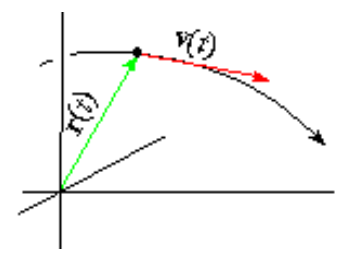
This figure illustrates the geometric meaning of velocity for parametric motion: at the point on the curve, the velocity vector lies tangent to the trajectory. Visually, it connects “instantaneous direction of motion” to the tangent direction of the path in the plane. Source
This connects motion to geometry: the particle follows a path in the plane, and the velocity vector is tangent to that path.
Acceleration behaves differently.
It does not have to point in the direction of motion. Instead, it reflects how the velocity vector is changing. That change may involve a change in magnitude, a change in direction, or both. As a result, a particle can be turning even if the magnitude of its velocity is not changing, and that turning still produces acceleration.
Units can help with interpretation:
If position is measured in meters and time in seconds, velocity is in meters per second
Acceleration is in meters per second squared
Keeping track of units makes it easier to distinguish position, velocity, and acceleration.
Interpreting vectors carefully
Common issues
A common mistake is to confuse the particle’s position vector with its velocity vector. The position vector tells where the particle is, while the velocity vector tells how its position is changing. Another common mistake is to interpret acceleration as the direction of motion. That role belongs to velocity, not acceleration.
It is also important to distinguish between a zero vector and a zero component. If one component of velocity is zero, the particle may still be moving because the other component is nonzero. Only when both components are zero is the velocity vector zero. The same idea applies to acceleration.
Finally, be careful when reading notation. In this topic, primes such as and always refer to derivatives with respect to time. Since motion is being tracked over time, the independent variable is the parameter , and derivatives describe how the particle moves as time changes.
Practice Questions
A particle has position vector .
Find and . [2 marks]
1 mark for
1 mark for
A particle moves in the plane with parametric equations and , where .
(a) Find the velocity vector . [2 marks]
(b) Find the acceleration vector . [1 mark]
(c) Find and . [1 mark]
(d) At , determine whether the particle is moving left or right, and whether it is moving up or down. [1 mark]
(a) 1 mark for differentiating correctly:
(a) 1 mark for differentiating correctly and forming the vector:
(b) 1 mark for
(c) 1 mark for and
(d) 1 mark for stating that the particle is moving left and down
FAQ
Yes. The geometric path can be identical while the timing is different.
If one parametrisation moves along the curve more quickly, more slowly, or in the opposite direction, then the derivatives with respect to time change. That means the velocity and acceleration vectors can also change, even though the curve itself stays the same.
If $ \vec{v}(t)\cdot \vec{a}(t)=0 $ and $ \vec{v}(t)\ne \vec{0} $, the acceleration is changing the direction of motion rather than the magnitude of the velocity at that instant.
This often happens when a particle is turning. It is an instantaneous statement, so it describes behaviour at one moment rather than over a whole interval.
When the vectors point in the same direction, the magnitude of velocity is increasing at that instant.
When they point in opposite directions, the magnitude of velocity is decreasing at that instant.
This can be useful for interpreting motion without needing to sketch the full path.
Check the relevant component of the velocity on both sides of the time in question.
A horizontal reversal occurs when $x'(t)$ changes sign.
A vertical reversal occurs when $y'(t)$ changes sign.
A component being zero at one instant is not enough by itself. You need a genuine sign change to confirm a reversal.
No. Zero acceleration means the velocity is constant.
If the constant velocity is nonzero, the particle keeps moving in a straight line.
If the constant velocity is $ \vec{0} $, the particle is stationary.
So zero acceleration tells you there is no change in velocity, not necessarily no motion at all.