AP Syllabus focus: 'Derivatives can be used to determine the speed of a particle moving along a curve in the plane defined using parametric or vector-valued functions.'
When motion is described by parametric equations or a vector-valued function, calculus connects the rate of change of position to speed, the quantity that tells how fast the particle moves along its path.
Understanding Speed on a Curve
Parametric and Vector-Valued Motion
A particle moving in the plane can be described by coordinate functions and , or by the vector-valued function .
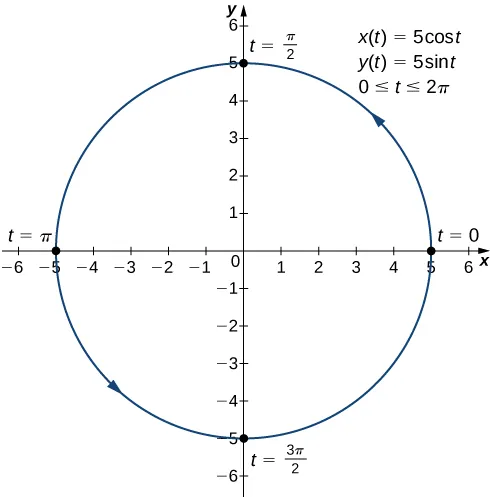
A parametric circle is shown with key parameter values labeled (e.g., , , ) and arrows indicating direction as increases. This emphasizes that controls how the particle moves along the curve, not just the curve’s shape in the -plane. Source
The parameter usually represents time.
The speed of the particle tells how fast it is moving at a specific instant, without saying anything about direction.
Speed: The instantaneous rate at which a particle moves along its path; it is the magnitude of the particle’s velocity and is always nonnegative.
Because speed ignores direction, it is a scalar quantity. This makes it different from the derivative of position, which keeps track of directional change in each coordinate. A particle can have a negative horizontal rate or a negative vertical rate, but its speed itself cannot be negative.
To find speed, combine the horizontal rate and the vertical rate .
These component rates work together to measure overall motion along the curve.
Formula for Speed
= speed at time , in units per unit time
= horizontal position of the particle
= vertical position of the particle
= time
= position vector of the particle
The two formulas express the same idea. The first is convenient when motion is given parametrically, and the second is convenient when motion is written as a vector-valued function. In both cases, speed is measured in units of distance per unit time.
Calculating and Interpreting Speed
How to Calculate Instantaneous Speed
When you are asked to calculate instantaneous speed, focus on derivative information from the coordinate functions, not on the shape of the curve alone.
Start with the position in the form and , or .
Differentiate each coordinate with respect to .
Evaluate those derivatives at the requested time if a specific instant is given.
Square the component rates, add them, and take the square root.
Interpret the result using units such as meters per second or feet per second.
If both component derivatives are zero at the same time, then the speed is zero at that instant. That means the particle is momentarily at rest, even though it still has a position on the curve.
Speed as a Function of Time
Sometimes an AP question asks for a speed function instead of a numerical value at one instant. In that case, leave the answer in terms of after differentiating and combining the component rates. This expression shows how the particle’s motion changes over time.
A clear algebraic form can make comparisons easier, especially when a problem asks whether the particle is moving faster at one time than at another. However, simplify carefully. The squaring step applies to the entire derivative of each coordinate, so sign errors and missing parentheses can change the result.
Why the Formula Uses a Square Root
Over a very small time interval, the particle moves a small horizontal amount and a small vertical amount. Those changes form the legs of a right triangle. The actual short distance traveled is approximated by the hypotenuse, so the Pythagorean theorem gives the expression . When that quantity is divided by and the interval becomes extremely small, the limit leads to the speed formula.
This geometric idea explains why negative component rates do not produce negative speed. Squaring removes the sign of each component before the total rate is found.
Interpreting Results Carefully
A large speed means the particle’s position is changing quickly with respect to time. A small speed means the particle is moving more slowly. Speed depends on how the position changes over time, not simply on how the curve looks.
Two different parametrizations of the same geometric path can produce different speeds, because speed depends on how quickly the particle moves through points on the curve. The curve alone does not determine speed; the time dependence in the coordinate functions matters.
If a speed function increases on an interval, the particle is moving faster and faster. If it decreases, the particle is slowing down. Even when the path curves, the value of speed measures only how fast the motion occurs, not which way the particle is turning.
It is also important not to confuse speed with the slope of the path. The slope describes the direction of the tangent line to the curve, while speed describes how fast the particle moves through the plane. A path can have a steep tangent line and still be traversed slowly, or a shallow tangent line and still be traversed quickly.
If the coordinate functions are differentiable, speed can be found directly from their derivatives. If one or both coordinate functions are not differentiable at a certain time, the instantaneous speed may not exist there. On an exam, always check that the derivatives you need are defined at the time being considered.
Common Errors to Avoid
Several mistakes appear often on AP Calculus BC problems involving speed.
Using instead of the square root of the sum of squares.
Forgetting the square root and finding speed squared rather than speed.
Attaching a negative sign to the final answer because one component derivative is negative.
Using instead of . The first measures distance from the origin, not speed.
Evaluating at the wrong time or dropping parentheses when substituting.
Ignoring units in a motion context.
Practice Questions
A particle has position for . Find the speed of the particle at .
Finds the derivative or equivalent component derivatives: 1 mark
Computes the speed at as : 1 mark
A particle moves in the plane with and for .
(a) Write an expression for the speed .
(b) Find all times when the particle is at rest.
(c) Find the speed at .
(a) Differentiates correctly to get and : 1 mark
(a) Uses the speed formula correctly to obtain : 1 mark
(b) Solves and and recognizes there is no common time value: 1 mark
(b) States that the particle is never at rest on : 1 mark
(c) Evaluates : 1 mark
FAQ
If a curve is parametrised by arc length $s$, then the speed with respect to that parameter is $1$ wherever the derivative exists.
In symbols, $|\mathbf{r}'(s)|=1$. That means each increase of one unit in $s$ corresponds to travelling one unit along the curve. This is useful because it separates the shape of the path from the rate at which time passes.
Look at the steepness of the coordinate graphs.
A large value of $|x'(t)|$ means the horizontal position is changing quickly.
A large value of $|y'(t)|$ means the vertical position is changing quickly.
Speed is greatest where the combined effect of those two slopes is largest.
The signs of the slopes do not matter for speed, because the formula squares them.
It means the particle is stationary at that instant, but that is not the whole story.
You cannot tell from that fact alone whether the particle:
reverses direction,
continues in roughly the same direction after pausing, or
changes its direction of travel in the plane.
To decide, examine the motion for times just before and just after that instant.
Yes. This can happen when the velocity vector passes through $\langle 0,\ 0\rangle$.
For example, if $\mathbf{r}'(t)=\langle t,\ 0\rangle$, then the speed is $|t|$, which is not differentiable at $t=0$ even though the coordinate functions themselves can still be very well behaved.
So a smooth path does not automatically guarantee a smooth speed function.
Yes. The formula combines horizontal and vertical changes using the Pythagorean theorem, so the spatial units must be compatible.
If one coordinate is measured in metres and the other in centimetres, convert them first. Otherwise, the computed speed will mix units incorrectly and the result will not represent a meaningful physical rate.