

AP Syllabus focus: 'For a particle in planar motion, the definite integral of the velocity vector represents the particle’s displacement, from which we might determine its position.'
In planar motion, integrating velocity over time gives a vector result that captures net change in position, connecting derivatives, accumulation, and initial conditions in a central BC motion model.
Displacement from Velocity
When a particle moves in the plane, its position is often written as . Its velocity vector is . Since integration undoes differentiation, the definite integral of velocity over a time interval tells how far the position vector changes over that interval, not how much ground the particle travels along its path.
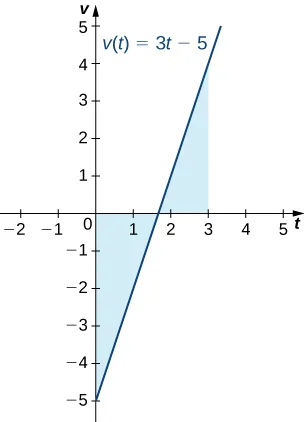
A velocity–time graph with shaded signed area illustrates that displacement is the accumulation of velocity over time. Regions above the -axis contribute positive displacement, while regions below contribute negative displacement, reinforcing that the definite integral measures net change rather than total travel. Source
Displacement vector: The net change in a particle’s position over a time interval.
Displacement is a vector, so direction matters. A positive -component means the particle ends farther to the right than it started, while a negative -component means it ends farther to the left. The same idea applies to the -component. Because displacement records only starting and ending position, opposite motions can cancel each other.
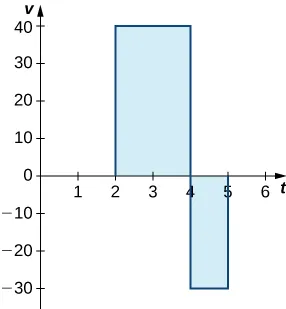
This piecewise velocity–time graph uses rectangular regions to show how signed area accumulates across time intervals. The positive block and negative block demonstrate how direction reversals subtract from the total, so the final displacement reflects net area rather than total distance traveled. Source
= displacement vector from time to time
= velocity vector as a function of time
= initial and final times
In AP Calculus BC, this integral is usually evaluated component by component. If , then . Each component of displacement comes from accumulating the corresponding component of velocity. This matters because the particle may move in one direction horizontally while moving in another direction vertically. Units also follow the meaning of the integral: if velocity is measured in meters per second and time in seconds, displacement is measured in meters.
Determining Position from Displacement
Once displacement is known, it can be combined with a starting location to find where the particle is at a later time. This is the main use of displacement in motion problems: velocity describes how position changes, and the definite integral packages that change over a chosen interval.
Position vector: A vector that gives the location of a particle relative to the origin at a given time.
To determine an actual position, you need an initial condition, such as the particle’s position at time . Velocity alone describes change, but it does not identify a unique location. Many different particles could have the same velocity function and still be in different places.
= position vector at the final time
= known position vector at the initial time
= displacement over the interval
This formula shows the relationship among position, velocity, and displacement. Starting position plus net change equals ending position. In component form, if , then the final position is found by adding the displacement components to and . You can also think of this as an application of the Fundamental Theorem of Calculus: because , any position function is an antiderivative of the velocity vector, and the initial condition selects the correct one.
Interpreting the Result
A displacement vector should always be read geometrically.
It tells how the endpoint compares with the starting point, not what route the particle followed in between. A particle can move forward, reverse direction, and still have a small displacement if the final position ends close to the initial position.
Several common interpretations are important:
If , the particle’s final position is the same as its initial position over that interval.
If only one component of the displacement is zero, the particle ends with the same coordinate in that direction but may still have changed position overall.
A nonzero displacement does not mean the particle moved in a straight line.
A large displacement component indicates a substantial net change in that coordinate, even if the particle changed direction during the interval.
These interpretations help on free-response and multiple-choice questions, where you may need to explain the meaning of a vector answer rather than just compute it.
Common AP Expectations and Pitfalls
On AP problems, the velocity vector may be given directly, or it may be embedded in a word problem with component functions. In either case, the key idea is to integrate the vector over the stated time interval and then use any given initial position correctly.
Keep these points in mind:
Use a definite integral for displacement over an interval. An indefinite integral gives a family of position functions and is not the same as displacement.
Keep the answer as a vector or ordered pair unless the problem clearly asks for something else.
Apply initial conditions after integrating when the question asks for position rather than displacement.
Watch the interval carefully. Changing the limits changes the sign and meaning of the displacement.
Integrate each component separately. Do not try to combine vector components into a single scalar expression.
Include units when provided. Displacement and position have the same units as the coordinate system.
Do not confuse net change with total travel. A particle can travel a long distance and still have small displacement if its motion partly cancels.
When interpreting or checking an answer, ask whether the vector points from the starting location to the ending location. That viewpoint keeps the calculus connected to the geometry of motion.
Practice Questions
A particle moves in the plane with velocity vector for . Find the displacement vector of the particle on the interval . [2 marks]
1 mark for setting up or evaluating
1 mark for the correct displacement vector
A particle moves in the plane with velocity vector for . At time , the particle is at position .
(a) Find the displacement vector on the interval .
(b) Find the position vector of the particle at time .
(c) State whether the particle ends to the left or right of its starting point and whether it ends above or below its starting point. [5 marks]
(a) 1 mark for correct component integrals
(a) 1 mark for
(b) 1 mark for adding displacement to the initial position
(b) 1 mark for
(c) 1 mark for stating the particle ends left of the starting point and above the starting point
FAQ
Reversing the limits changes the sign of the displacement vector.
So, $\int_b^a \mathbf{v}(t),dt=-\int_a^b \mathbf{v}(t),dt$. Geometrically, this means you are describing the net change in position for the motion read backwards in time.
Yes. Displacement depends on the integral of velocity over the interval, not on the exact shape of the velocity graph at every moment.
Two particles may have different motions during the interval, but if their velocity vectors accumulate to the same net change in each component, their displacement vectors will match.
Integrate each piece on the interval where it applies, then add the resulting vectors.
For example:
integrate the first formula on its time interval
integrate the second formula on its next interval
continue as needed
combine the component results
This is still one displacement, built from several pieces of motion.
Use the given time directly. If you know $\mathbf{r}(c)$, then the most natural formula is $\mathbf{r}(t)=\mathbf{r}(c)+\int_c^t \mathbf{v}(u),du$.
There is no requirement to start at zero. What matters is matching the lower limit of integration to the time at which the position is known.
Check the signs and rough sizes of the components.
If the $x$-component of velocity is mostly positive on the interval, the displacement in the $x$-direction should usually be positive. If one component of velocity changes sign often, some cancellation may occur, so the displacement there may be smaller than expected.
A quick graphical or numerical check of each component can often catch sign errors.
