

AP Syllabus focus: 'For a particle in planar motion, the definite integral of speed represents the particle’s total distance traveled over the interval of time.'
Total distance in planar motion measures how far a particle actually travels along its path over time. The key idea is that speed accumulates distance, so total distance comes from integrating speed.
Understanding total distance
When a particle moves in the plane, its path may curve, loop, or even retrace itself.
The total distance traveled over a time interval records the entire amount of motion along that path from the starting time to the ending time. It does not depend only on where the particle starts and ends.
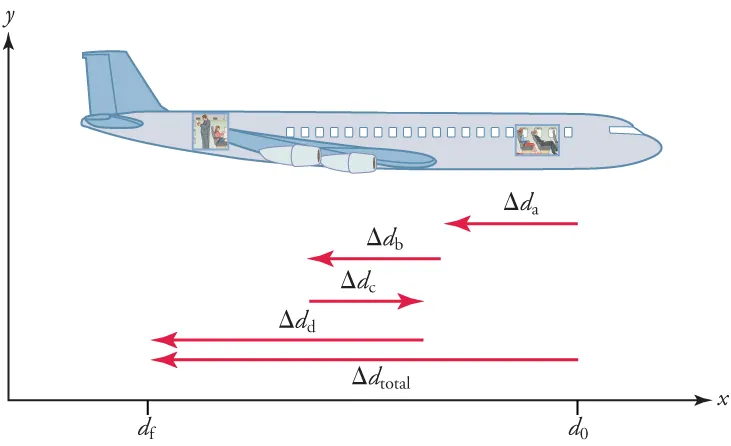
The diagram breaks a trip into multiple signed displacement segments, illustrating how direction changes can make net displacement small even when the path traveled is substantial. In calculus terms, this is why total distance is modeled by accumulating nonnegative “amount traveled” rather than allowing positive and negative components to cancel. Source
A particle can finish near its starting point and still have traveled a large total distance if it moved around a lot before returning.
Total distance traveled: The total length of motion a particle covers along its path over a given time interval.
This idea matters because motion in two dimensions can be more complicated than motion on a straight line. Horizontal and vertical changes may increase, decrease, or reverse direction, but total distance keeps track of the full amount traveled. It is always nonnegative, and motion over different parts of the interval adds together.
Speed as the quantity to integrate
To find total distance, you need the particle’s speed. If the motion is given parametrically by and , or equivalently by a vector-valued position function , then the particle has velocity components and . These components describe motion in the horizontal and vertical directions, but neither one alone gives the full rate of travel along the curve.
Speed: The magnitude of the velocity of a particle; in planar motion, it gives the rate at which distance is being traveled.
For planar motion, speed is found from both velocity components together: . Because this is a square root of a sum of squares, speed cannot be negative. That is why integrating speed measures total distance without any cancellation from changes in direction.
Distance formula for planar motion
Once speed is known, total distance is found by integrating that speed over the time interval. The interval must be written in terms of time, because the particle’s motion is being tracked as time changes. This is the central formula for this subsubtopic.
= total distance traveled on , units of length
= speed at time , units of length per unit time
= initial time
= final time
This formula says that total distance is the accumulated speed over time. The units also make sense: speed has units of length per unit time, and multiplying by a small amount of time gives a small amount of distance. Integrating over the full interval adds all of those small pieces together.
Applying the formula correctly
A reliable process helps avoid common mistakes.
Identify the time interval clearly. Total distance is always computed from an initial time to a final time .
Find the velocity components if needed. For parametric motion, compute and .
Build the speed function using . If the problem already gives speed directly, use that expression.
Integrate speed, not position or a single component. Total distance comes from , not from integrating , , , or by themselves.
Evaluate on the same time interval used in the motion description. If the question asks for motion from one time to another, do not switch to -values or -values as bounds.
In some problems, the integral is straightforward. In others, the antiderivative may be harder to find. What matters conceptually is that the definite integral of speed represents the full distance traveled during the stated time interval.
Interpreting answers and avoiding errors
The answer to a total distance problem should be read as a length, not as a coordinate or a vector. If a particle stops momentarily, then its speed is at that instant, so no distance is added during that instant. If it later moves again, the total distance continues increasing. Because speed is nonnegative, different parts of the motion do not cancel each other out.
Common errors
Using displacement ideas instead of distance ideas. Total distance is not just the change from initial position to final position.
Integrating a component velocity instead of speed. The expressions and can be positive or negative, so they do not measure total distance by themselves.
Forgetting the square root in the speed formula. The quantity under the radical combines the two velocity components, but the speed is the radical itself.
Using the wrong bounds. Since the motion is parameterized by time, the bounds must be times.
Assuming retraced motion does not count. If the particle travels over the same part of the path more than once, each pass contributes to total distance.
Practice Questions
A particle moves in the plane with position and for . Find the total distance traveled.
1 mark for finding the speed:
1 mark for the definite integral and answer:
A particle has position vector for .
(a) Find the speed of the particle at time .
(b) Find the total distance traveled on the interval .
1 mark for
1 mark for
1 mark for speed:
1 mark for correct setup:
1 mark for correct evaluation:
FAQ
Not if the new parameter traces exactly the same motion over the same part of the curve without skipping or repeating any section.
Mathematically, a valid smooth reparametrisation changes the form of the speed expression, but the definite integral still gives the same total distance after substitution.
A definite integral taken from a larger time to a smaller time changes sign, so $\int_b^a v(t),dt$ would be negative.
Because total distance cannot be negative, you should interpret the motion over the interval in the correct chronological order and use $\int_a^b v(t),dt$ with $a<b$.
Average speed over $[a,b]$ is found by dividing total distance by total time:
$Average\ speed=\dfrac{1}{b-a}\int_a^b v(t),dt$
So total distance gives the accumulated travel, while average speed tells you the overall rate of travel across the whole interval.
Yes, sometimes it can.
If the speed is still integrable on the interval, total distance may exist even when the path is not perfectly smooth at one instant. In practice, you may split the interval at the troublesome time and add the distances from each side.
In standard AP Calculus BC problems, this is not expected.
However, in a broader mathematical setting, it is possible if the speed becomes unbounded strongly enough near some time in the interval. The key issue is whether the integral of speed converges.
