AP Syllabus focus: 'Methods for calculating derivatives of real-valued functions can be extended to functions in polar coordinates, which describe curves using r and θ.'
Polar coordinates provide a different way to describe points and curves in the plane, using distance and angle instead of horizontal and vertical position, and they prepare the way for later calculus ideas.
What Polar Coordinates Measure
In rectangular coordinates, a point is identified by its horizontal and vertical position. In polar coordinates, a point is located by giving its distance from a fixed point and its direction from a fixed ray.
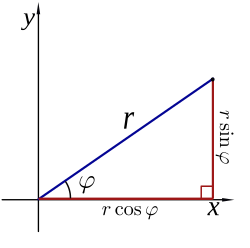
This figure illustrates how the same point can be described in two coordinate systems: by Cartesian coordinates and by polar coordinates . The right triangle geometry shown is the basis for the conversions and , which connect “distance and direction” to horizontal and vertical components. Source
Polar coordinates: A system for locating a point in the plane by using its distance from a fixed point and its angle from a fixed ray.
The fixed point is called the pole, and it plays the same role as the origin in the rectangular plane.
The fixed ray is called the polar axis. By convention, angles are measured from the polar axis, with positive angles turning counterclockwise and negative angles turning clockwise. In calculus, angles are usually measured in radians, because later derivative ideas are built around radian measure.
Reading a Polar Point
A polar point is written as .
gives the directed distance from the pole.
gives the angle from the polar axis.
If , the point lies on the ray at angle .
If , the point lies units in the opposite direction.
If , the point is at the pole.
This system behaves differently from rectangular coordinates because a single point can have more than one polar description. Adding any integer multiple of to the angle does not change the direction. Also, a negative value of can describe the same point as a positive value with a different angle. That nonuniqueness is one of the most important features of polar coordinates.
Polar Equations and Polar Functions
A curve in polar form is usually written by making the radius depend on the angle. Instead of giving a -value for each -value, a polar equation tells you how far from the pole the point is when the angle has a certain value.
Polar equation: An equation that describes a curve by relating the radius to the angle .
This notation is the standard way to present a polar relationship.
= signed distance from the pole
= angle from the polar axis, in radians
= real-valued output giving the radius
As changes, the point moves and traces out a graph. Some polar equations produce closed curves, while others generate open curves or repeating patterns. The key idea is that the graph is created by tracking how the radius changes as the angle changes.
Why Polar Form Fits Calculus
The connection to calculus comes from treating as a real-valued function of . If is differentiable, then the radius changes smoothly with respect to the angle, and the notation describes that rate of change. This is why methods used for ordinary real-valued functions can be extended to polar functions.
Even though the graph appears in the plane, the rule still begins with one input and one output. The input is the angle, and the output is the radius. Because of that structure, familiar calculus ideas such as continuity, differentiability, and rates of change still apply. What changes is the geometric meaning of the variables.
Interpreting Polar Graphs
Reading a polar graph requires attention to both distance and direction.
What the Radius Tells You
A large positive value of places the point far from the pole along the ray at angle .
A small positive value of keeps the point near the pole.
A negative value of sends the point to the opposite side of the pole.
A value of near zero means the curve is close to the pole.
A change in the sign of can make a graph appear to switch sides suddenly, even if is changing smoothly. That is why polar curves can form loops, cross through the pole, or retrace parts of themselves.
What the Angle Tells You
The angle controls the orientation of the point. As increases, the ray from the pole rotates. If the function has repeating behavior, then the graph may repeat after a certain interval of angles. This makes polar coordinates especially useful for curves with rotational structure.
A polar graph is best understood as a tracing process. You imagine the angle turning while the radius changes according to the function. The graph is the path created by that moving point.
Features That Make Polar Coordinates Different
Several features make polar coordinates distinct from rectangular coordinates:
The system is based on distance and angle, not horizontal and vertical position.
The pole serves as the reference point for every location on the graph.
A single point can have multiple polar names, so coordinate descriptions are not unique.
A polar equation describes radius as a function of angle.
Negative values of are allowed and affect where the point is plotted.
Since is a real-valued function of , the language of derivatives extends naturally to polar form.
Radians are the standard angle unit in calculus because they support later differentiation work correctly.
Practice Questions
A point has polar coordinates . Describe its location in the plane.
1 mark: States that the point is units from the pole.
1 mark: States that it lies opposite the ray , or equivalently on the ray .
A curve is given by for .
(a) Explain what the value of tells you about the location of a plotted point. (b) Find all values of in the interval for which the curve passes through the pole. (c) State the interval(s) where the point lies in the same direction as the ray at angle . (d) State the interval(s) where the point lies in the opposite direction from the ray at angle . (e) Determine whether the curve is traced more than once on , and justify your answer.
1 mark: Explains that positive places the point on the ray , negative places it in the opposite direction, and places it at the pole.
1 mark: Finds when .
1 mark: States that the point is in the same direction as the ray for .
1 mark: States that the point is in the opposite direction for .
1 mark: Correctly states that the curve is traced twice and justifies this by noting that the second half of the interval gives negative radius values that reproduce the same set of points.
FAQ
At the pole, the distance is zero, so direction no longer matters. Every angle points to the same location once the radius is $0$.
This is why coordinates such as $(0,\pi/4)$ and $(0,5)$ represent exactly the same point. In polar work, this is normal and does not create a contradiction.
Most graphing tools plot points by increasing $\theta$ through a chosen interval and joining nearby points. The graph you see depends heavily on the interval and the step size.
If the step size is too large, a calculator may miss loops, petals, or crossings at the pole. If the interval is too short, it may draw only part of the curve.
A useful interval often comes from the function’s repeating behaviour. Look for:
trig functions and their periods
sign changes in $r$
values where $r=0$
any obvious symmetry
If a curve repeats after a certain amount of turning, you usually only need one full repeating interval to understand its shape.
Polar coordinates are not unique, so different equations can send you to the same collection of points. A negative radius can be replaced by a positive radius with an angle shift of $\pi$.
Because of this, two equations may look unrelated algebraically whilst still describing the same graph geometrically.
Radians connect angle directly to arc length and circular motion. That makes rate-of-change ideas behave cleanly when angles are changing.
If angles were measured in degrees, derivative formulas would carry extra constants, and the calculus would be less natural. For that reason, radians are the standard language for polar functions in calculus.