AP Syllabus focus: 'A curve given by a polar equation r = f(θ) can be related to rectangular coordinates, allowing methods for real-valued functions to extend to polar functions.'
Polar and rectangular systems describe the same plane in different ways. AP Calculus BC expects you to move fluently between them so that polar curves can be analyzed with familiar coordinate relationships.
Two coordinate systems for the same point
In rectangular coordinates, a point is located by its horizontal and vertical distances from the origin, written as . In polar coordinates, the same point is described using a distance from the origin and a direction angle, written as .
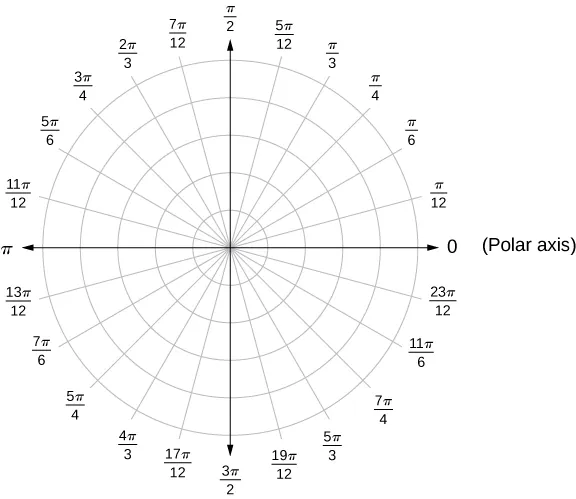
A polar coordinate grid with labeled angles (radians) and concentric circles for constant values. This makes it clear that selects a ray from the origin while measures directed distance along that ray, which is the key interpretation skill for polar plotting. Source
Polar coordinates: An ordered pair where is the directed distance from the origin to the point and is the angle measured from the positive -axis.
The key idea is that a polar description can be translated into rectangular information because the point, the angle, and the radius form a right-triangle relationship.
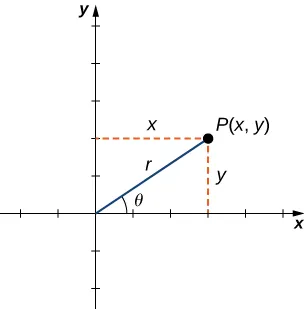
A point is shown with rectangular coordinates and polar coordinates . The diagram highlights the right-triangle relationship between (the hypotenuse) and the legs and , which is the geometric reason the conversion formulas and work. Source
That connection is what lets algebraic and calculus methods developed for real-valued functions apply to polar curves as well.
= rectangular horizontal coordinate
= rectangular vertical coordinate
= distance from the origin
= angle of the point from the positive -axis, when
These relationships work in both directions. If you know and , you can find and . If you know and , you can recover and determine an appropriate angle by using the point’s quadrant.
Converting a point or curve from polar to rectangular form
When a point is given in polar form, convert it by substituting the known values of and into the formulas for and . This produces the rectangular coordinates of the same point.
For a polar equation such as , the same idea gives rectangular expressions:
This means a polar curve can often be viewed through rectangular coordinates as changes. Even when you do not eliminate , you have still related the polar curve to the rectangular system.
Sometimes the goal is to produce a single rectangular equation involving only and . Common substitutions include:
replace with
replace with
replace with
This is especially useful when the polar equation contains products of with trigonometric functions or expressions that can be multiplied by . Expressions involving often become simpler in polar form, and the reverse is also true when converting back to rectangular coordinates.
Converting from rectangular to polar form
To convert a point from rectangular coordinates to polar coordinates, first find the distance from the origin using . Then determine an angle that places the point in the correct direction from the origin.
The angle step requires care. The equation gives only a tangent value, and many angles share the same tangent. You must use the signs of and to choose the correct quadrant. If the point lies on an axis, the angle should match that axis directly rather than relying only on tangent.
When converting an entire rectangular equation to polar form, substitute:
Then simplify. This often turns equations involving circles centered at the origin, radial symmetry, or repeated terms into cleaner polar equations.
Another important idea is equivalent polar coordinates.
Equivalent polar coordinates: Different ordered pairs that represent the same point, such as and , or and .
Because of this equivalence, a single rectangular point usually has infinitely many polar representations. That is normal and does not mean the conversion is wrong.
Important interpretation ideas
A rectangular equation usually names points directly, while a polar equation often emphasizes how distance from the origin changes as the angle changes. During conversion, it helps to decide whether you are converting:
a single point
an equation
a curve traced as changes
Those tasks are related, but not identical. A point becomes one or more coordinate pairs. An equation requires substitution and algebra. A curve may be easiest to understand after rewriting it in terms of and or after expressing and as functions of .
The origin deserves special attention. In rectangular coordinates it is only , but in polar coordinates it can be written as for any angle. This is one reason polar descriptions are not unique.
Negative values of also matter. A negative radius places the point in the direction opposite the angle . This can create polar equations that describe the same rectangular curve in more than one way, depending on how the curve is written.
Common mistakes to avoid
Forgetting that is often the safest starting relationship.
Using without checking the quadrant.
Assuming each point has only one polar representation.
Treating as though it were automatically a rectangular function .
Mixing up the roles of and .
Losing useful information about angle restrictions when simplifying an equation.
Once conversions are set up correctly, polar curves can be interpreted with the same coordinate ideas used for real-valued functions, which is the main purpose of moving between the two systems.
Practice Questions
A point has polar coordinates . Find its rectangular coordinates.
Uses and correctly. [1]
Gets and , so the rectangular coordinates are . [1]
The curve is given in polar form by .
(a) Convert the curve to a rectangular equation and simplify.
(b) State the center and radius of the rectangular curve.
Starts with . [1]
Multiplies both sides by to obtain . [1]
Substitutes and to get . [1]
Rearranges to . [1]
States center and radius . [1]
FAQ
A common convention is to choose $r\ge 0$ and then place $\theta$ in a stated interval, often $0\le \theta<2\pi$ or $-\pi<\theta\le \pi$.
If the problem does not specify an interval, either convention may appear in coursework, but your angle should still match the correct quadrant. On an AP-style problem, always follow any interval restriction that is given.
It creates expressions that match the standard conversion identities directly:
$r\cos\theta=x$
$r\sin\theta=y$
$r^2=x^2+y^2$
For instance, if an equation contains $\cos\theta$ or $\sin\theta$ alone, multiplying by $r$ can turn it into something you can replace with $x$ or $y$. This is one of the quickest algebraic moves in polar conversion.
The rectangular equation may describe the entire geometric curve, but the restricted $\theta$ interval may describe only part of it.
That means you should distinguish between:
the full rectangular relation, and
the portion actually traced by the allowed values of $\theta$
This matters when identifying endpoints, partial curves, or whether a point is included more than once.
Polar graphs are generated by sampling values of $\theta$, not by plotting every point continuously in rectangular space.
A gap can appear if:
the sampling is too coarse
$r$ changes sign quickly
the curve passes through the origin
the window is poorly chosen
So a visual gap does not always mean the curve itself is broken. It may be a plotting issue.
Test a few easy angles or known points and see whether both forms describe the same locations.
Useful checks include:
intercepts on the axes
whether the curve passes through the origin
symmetry about an axis or the origin
whether a circle’s centre and radius make sense
A quick consistency check often catches sign errors in $\sin\theta$ or $\cos\theta$ replacements.