AP Syllabus focus: 'For a curve given by a polar equation r = f(θ), derivatives of r, x, and y with respect to θ can provide information about the curve.'
Polar curves are described by distance and angle rather than by separate rectangular coordinates, so understanding how , , and change as changes is a key calculus skill.
Understanding a polar curve
A polar equation gives the distance from the origin as a function of the angle.
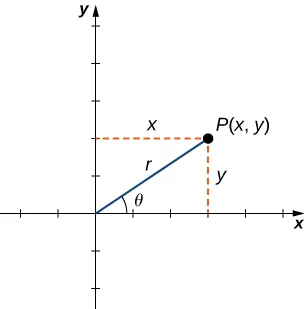
This diagram illustrates the basic geometry of polar coordinates: the point is located by a directed distance from the origin and an angle measured from the positive -axis. Seeing as a radius-like segment and as a rotation helps connect polar motion to how a point traces a curve as varies. Source
Instead of starting with and , you start with and .
Polar equation: An equation of the form that describes a curve by giving the directed distance from the origin as a function of the angle .
When changes, the point on the curve may move closer to the origin, farther away, or change direction in the plane. The derivative measures how the radial distance changes as the angle changes.
If is positive at a value of , the point is moving outward from the origin at that instant. If is negative, the point is moving inward. If , the radial distance is momentarily not changing, although the point can still be moving because the angle is changing.
It is important to remember that is not the slope of the curve. It describes change in radial distance, not change in vertical position compared with horizontal position.
Converting to rectangular coordinates
Even though a curve is given in polar form, the corresponding rectangular coordinates still satisfy the standard relationships between polar and rectangular systems.
These let you treat the curve as a pair of functions of .
= horizontal coordinate
= vertical coordinate
= rate of change of horizontal position with respect to
= rate of change of vertical position with respect to
Because depends on , both and are products of two functions of . That is why the product rule is essential when differentiating. A very common mistake is to differentiate as if were a constant. In polar calculus, usually changes with , so its derivative must be included.
Why these derivatives matter
The derivatives and describe how the point moves in the rectangular plane as the angle increases.
If , the point is moving to the right.
If , the point is moving to the left.
If , the point is moving upward.
If , the point is moving downward.
These signs help you understand the local behavior of the curve without graphing every point. They give directional information about motion along the curve as increases.
Interpreting , , and together
A polar curve contains two kinds of change at the same time:
Radial change, measured by
Horizontal and vertical change, measured by and
This distinction is important. A point can have and still have nonzero or . That means the distance from the origin is momentarily unchanged, but the point still moves because its direction changes.
Likewise, or can be zero even when is not zero. For instance, the point may be moving straight up or straight left at that instant, so one rectangular coordinate is temporarily constant while the other continues to change.
When both and are examined together, they describe the instantaneous direction of travel in the plane. This is especially useful when a polar curve crosses itself, forms a loop, or changes direction sharply, because the same point in the plane can sometimes be reached at different values of .
Process for finding the derivatives
For AP Calculus BC, the standard process is straightforward:
Start with the polar equation .
Differentiate to find .
Rewrite the rectangular coordinates as and .
Differentiate both expressions with respect to .
Use the product rule carefully in each derivative.
Simplify the results enough to make sign analysis easier.
This process treats a polar curve as a parametric curve with parameter . In that form, the curve is analyzed through its rectangular component functions.
Units and notation
In calculus, angle measure is assumed to be in radians unless stated otherwise. The derivative formulas for and in their standard form rely on radian measure.
Be careful with notation:
is not the same as or .
measures radial change.
and measure rectangular component changes.
Each derivative answers a different question about the same curve.
Common pitfalls
Students often lose points on this topic for procedural reasons.
Forgetting that is a function of
Omitting the product rule in or
Treating as if it were the slope of the polar curve
Mixing degree measure with derivative formulas that assume radians
Failing to interpret the sign of a derivative in context
These errors usually come from losing track of which quantity is changing with respect to .
Practice Questions
For the polar curve , where , find and .
1 mark for
1 mark for or any equivalent expression
The polar curve is given by . Let and .
(a) Find .
(b) Find expressions for and .
(c) At , determine whether the point is moving left or right and whether it is moving up or down as increases.
1 mark for
1 mark for correct setup of
1 mark for a correct expression for or equivalent
1 mark for a correct expression for or equivalent
1 mark for evaluating at to get and , then stating the point is moving left and up
FAQ
Polar coordinates are not unique. Adding $2\pi k$ to an angle gives the same direction, and $(r,\theta)$ also represents the same point as $(-r,\theta+\pi)$.
This matters for derivatives because the curve is being traced by a particular parametrisation. Two different $\theta$-values can land on the same geometric point while giving different values of $dx/d\theta$ and $dy/d\theta$.
The formulas do not change. You still use $x=r\cos\theta$ and $y=r\sin\theta$, and you still differentiate with the product rule.
A negative $r$ places the point in the direction opposite to $\theta$. Because of that, the signs of $x$, $y$, $dx/d\theta$, and $dy/d\theta$ can behave differently from what a quick sketch suggests. Always substitute the actual value of $r$, not $|r|$.
Yes. If both are zero, the rectangular rate of change vanishes at that instant.
That does not automatically mean the curve is undefined. It may indicate a cusp, a point traced more than once, or a moment where first-order motion disappears and higher-order behaviour becomes important. In such cases, nearby $\theta$-values often reveal what the curve is doing.
If $r$ has period $T$, then $dr/d\theta$ usually has the same period. The component functions $x(\theta)$ and $y(\theta)$ may repeat with period $T$, $2T$, or another related interval because of the sine and cosine factors.
This can save time when analysing behaviour. Once you understand the derivatives on one full repeating interval, the same pattern often continues. Still, be cautious when negative $r$ is involved, because the graph may appear to repeat sooner than the algebra suggests.
Usually it is safer to keep $x=r\cos\theta$ and $y=r\sin\theta$ in product form and differentiate directly. That makes the product rule easier to track.
Simplifying afterwards is often helpful for sign analysis or for spotting common factors. If you simplify first, make sure the new expression is equivalent for every relevant value of $\theta$, not just for most of them.