AP Syllabus focus: 'For a curve given by a polar equation r = f(θ), the first derivative of y with respect to x can provide information about the curve.'
Polar curves describe position with a radius and an angle, so their slopes are found by connecting polar notation to rectangular coordinates through the parameter .
Understanding Polar Derivatives
A polar curve is not written directly in the form . Instead, the point moves in the plane according to an angle and a radius . To find slope, you treat the curve as a parametric curve whose parameter is .
Polar curve: A curve described by an equation of the form , where each point is located by a distance from the origin and an angle from the polar axis.
To connect a polar curve to ordinary slope, rewrite the coordinates in rectangular form.
If depends on , then both and also depend on . This is why the derivative for a polar curve is found using a quotient of derivatives with respect to .
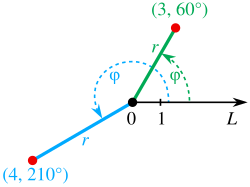
The diagram shows how the same point can be described in polar form by and in rectangular form by , with and interpreted as projections of the radius onto the axes. This geometric projection viewpoint is exactly why both and change with , leading to the parametric-derivative quotient . Source
= horizontal rectangular coordinate
= vertical rectangular coordinate
= radius as a function of angle
= angle, usually measured in radians
Because is a function of , differentiating these expressions requires the product rule. A frequent error is to differentiate only the trig part and forget that the radius itself is changing.
The Formula for
Once the curve is viewed parametrically, the slope is found the same way as for parametric equations: divide the rate of change of by the rate of change of . This gives the slope of the tangent in the rectangular plane.
= slope of the curve in rectangular coordinates
= rate of change of with respect to
= rate of change of with respect to
This quotient is valid when . If the denominator is zero, the slope is not an ordinary finite number, so the tangent may be vertical or may need further investigation.
When you substitute the expressions for and , you get a formula entirely in terms of , , and .
= derivative of the radius with respect to the angle
This form is especially useful on AP problems because the curve is usually given as an explicit polar equation, so can be found directly.
Why the Formula Makes Sense
The derivative compares how fast the vertical coordinate changes with how fast the horizontal coordinate changes. In polar form, neither coordinate is given directly as a function of the other, but both are controlled by the same parameter . Comparing their instantaneous rates at the same angle gives the correct slope.
Each derivative has two parts. Terms involving come from the radius changing, while the terms involving and come from the point rotating as the angle changes. This means the slope can change for two different reasons: the point may be moving farther from the origin, or its direction may be turning, or both at once.
Process for Finding
Start with the given polar equation and identify .
Differentiate to find .
Use the product rule formulas for and .
Form the quotient .
Simplify only as much as needed to evaluate or interpret the slope.
If a specific angle is given, substitute that value after differentiating unless early substitution is clearly safe.
Keeping the derivative in quotient form is often strategic. It makes it easier to test whether the numerator or denominator is zero, which is important when interpreting tangent behavior.
Strategic Simplification
After differentiating, decide whether factoring or expanding is more helpful. Factoring is usually better when you want to find where the slope is zero or undefined, because zeros are easier to read from a factored expression. Expanding or using trig identities can be better when you need the numerical value of the slope at a particular angle. There is no single required final form, but every algebraic step must preserve the original denominator restrictions. A correct unsimplified quotient is often clearer than an over-simplified one.
Interpreting What the Derivative Tells You
The value of gives local information about how the curve behaves in the rectangular plane.
If , the curve is increasing from left to right at that point.
If , the curve is decreasing from left to right at that point.
If and , the tangent is horizontal.
If and , the tangent is vertical.
These conditions are often more useful than a fully simplified expression. On many exam questions, the goal is not just to compute a derivative but to use it to describe the graph’s behavior at selected angles.
Common Pitfalls
Ignoring that is a function of : this causes missing product-rule terms.
Mixing up and : they measure different kinds of change.
Substituting an angle too early: this can hide structure that helps with simplification or tangent analysis.
Forgetting denominator restrictions: a zero denominator means the slope formula cannot be treated as a finite quotient.
Over-simplifying trigonometric expressions: algebraic mistakes can change the sign of the slope or remove important zero values.
Losing the geometric interpretation: the final answer describes a rectangular slope, even though the curve is given in polar form.
Practice Questions
For the polar curve , write an expression for in terms of .
1 mark for finding
1 mark for a correct derivative expression, such as or any equivalent form
For the polar curve :
(a) Find and .
(b) Find all values of in for which the tangent is horizontal.
1 mark for
1 mark for or an equivalent form such as
1 mark for or an equivalent form such as
1 mark for solving to get the candidates
1 mark for checking and concluding that the horizontal tangents occur at
FAQ
At the pole, slope can be more delicate because several angles may describe the same physical point.
If direct substitution gives both $\dfrac{dx}{d\theta}=0$ and $\dfrac{dy}{d\theta}=0$, the usual quotient test is inconclusive. In that case, you need to inspect nearby values of $\theta$ or use a local expansion to determine the tangent behaviour.
Yes. This can happen at self-intersections or when the same point is traced more than once.
In polar form, the slope depends on the parameter value as well as the location. If two different angles produce the same Cartesian point, you should evaluate $\dfrac{dy}{dx}$ at each angle separately, because the tangents may be different.
Algebraically equivalent expressions for $r$ can produce derivative formulas that look different after product rule and trigonometric simplification.
That does not mean one is wrong. If the equations represent the same curve and the algebra is valid, the derivative expressions should agree after simplification or when evaluated at the same angle.
An undefined slope alone is not enough to settle the issue.
If $\dfrac{dx}{d\theta}=0$ and $\dfrac{dy}{d\theta}\neq 0$, the tangent is vertical.
If both are zero, the point may be a cusp, a repeated point, or another special case.
In the second situation, examine nearby parameter values rather than relying on the quotient alone.
No. In fact, doing that is usually inefficient and may be impossible.
For AP Calculus BC, it is normally enough to write $x=r\cos\theta$ and $y=r\sin\theta$, then differentiate with respect to $\theta$. That approach is faster, cleaner, and better suited to curves that are naturally described in polar form.