AP Syllabus focus: 'The concept of calculating areas in rectangular coordinates extends to polar coordinates, including the area of a single petal of a rose curve or inner loop of a limaçon.'
These notes show how polar area integrals isolate one rose petal or one inner loop of a limaçon by choosing the correct angular interval and interpreting how the curve is traced.
Why the interval matters
For polar area, the formula itself is straightforward, but the main challenge is choosing the correct bounds. When the problem asks for the area of one petal or one inner loop, you should not automatically integrate over an entire period such as . Instead, you must identify the smaller interval that traces only the requested region exactly once.
A rose petal or an inner loop is usually traced from one time the curve passes through the pole to the next time it passes through the pole. That makes solving a central step in these problems.
Rose curve: A polar curve commonly written in the form or that forms repeated petal-shaped regions.
The area setup for petals and loops uses the same polar area formula as any other single polar region.
= area in square units
= polar radius as a function of
= angle bounds that trace exactly one petal or one inner loop
= angle in radians
Because the integrand contains , a negative value of does not make the area negative. The real issue is whether your chosen interval traces the desired region once, or whether it overlaps or retraces part of the curve.
Area of a Single Rose Petal
Rose curves are especially suited to symmetry, but symmetry should support your reasoning rather than replace it. The safest approach is to identify one petal by looking for consecutive angles where and checking that the curve starts at the pole, reaches a maximum distance from the pole, and returns to the pole without tracing a different petal.
For common rose curves:
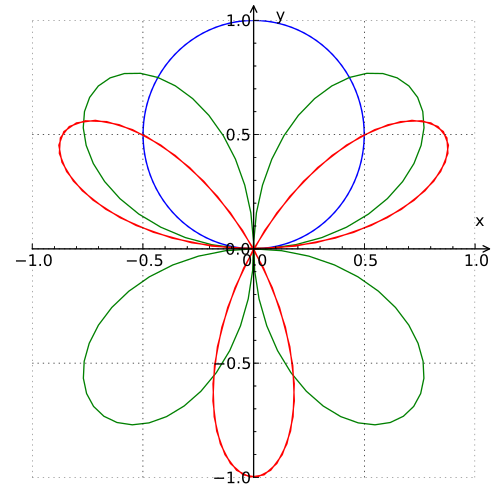
The red curve is the 3‑petal rose , a standard example where each petal is traced between consecutive solutions of . Viewing the full graph helps you see why integrating over an entire period can count multiple petals, while a smaller angle interval isolates a single petal. Source
and generate repeated petals.
If is odd, the graph has petals.
If is even, the graph has petals.
Those facts help with graph recognition, but the area of one petal still depends on the interval that traces just that petal.
Choosing bounds for one petal
Use this process:
Solve .
Find two consecutive solutions that bound one petal.
Check that the curve stays on that same petal between those angles.
Apply over that interval.
For rose curves, consecutive zeros of often mark the beginning and end of a petal. Between those zeros, the curve typically moves out from the pole and back again, enclosing one petal-shaped region.
Symmetry can shorten the work:
If a petal is symmetric about an axis or line, you may integrate over half the petal and double the result.
This is only valid if your half-interval traces exactly half of the same petal.
A common AP mistake is to choose bounds that cover more than one petal, then forget that the integral gives the combined area of all petals traced on that interval.
Area of a Limaçon Inner Loop
Limaçon: A polar curve commonly written in the form or . When , the curve has an inner loop, which is a smaller closed region traced near the pole.
The inner loop of a limaçon is different from a rose petal because it is created by the curve turning inward and crossing the pole. In many cases, the loop occurs on an interval where is negative. That is not a problem for area; the formula still uses .
What matters is identifying the interval where the graph traces the inner loop and nothing else.
Choosing bounds for the inner loop
Use this process:
Solve to find where the curve passes through the pole.
Use the two relevant pole-crossing angles as the boundaries of the loop.
Check from the graph or sign pattern of that the interval traces the inner loop once.
Integrate only over that interval.
For a limaçon with an inner loop, the loop is enclosed between two angles where the curve returns to the pole. That makes those zeros of the natural endpoints for the area integral.
It is important not to confuse an inner loop with other limaçon shapes:
If , there is an inner loop.
If , the graph is a cardioid.
If , the graph does not have an inner loop.
Only the first case gives a separate inner-loop area.
Common checks and mistakes
Before evaluating an area integral, make sure your setup passes these checks:
Does the interval start and end at the pole? For petals and inner loops, that is often the correct structure.
Does the interval trace the region once? If the graph retraces, the integral may double-count area.
Are you finding one region, not the entire curve? This is the most common error.
Did you square the entire radius expression? The integrand is , not just .
Does the graph support your bounds? A quick sketch is often the best verification.
For AP Calculus BC, success on these problems comes from combining the polar area formula with careful interval selection. The formula is standard; the reasoning about the curve is what distinguishes the area of a single petal or a single inner loop from the area of a whole polar graph.
Practice Questions
For the rose curve , write a definite integral that represents the area of one petal. [2 marks]
1 mark for identifying bounds for one petal, such as consecutive zeros and .
1 mark for a correct integral, such as .
The curve is a limaçon with an inner loop. Find the area of the inner loop. [5 marks]
1 mark for solving and obtaining and .
1 mark for using the correct area integral .
1 mark for a correct antiderivative or equivalent simplification.
1 mark for correct evaluation of the definite integral.
1 mark for the final answer .
FAQ
Polar graphs can repeat because of periodicity, and a negative radius can place a point in the opposite direction.
So two different intervals may trace the same geometric petal. What matters is that the chosen interval traces that petal once and only once, not that there is only one possible interval.
For $r=a+b\cos\theta$ or $r=a+b\sin\theta$, compare $|a|$ and $|b|$.
If $|a|<|b|$, the curve has an inner loop.
If $|a|=|b|$, the curve is a cardioid.
If $|a|>|b|$, there is no inner loop.
This test is often quicker than relying on a sketch alone.
Polar graphs are very sensitive to settings.
A large angle step can skip key points.
An unsuitable viewing window can cut off part of the graph.
Degree mode instead of radian mode can distort the picture.
If the graph looks wrong, check the mode, window, and graph resolution before trusting the image.
Yes. A polar curve can revisit the same point because of periodicity or because positive and negative values of $r$ can describe the same location in the plane.
If your interval traces the same enclosed region twice, the area integral will count it twice as well. That is why tracing behaviour matters as much as the formula.
That usually means the curve is a cardioid rather than a looped limaçon.
A cardioid has a cusp at the pole, but it does not contain a separate inner loop. So there is no distinct inner-loop area to calculate, even though the curve still encloses a region.