AP Syllabus focus: 'Areas of regions bounded by polar curves can be calculated with definite integrals, which requires identifying intersection points of the curves.'
Finding where polar curves meet is a key setup step in many AP Calculus BC problems, because correct intersection angles determine the relevant interval and prevent missing or double-counting parts of a region.
Why intersection points matter
In polar problems, an intersection point is a physical point in the plane that lies on both curves. When you later describe a region bounded by two polar graphs, the angles of intersection usually become the interval endpoints you need. If those angles are wrong, every later step is affected.
Polar equations are more subtle than rectangular equations because the same point can have more than one polar description. As a result, finding intersections is not just solving one equation and stopping. You must also decide whether different angle values represent the same location, and whether the pole should be included as a shared point.
What it means for two polar curves to intersect
A point on a polar curve is written as . Two polar curves intersect when they pass through the same point in the plane. Very often this happens when both curves give the same radius at the same angle, but that does not always capture every case.
One especially important point is the pole.
Pole: The origin in polar coordinates, represented by for any angle .
Because every angle corresponds to the pole when , the origin can be an intersection even if the two curves reach it at different angle values. This is a common AP mistake: students solve for equal radii and forget to check whether both curves also pass through the origin separately.
Polar coordinates are also not unique.
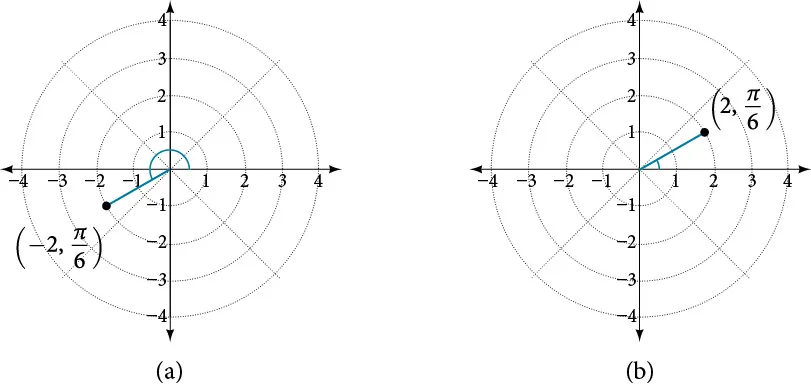
This figure illustrates how a negative radius changes the plotted location: lands on the ray opposite at distance from the pole. Visually, it reinforces the identity that the same point can be written as or , which is a common source of “missed” intersections if you only match radii at the same angle. Source
The point can be represented again by , where is any integer, and also by . That means equal points do not always come from identical-looking coordinates.
Standard algebraic approach
For most AP Calculus BC questions, the first step is to set the two radius functions equal and solve on a suitable interval.
= radial value of the first curve
= radial value of the second curve
= angle being tested, in radians
This equation gives candidate intersections where both curves produce the same radius for the same angle. After solving, you still need to decide whether those candidates give all distinct intersection points.
A reliable process is:
Choose an interval that captures the relevant tracing of both curves, often unless a smaller interval traces the full graph.
Solve algebraically.
Check whether each curve can equal , so the pole is not overlooked.
Use the graph or symmetry to see whether some angle solutions describe the same physical point.
Report distinct points in the plane, not just distinct values of .
In many AP-style questions, the algebraic equation gives the non-origin intersections, while a separate pole check completes the list.
Key complications to watch for
Intersections at the pole
If both curves pass through the pole, then the origin is an intersection even when the matching angles are different. One curve might have at , while the other has at . Those are different parameter values, but they describe the same physical point.
That is why solving only can miss an answer. Whenever a polar equation contains factors that may become zero, checking separately is a good habit.
Same point, different polar descriptions
Sometimes one curve reaches a point with a positive radius, while the other reaches the same point using a negative radius at a different angle. In that situation, the curves intersect, but the intersection may not appear from the equation alone.
For AP Calculus BC, the best response is usually practical rather than overly theoretical:
sketch or inspect the graphs,
notice whether negative values occur,
verify suspicious points instead of trusting one algebraic step blindly.
Curves traced more than once
Some polar curves revisit the same point as changes. If you solve an equation and get several angle values, some of them may correspond to a point already counted. A correct answer lists distinct intersections in the plane, not every parameter value that lands there.
This matters especially on symmetric graphs. An equation may produce angles that differ by , but if one radius is negative, those two descriptions can represent the same physical point.
How to verify your intersection set
Good verification prevents lost points on free-response work. Useful checks include:
Graph behaviour: Does the picture suggest the same number of intersections you found?
Symmetry: If both curves are symmetric, do your answers reflect that pattern?
Pole check: Did you test on each curve separately?
Distinct points: Are you listing physical points rather than repeating the same point with different coordinates?
Reasonable interval: Did you solve on an interval that traces the needed parts of each graph?
If your answer does not match the visual behaviour of the curves, revisit the interval choice and the pole before redoing the algebra.
Common AP mistakes
Treating equal angle values as the only way two polar curves can meet.
Forgetting that the pole can be shared even when the angles are different.
Listing every angle solution without checking whether some describe the same point.
Solving on too small an interval and missing valid intersections.
Trusting calculator output without considering how the curves are traced.
Practice Questions
The polar curves and intersect.
Find all intersection points for . [3 marks]
1 mark for setting and obtaining
1 mark for identifying the non-pole intersection as
1 mark for checking on both curves and stating that the pole is also an intersection
The polar curves and intersect.
(a) Solve for all values of satisfying on .
(b) Determine the distinct non-pole intersection point(s).
(c) State whether the pole is also an intersection, and justify your answer. [5 marks]
1 mark for rewriting as
1 mark for finding and
1 mark for recognizing that these two angle values represent the same physical non-pole point
1 mark for giving the distinct non-pole intersection point as or an equivalent polar description
1 mark for stating that the pole is also an intersection because and each have solutions, so both curves pass through
FAQ
Start by looking for the period of the trigonometric expression in $r=f(\theta)$.
Then use symmetry:
many curves with sine or cosine can be traced on less than $0\le\theta<2\pi$,
a rose $r=a\cos(n\theta)$ or $r=a\sin(n\theta)$ is often fully traced on $0\le\theta<\pi$ when $n$ is odd,
when $n$ is even, $0\le\theta<2\pi$ is usually safer.
If you are unsure, use a graph and check whether points begin repeating before the interval ends.
A calculator depends on plotting resolution, window settings, and how it handles negative $r$ values.
Possible issues include:
the trace skipping over a narrow intersection,
the window cutting off part of a graph,
the device plotting the same physical point more than once because of repeated tracing,
numerical rounding near the pole.
Use the calculator as evidence, not as your only method. Algebra and a quick sketch should confirm what the screen suggests.
First, simplify as much as possible and look for symmetry.
If an exact solution still does not appear, a numerical approximation may help:
graph both curves,
estimate the relevant interval,
use a numerical solver for the equation in $\theta$,
check each solution against the graph.
If the problem is from an AP-style setting, exact answers are usually intended when they exist. Numerical work is most useful for checking or for understanding the graph’s structure.
A dependable method is to compare rectangular coordinates.
Compute:
$x=r\cos\theta$
$y=r\sin\theta$
If both values match for two solutions, they describe the same point in the plane.
You can also use the polar identity that $(r,\theta)$ and $(-r,\theta+\pi)$ represent the same location. This is often quicker when one of the radii is negative.
Yes. A tangential intersection happens when the curves touch at a point without clearly crossing there.
This matters because:
a graph may make the intersection hard to notice,
an algebraic equation may produce a repeated root,
the curves can appear to have fewer crossings than expected even though they still share a point.
When the picture suggests touching rather than crossing, inspect the candidate angle carefully and verify the physical point, especially near the pole or on highly symmetric graphs.