

AP Syllabus focus: 'Areas of regions bounded by polar curves can be calculated with definite integrals.'
Finding area between polar curves extends the basic polar area idea by comparing two radii over the same angle interval and integrating the resulting difference in sector areas.
Core Idea
When two polar curves bound a region, the area is found by looking at a small sector for each angle in the interval. For that angle, one curve lies farther from the pole and the other lies closer to the pole. The bounded area comes from subtracting the smaller sector from the larger one.
This leads to an important idea: in polar coordinates, area depends on the square of the radius, not just the radius itself.
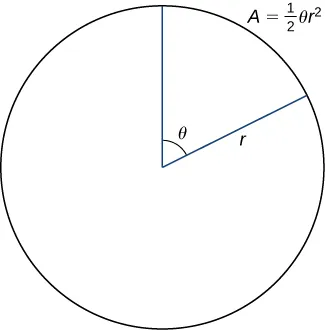
A circular sector of radius and central angle (in radians) has area . This picture is the geometric reason polar-area integrals involve rather than . Source
That is why the formula uses a difference of squares.
Area between two polar curves: The area enclosed by two polar curves over an interval of , found by subtracting the inner radial contribution from the outer radial contribution.
A correct setup depends on identifying which function is the outer curve and which is the inner curve on the interval being used.
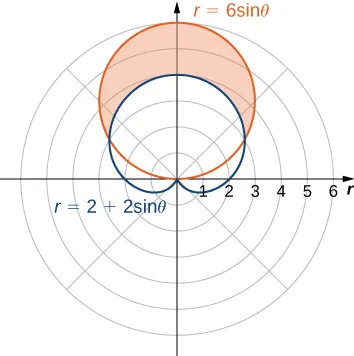
A shaded region is shown “inside” one polar curve and “outside” another, illustrating the outer-versus-inner radius comparison at each angle . Visually, the area between curves is computed as the area from the outer boundary minus the area from the inner boundary over the same angular interval. Source
If that relationship changes, the integral must also change.
The Area Formula
If one curve stays outside the other for the entire interval from to , then a single definite integral can be used.
= area of the region, square units
= starting and ending angles, in radians
= outer radius on
= inner radius on
The limits of integration must describe the portion of the graph that actually forms the boundary of the region. A correct formula with incorrect bounds still gives the wrong area.
In AP Calculus BC, this is usually a definite integral setup problem first and an evaluation problem second. The structure of the region matters as much as the computation.
Why the Squares Matter
A thin polar sector with radius and small angle width has area approximately . For a region between two curves, the small area slice is therefore
larger sector: based on the outer radius
smaller sector: based on the inner radius
bounded slice: the difference of those two sector areas
That geometric idea explains why the formula is not based on alone.
Choosing the Outer and Inner Curves
To decide which curve is outer, compare their radial values at the same angle over the interval being considered. The curve with the greater radius is the outer curve for that part of the interval.
This comparison must be made on the exact interval used in the integral. A curve may be outer on one interval and inner on another. Because of that, it is not enough to identify a “bigger” curve globally.
Useful habits when setting up the integral include the following:
sketch or inspect the curves on the intended interval
check which radius is larger for representative angles
confirm that the chosen interval traces the bounded region once
keep the subtraction in the order outer minus inner
If the order is reversed, the integrand becomes negative even though area must be nonnegative. That usually signals that the outer and inner curves were assigned incorrectly.
When You Must Split the Integral
Some regions cannot be handled by one integral because the curves switch roles. In that case, the area must be written as the sum of two or more definite integrals, each using the correct outer-minus-inner order.
Many AP questions require this step because a single subtraction order is not valid across the whole interval.
= endpoints of the full angular interval, in radians
= angle where the outer and inner roles switch
= the two polar functions being compared
This piecewise approach is often the difference between a correct and incorrect setup. Even if both curves appear in the same picture, the area formula must respect how the boundary behaves across the interval.
Interpreting the Definite Integral
The definite integral adds up many thin polar slices. Each slice represents a small wedge-shaped piece of the region. This interpretation helps with error checking:
if the region is small, the integral should not produce an unrealistically large number
if the two curves are close together, the integrand should also be relatively small
if the bounded region is made of separate pieces, the setup usually needs multiple integrals
Because the formula is geometric, the final answer should be expressed in square units.
Common Errors to Avoid
Frequent Setup Mistakes
Subtracting radii instead of squared radii
The polar area formula is based on sector area, so is essential.Using the wrong outer curve
Always compare the curves on the interval being integrated.Forgetting to split the interval
If the curves switch order, one integral is not enough.Using bounds that trace the region more than once
This leads to double counting.Working in degrees while integrating with respect to
Definite integrals in calculus are interpreted in radians.
Good Final Checks
Before evaluating, ask:
Does the integrand stay nonnegative?
Do the bounds match the bounded region?
Does each part of the region get counted exactly once?
Have outer and inner curves been chosen correctly on every interval?
Practice Questions
The region is bounded by the polar curves and for . Write, but do not evaluate, a definite integral that gives the area of .
1 mark for using the polar area-between-curves structure
1 mark for the correct integral:
The polar curves and bound a region for .
(a) State the interval on which is the outer curve and the interval on which is the outer curve.
(b) Find the area of the region between the curves for .
1 mark for identifying that the switch occurs at
1 mark for stating that is outer on
1 mark for stating that is outer on
1 mark for a correct split-area setup:
1 mark for correct evaluation to
FAQ
Negative $r$ values can be tricky because the plotted point lies in the opposite direction from the angle shown.
That means you should not compare raw algebraic values of $r$ alone. Instead, look at the actual graph and decide which curve forms the outer boundary of the region.
If negative radii appear, it is often safest to:
sketch carefully
use technology to trace the curve
check whether the same geometric point is being represented in a different way
Polar graphs depend heavily on window settings, angle increments, and plotting resolution.
A calculator may:
miss a small loop
make two curves seem not to intersect
draw a boundary with gaps
suggest the wrong outer curve on part of the interval
If the picture seems suspicious, change the viewing window and reduce the step size.
For AP-style work, the graph is a guide, not final proof.
Symmetry can reduce computation and help you check your setup.
For instance, if the region is symmetric about the polar axis or the line $\theta=\dfrac{\pi}{2}$, you may be able to find half the area and double it.
However, only use symmetry if:
the two curves share that symmetry
the chosen interval captures exactly one symmetric piece
doubling or quadrupling will not create overlap
Symmetry is especially useful for checking whether an answer is reasonable.
Yes. Polar coordinates are not unique, so the same geometric curve can be written in more than one way.
For example, a point may be represented by:
a positive radius at angle $\theta$
a negative radius at angle $\theta+\pi$
This matters for bounded regions because one equation might trace a boundary once, while another traces the same points in a less obvious order.
When this happens, focus on the actual enclosed region rather than the appearance of the formulas.
A finite area requires a closed boundary over a finite interval of $\theta$.
Warning signs that the region may not be finite include:
the curves do not reconnect to form a closed shape
one curve keeps extending outward
the interval does not capture a complete enclosed piece
A quick check is to ask whether every ray in the interval hits both boundaries and whether the endpoints of the interval close the region.
If not, the integral may describe an open set rather than a bounded one.
