AP Syllabus focus: 'Areas of regions bounded by two polar curves, such as regions inside one curve and outside another, can be calculated with definite integrals.'
When a polar region lies inside one curve but outside another, the main challenge is identifying the correct angle interval and comparing the two radial distances in that interval before integrating.
Interpreting the Region
The phrase inside one curve and outside another describes a polar region formed by two radial boundaries.
Inside one curve and outside another: A polar region consisting of all points whose distance from the origin is less than or equal to one curve’s radius and greater than or equal to another curve’s radius for the same angle.
In polar coordinates, a point is located by an angle and a radius . For a fixed angle, the region usually begins at the inner curve and ends at the outer curve.
That means the area is built from thin sectors rather than vertical or horizontal strips.
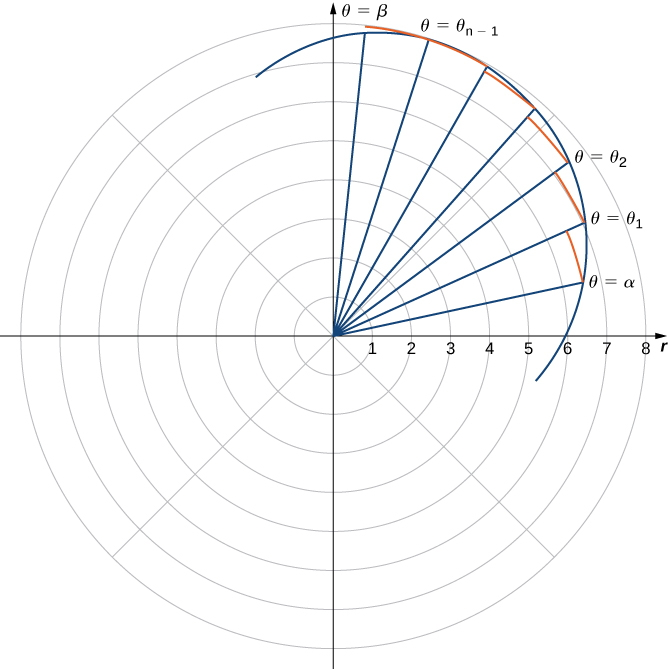
A shaded polar region approximated by circular wedges (sectors), making the area computation feel like a Riemann sum in . This picture motivates why polar area uses sector areas and leads naturally to integrals involving rather than rectangular strips. Source
A correct setup depends on the part of the graph that actually satisfies both conditions at once:
the point must be inside the designated outer curve
the point must be outside the designated inner curve
the point must lie in the angle interval where the region is truly enclosed
This is why a sketch is so important. The algebra alone may not show which part of the curves creates the required region.
Area Formula for This Situation
For polar area problems of this type, the area comes from subtracting the area swept out by the inner curve from the area swept out by the outer curve over the same interval.
= area in square units
= radius of the curve farther from the origin on
= radius of the curve closer to the origin on
= angle bounds in radians
This formula works only when the same curve stays outer and the same curve stays inner throughout the entire interval. If the curves switch roles, one integral is not enough.
Choosing the Correct Angle Bounds
The angle bounds must match the region you want, not just any convenient interval. In problems about being inside one curve and outside another, the bounds usually come from the angles where the region starts and stops being enclosed.
A strong setup usually follows this logic:
identify the relevant portion of each curve from the graph
determine where the desired region exists
use the angles that bound exactly that region
check whether the region is continuous or split into separate pieces
If the region appears in two disconnected parts, you must add two integrals. Do not force a single integral over an interval where the description changes.
Determining Which Curve Is Outer and Which Is Inner
At each angle in the chosen interval, compare the two radii:
the larger radius is the outer boundary
the smaller radius is the inner boundary
This comparison must be made on the actual interval of interest. A curve that is outer on one interval may become inner on another. That is one of the most common reasons students lose points.
It helps to think geometrically: for a fixed , move outward from the origin. The first boundary you hit is the inner curve. The second boundary you hit is the outer curve. The region between those two hits is the part being measured.
When You Must Split the Integral
Sometimes the requested region is still described as “inside one curve and outside another,” but the boundary relationship changes across the graph. In that case:
find where the change occurs
break the region into pieces
write a separate integral for each piece
add the results
A single expression such as should never be used over an interval where it becomes negative unless the geometry truly supports that setup. Area must come from outer minus inner, piece by piece if necessary.
Symmetry and Efficiency
Symmetry can simplify the work, but only after you verify that the region itself is symmetric, not just the individual curves. If one half of the region is a mirror image of the other, you may:
integrate over one symmetric portion
multiply by the correct factor
This saves time, but it is safe only when the angle interval and the inside-outside description match perfectly on both sides.
Common Pitfalls
Students often make these mistakes:
using the intersection angles of the full curves instead of the bounds of the requested region
subtracting in the wrong order and getting a negative value
assuming the region exists for every angle between two intersections
forgetting to split the area when the outer curve changes
using symmetry without checking the actual enclosed region
AP Exam Strategy
On an AP Calculus BC problem, a reliable approach is:
sketch both polar curves
mark the region that is inside one and outside the other
identify the angle interval or intervals for that exact region
decide which radius is outer and which is inner on each interval
write the area as
evaluate only after the setup is correct
Most errors happen before integration begins, so careful geometric interpretation is just as important as correct calculus.
Practice Questions
The region is inside the polar curve and outside the circle . Write, but do not evaluate, a definite integral for the area of .
1 mark for correct bounds: to
1 mark for correct area integral:
The region is inside the curve and outside the circle .
(a) Find the angles where the curves intersect.
(b) Write a definite integral for the area of .
(c) Find the exact area of .
1 mark for setting intersections equal:
1 mark for correct intersection angles:
1 mark for correct integral setup:
1 mark for correct simplification or antiderivative
1 mark for correct exact area:
FAQ
Treat each piece as its own polar area problem.
Find the angle interval for the first piece, write its area integral, then do the same for the second piece. Add the two results at the end.
Do not use one large interval unless the same outer curve and inner curve remain valid throughout. If the region disappears or the curves switch roles in the middle, a single integral will misrepresent the geometry.
Check the region itself, not just the equations.
A useful test is to ask whether reflecting the shaded part across an axis or rotating it gives an identical region with the same bounds and the same inside-outside description. If yes, symmetry may reduce the work.
If the curves are symmetric but the requested region uses only one portion, symmetry can lead to overcounting.
That does not automatically create a problem.
It simply means that for some angles the inner boundary or outer boundary may be $r=0$. The area formula still works, provided you choose the correct interval and compare the radii carefully.
The main issue is geometric: near the origin, regions can open or close quickly, so the sketch becomes especially important.
Negative $r$ values can place points in the opposite direction from the given angle, so they may change how the graph is interpreted.
In these situations, relying only on the formula in the equation can be misleading. A graph or careful plotting helps you see the actual location of the curve and whether a point is genuinely inside or outside the region being asked for.
This is why a visual check is especially valuable when negative radii appear.
Use three checks:
Your bounds should trace exactly the shaded region.
The expression $r_{outer}^2-r_{inner}^2$ should stay nonnegative on the interval.
The region described by your integral should match the graph point-by-point for a typical angle.
If any of these fail, the setup is probably wrong even if the calculus steps are correct.