

AP Syllabus focus:
‘This section will focus on the explanatory variable, defined as the variable whose values are used to explain or predict corresponding values for the response variable. It will discuss how to identify an explanatory variable in a dataset and its significance in bivariate analysis.’
Understanding the Explanatory Variable
The explanatory variable plays a central role in studying relationships between two quantitative variables, guiding how one variable may help predict or explain changes observed in another.
The Role of the Explanatory Variable in Bivariate Analysis
When analyzing bivariate quantitative data, researchers examine two numerical variables measured on the same individuals to explore how they relate. One variable is designated as the explanatory variable, and the other becomes the response variable. The explanatory variable is introduced as the variable whose values are used to explain or predict corresponding values for the response variable, making it essential in establishing directionality in statistical investigations.
Explanatory Variable: The variable whose values are used to explain, predict, or account for changes in another variable, known as the response variable.
After identifying the explanatory variable, analysts explore how changes in this variable correspond to patterns in the response variable. This relationship helps frame questions such as whether increases, decreases, or variations in one factor may be associated with changes in the other.
Identifying the Explanatory Variable
In many studies, context determines which variable should be treated as explanatory. The designation is not always inherent to the numerical values themselves; instead, it reflects the research purpose.
Common guiding principles include:
Temporal precedence: If one variable naturally occurs before another, the earlier variable typically serves as the explanatory variable.
Predictive intent: If the goal is to predict or estimate one quantity from another, the predicting variable is the explanatory variable.
Contextual reasoning: In observational studies where prediction is not strictly required, the variable believed to influence or relate to changes in the other may be treated as explanatory.
Even when relationships are explored without experimental control, assigning roles helps clarify interpretation and organize the analysis.
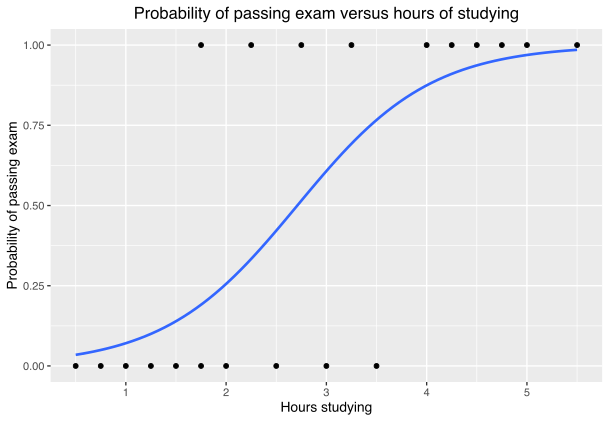
This logistic regression graph illustrates how an explanatory variable (hours studying) can be used to predict a response variable (probability of passing), visually reinforcing the idea of directional interpretation in bivariate analysis. Source.
Distinguishing Explanatory and Response Variables
The response variable, introduced alongside the explanatory variable, is the outcome being measured or predicted. It is particularly important to recognize that the choice of explanatory variable does not imply causation. This aligns with the broader understanding in statistics that associations do not automatically demonstrate cause-and-effect relationships.
Response Variable: The variable that measures an outcome or result, often examined to determine how it changes in relation to an explanatory variable.
This conceptual distinction supports clearer communication and analysis, especially when representing the relationship visually or quantitatively.
Using the Explanatory Variable in Graphical Analysis
When creating a scatterplot—one of the primary tools for analyzing relationships between quantitative variables—the explanatory variable appears on the x-axis, while the response variable appears on the y-axis.
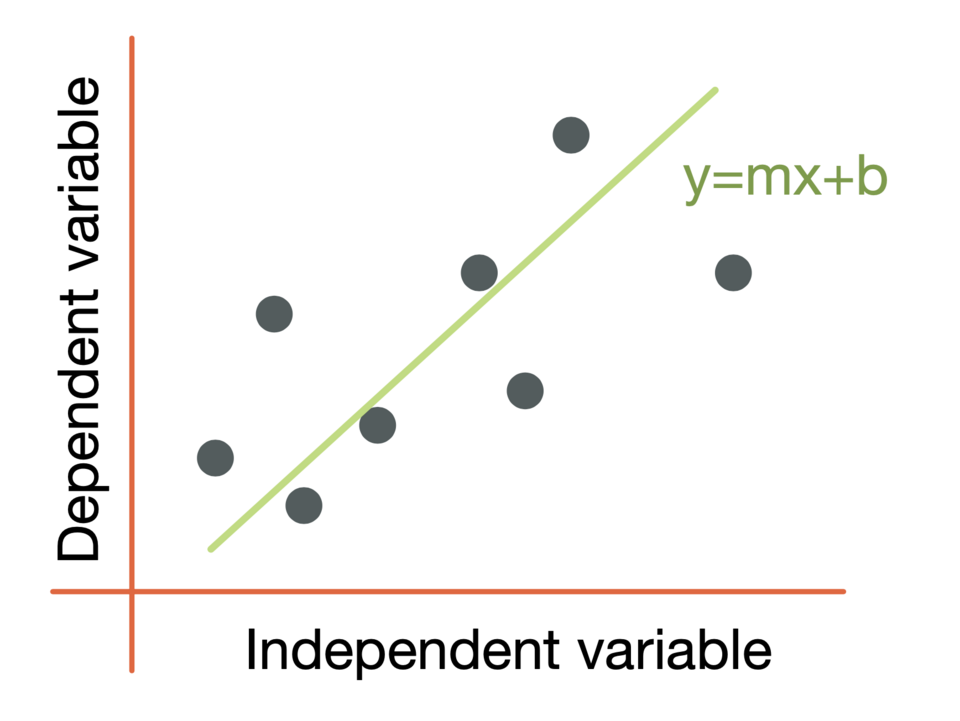
This scatterplot demonstrates how the explanatory variable is placed on the horizontal axis and the response variable on the vertical axis, establishing visual direction in quantitative data analysis. The fitted regression line slightly exceeds the specific focus of this subsubtopic but provides helpful context for understanding variable roles. Source.
Key reasons for this arrangement include:
It visually frames the predictive relationship.
It supports interpretation of direction, form, and strength of association.
It prepares the dataset for future procedures such as correlation or regression.
Although graphical placement reinforces directionality, it remains essential to remember that such directionality does not establish proof of causation.
Significance of the Explanatory Variable in Interpretation
Designating an explanatory variable provides structure for interpreting trends and assessing potential associations:
Analysts can describe whether increases in the explanatory variable are associated with increases or decreases in the response variable.
Patterns in the scatterplot can suggest potential linear or nonlinear relationships that may warrant further analysis.
The roles of explanatory and response variables become foundational in later topics such as correlation, regression, and residual analysis.
By setting the stage for more advanced tools, the explanatory variable helps organize thinking about how variables relate and how predictions may be formed, even when no causal mechanism is implied.
Importance in Research Question Development
For many investigations, identifying the explanatory variable is the first step to developing meaningful statistical questions. Assigning this role encourages clarity in inquiry, such as:
What variable might reasonably explain variation in the outcome?
Which variable is more logical to treat as a predictor in context?
How will defining these roles guide subsequent stages of analysis?
Clarity in variable roles ensures consistency across graphical displays, numerical summaries, and modeling techniques.
Practical Considerations When Assigning Variable Roles
While some datasets clearly suggest a natural explanatory variable, others require analytical judgment. Researchers should consider:
Whether switching the roles would confuse interpretation.
Whether external knowledge indicates one variable likely influences the other.
Whether the analytical goal centers on explanation, prediction, or general association.
Once assigned, these roles remain consistent throughout the analysis to maintain coherence and interpretive accuracy.
FAQ
When influence could run in either direction, statisticians rely on contextual knowledge rather than numerical patterns. For example, biological, psychological, or economic reasoning can guide which variable is more defensibly treated as explanatory.
Another approach is to consider which variable would be more practical to measure or manipulate in a hypothetical study, as this often suggests a natural explanatory role.
Yes. Although this subsubtopic focuses on quantitative pairs, an explanatory variable can be categorical if the researcher is examining differences in a quantitative response across distinct groups.
Typical uses include comparing mean outcomes for levels of a categorical factor, though this moves away from scatterplots and into grouped numerical summaries.
Correlation itself does not depend on which variable is designated explanatory, because correlation is a symmetric measure.
However, the interpretation of the relationship becomes clearer when one variable is framed as the potential predictor, especially when discussing real-world meaning or potential applications.
Graphical interpretation becomes more confusing because the visual cue for prediction direction is reversed.
While numerical results such as correlation remain unchanged, mislabelling can lead to incorrect or ambiguous explanations, especially when someone infers the direction of the association directly from the plot.
The distinction helps structure the thinking behind research questions by clarifying which variable’s variation is of primary interest and which may provide insight into that variation.
It also ensures consistency across displays, summaries, and reasoning, making the analysis easier to communicate and interpret even in purely exploratory work.
Practice Questions
Question 1 (1–3 marks)
A researcher records the number of hours per week that students spend reading (Variable X) and their corresponding vocabulary test scores (Variable Y).
(a) Identify which variable should be treated as the explanatory variable.
(b) Briefly justify your choice.
Question 1
(a) 1 mark for correctly identifying hours spent reading as the explanatory variable.
(b) 1–2 marks for a justification such as:
• The researcher is using reading hours to explain or predict vocabulary scores. (1 mark)
• Reading time is logically the factor that precedes and may influence vocabulary development. (1 mark)
Maximum: 3 marks
Question 2 (4–6 marks)
A study investigates whether the amount of daily screen time (in hours) can explain differences in students’ levels of reported eye strain (measured on a numerical scale).
(a) State which variable should be considered the explanatory variable and which should be considered the response variable.
(b) Explain why assigning these roles is useful when analysing bivariate quantitative data.
(c) Describe one circumstance in which the roles of explanatory and response variables might be unclear or difficult to assign.
Question 2
(a) 1 mark for identifying screen time as the explanatory variable.
1 mark for identifying eye strain level as the response variable.
(b) Up to 2 marks for explaining usefulness:
• Helps organise the analysis and clarify which variable is used to explain or predict the other. (1 mark)
• Provides consistent interpretation when constructing graphs such as scatterplots or later steps like regression. (1 mark)
(c) Up to 2 marks for a valid circumstance, such as:
• When there is no clear temporal order between variables. (1 mark)
• When the study does not aim to predict one variable from the other and the relationship is exploratory. (1 mark)
• When external context gives no reasonable basis to assume one variable influences the other. (1 mark)
Maximum: 6 marks
