

AP Syllabus focus:
‘Detailed exploration of observational studies, focusing on their nature of not imposing treatments but observing existing variations. Differentiate between retrospective and prospective observational studies, including sample surveys, and discuss the selection process for each type to ensure unbiased, representative data collection.’
Observational studies play a central role in statistics by allowing researchers to examine relationships without influencing participants, helping reveal real-world patterns while emphasizing careful design to reduce bias.
Understanding Observational Studies
Observational studies involve collecting data by observing existing conditions rather than assigning treatments. In this type of research, investigators do not alter participants’ environments or behaviors. Instead, they record naturally occurring differences to explore relationships among variables. Because no treatment is imposed, observational studies cannot by themselves establish cause-and-effect relationships, but they are valuable for identifying patterns, associations, and trends in populations.
When first discussing observational studies, it is essential to distinguish them from experiments, in which researchers deliberately administer treatments to measure effects. Unlike experiments, observational studies often allow researchers to investigate questions that would be unethical, impractical, or impossible to study through controlled experimentation.
Core Characteristics of Observational Studies
Several defining characteristics shape the structure and interpretation of observational studies:
Researchers observe without influencing the subjects.
Existing variation among individuals becomes the primary source of differences for analysis.
Random selection may be used to obtain representative samples, though random assignment is never used.
Potential confounding variables—factors related to both explanatory and response variables—must be considered carefully because they may distort observed associations.
Because observational studies rely on naturally occurring data, they require clear planning and careful interpretation to avoid misleading conclusions.
Types of Observational Studies
Observational studies fall into several major categories, each serving a distinct statistical purpose. The three primary forms aligned with the AP syllabus are retrospective studies, prospective studies, and sample surveys.
Retrospective Observational Studies
Retrospective studies examine past behaviors, exposures, or events. Researchers look backward in time by collecting data from records, archives, or participants’ recollections.
Retrospective Study: A study that collects data about past events, exposures, or characteristics and relates them to current outcomes.
Such studies are efficient because the data already exist. However, they may be limited by incomplete records or inaccurate memory. These issues can lead to potential bias and require careful evaluation of data quality.
Prospective Observational Studies
In contrast, prospective studies track individuals forward in time. Researchers select a group at the beginning and record relevant variables as events unfold.
Prospective Study: A study that identifies subjects in the present and follows them into the future to record exposures and subsequent outcomes.
Prospective designs often produce higher-quality data because measurements follow a structured plan.
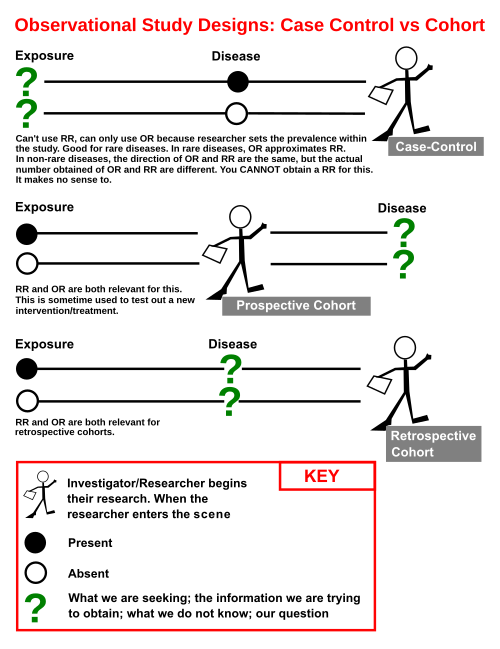
This diagram contrasts case-control studies with prospective and retrospective cohort studies, all examples of observational designs. The timelines show whether investigators begin with exposure or outcome as they move through time. The case-control portion adds context slightly beyond the AP syllabus by situating cohort studies among other observational approaches. Source.
Sample Surveys
A sample survey gathers information from a subset of a population to make inferences about the population as a whole. Surveys are a major type of observational study because they collect data without influencing participants.
Sample Survey: An observational study that collects data from a sample selected from a population, typically through a standardized questionnaire or interview process.
Sample surveys aim to obtain a representative sample so conclusions can reflect the larger population accurately.
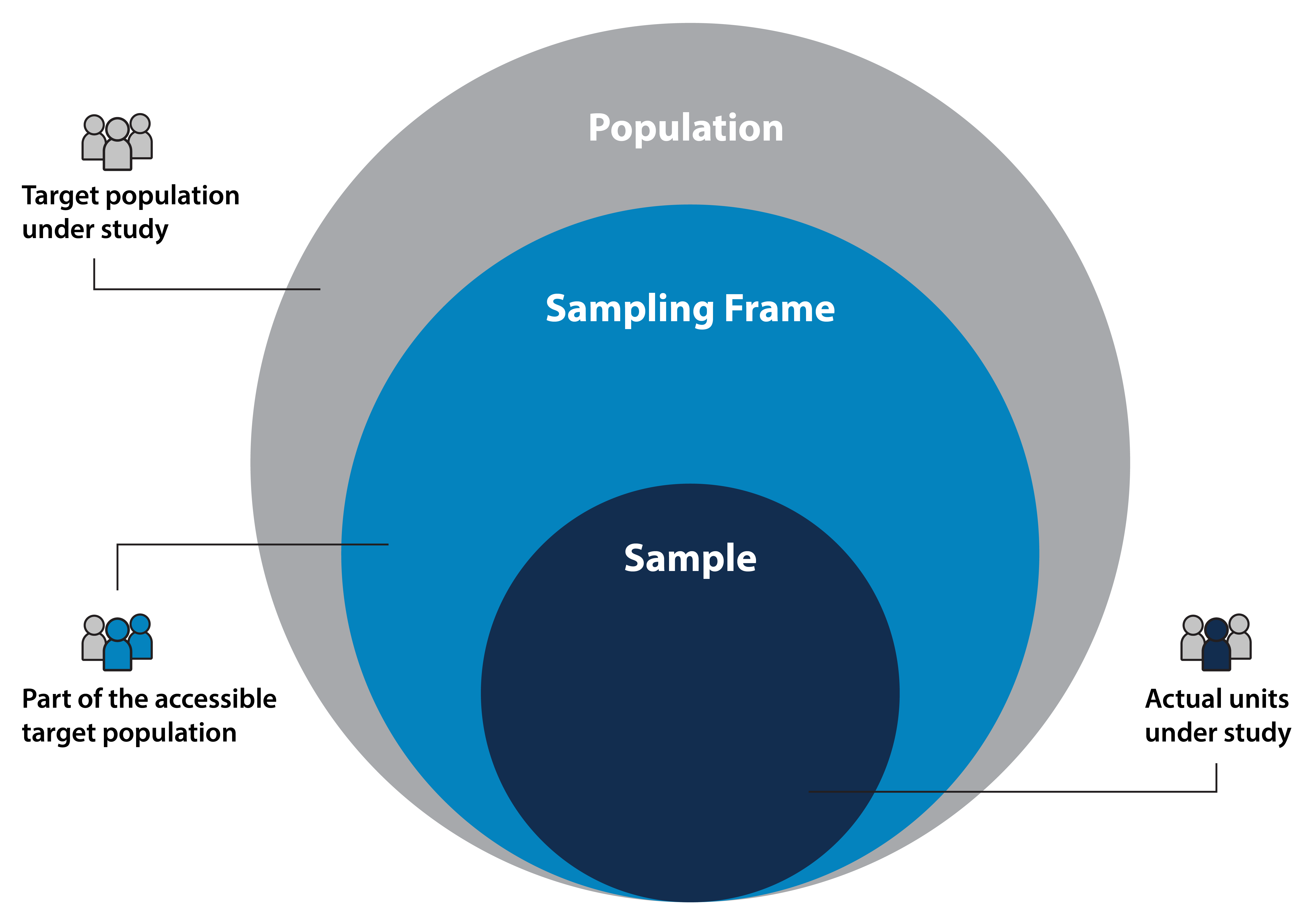
This diagram illustrates how a sample used in an observational study is nested within a sampling frame, which is itself part of the overall population. It emphasizes that only individuals in the sampling frame can be selected, and only selected individuals form the final sample. The inclusion of “sampling frame” goes slightly beyond the AP syllabus but clarifies practical limits on who can be reached during sampling. Source.
Selecting Subjects for Observational Studies
The reliability of an observational study depends heavily on how individuals are selected.
Importance of Representative Sampling
A representative sample mirrors the characteristics of the population. To achieve this, researchers should rely on random selection. Using chance procedures helps avoid bias, where certain members of the population are more or less likely to be chosen. A poorly selected sample may misrepresent the true distribution of views or behaviors.
Strategies to support representativeness include:
Using a well-defined sampling frame
Implementing random sampling methods
Avoiding convenience or voluntary response sampling
Ensuring adequate sample size proportional to the study’s goals
While observational studies cannot use random assignment, they can and should employ random selection whenever possible to strengthen generalizability.
Minimizing Bias in Observational Studies
Observational studies are particularly vulnerable to sources of bias that may distort results. Although the syllabus does not require extended detail on all forms of bias here, students should understand the relevance of minimizing confounding influences and selection distortions.
Common approaches to reduce bias include:
Clearly defining variables and measurement procedures
Collecting data consistently across all subjects
Using validated instruments or question formats in surveys
Recording potential confounders to account for them during analysis
Thoughtful planning enhances the credibility of observational findings and supports more accurate interpretation.
The Role and Limitations of Observational Studies
Observational studies are essential tools for identifying associations and describing population characteristics. Because no treatments are imposed, however, they cannot demonstrate causation. Confounding variables may create or mask apparent relationships, and the lack of controlled conditions limits the ability to isolate explanatory factors. Nevertheless, when carefully designed with representative sampling, observational studies produce valuable evidence that can guide future experiments, policymaking, or targeted investigations.
FAQ
Researchers typically weigh time, cost, and data quality. Retrospective studies are faster and cheaper because data already exist, but historical records may be incomplete or inconsistent.
Prospective studies provide more reliable and standardised measurements but require long-term commitment and larger budgets.
Researchers also consider whether the exposure of interest can be measured accurately only in real time, which often favours a prospective design.
Although confounding cannot be eliminated fully, researchers may reduce its influence through:
• Collecting detailed background information to adjust for confounders during analysis
• Stratifying subjects into comparable groups based on key characteristics
• Matching individuals with similar attributes across exposure groups
Clear, consistent measurement of variables also helps minimise hidden sources of variation.
Many research questions involve ethical or practical constraints. For example, assigning harmful behaviours as treatments in an experiment would violate ethical guidelines.
Observational studies allow researchers to study real-world behaviour that cannot be manipulated. They also enable examination of large-scale or long-term patterns that would be too complex or costly to test experimentally.
Researchers can enhance reliability by using clearly worded, neutral questions and piloting the survey to identify issues before full deployment.
Using consistent administration methods—such as the same mode of delivery and timing—reduces variation.
Ensuring that non-response is minimised through follow-ups and reminders helps maintain representativeness.
Observational studies often reveal associations that guide the development of hypotheses for controlled experiments.
They help identify variables worth testing and indicate patterns that may merit further investigation.
By providing evidence from real-world contexts, observational studies can highlight practical considerations—such as likely effect sizes or key subgroups—that shape the design of follow-up experiments.
Practice Questions
Question 1 (1–3 marks)
A school administrator wants to understand whether students who participate in after-school clubs tend to have higher overall wellbeing. The administrator sends a questionnaire to a randomly selected sample of students and records their responses without influencing their behaviour.
a) Identify the type of observational study being conducted.
b) Explain why this type of study cannot establish a cause-and-effect relationship.
Question 1 (1–3 marks)
a) 1 mark
Correctly identifies the study as a sample survey or observational study (either term acceptable).
b) 1–2 marks
1 mark for stating that no treatment is imposed / the researcher does not control participation.
1 mark for stating that confounding variables or naturally occurring differences prevent causal conclusions.
Total: 3 marks
Question 2 (4–6 marks)
A public health researcher wishes to investigate whether regular cycling is associated with improved cardiovascular health. They select a group of adults in 2025, record whether each person currently cycles regularly, and then monitor their health outcomes annually for the next five years.
a) Identify the type of observational study being carried out and justify your answer.
b) Describe one strength and one limitation of using this type of observational study in this context.
c) Explain why random selection is important when interpreting the findings of this study.
Question 2 (4–6 marks)
a) 1–2 marks
1 mark for identifying the study as a prospective observational study.
1 mark for justifying this by noting that participants are followed forward in time after exposure status is recorded.
b) 2 marks
1 mark for a strength (e.g., data collected systematically over time, better quality than retrospective studies).
1 mark for a limitation (e.g., time-consuming, potential confounding variables, cannot establish causation).
c) 1–2 marks
1 mark for stating that random selection helps produce a representative sample.
1 mark for explaining that this improves the ability to generalise findings to the wider population.
Total: 6 marks
