AP Syllabus focus:
‘Introduction to bias in sampling, where certain responses are systematically favored over others, influencing the reliability of study conclusions. This section will cover the concept of bias and its impact on statistical analysis, emphasizing the importance of recognizing and avoiding bias in sampling methods.’
This section introduces why recognizing bias in sampling is essential for producing trustworthy statistical conclusions. Identifying biased methods helps ensure that sample data truthfully reflect the population being studied.
Understanding Sampling Bias
Sampling bias arises when a sampling method systematically favors certain responses or groups, meaning that individuals in the population do not have equal or appropriately proportional chances of being selected. This results in a sample that is not representative of the population, which undermines the validity of any inferences drawn from the data.
Sampling Bias: A systematic error in which the method used to select a sample causes certain individuals or responses to be overrepresented or underrepresented.
Biased samples often lead to misleading estimates, distorted patterns, and incorrect generalizations. Because statistical inference relies on the accuracy of sample data, understanding how bias arises and how to avoid it is a fundamental skill in AP Statistics.
A biased sample is one that systematically favors certain individuals or responses over others, so it does not accurately represent the population.
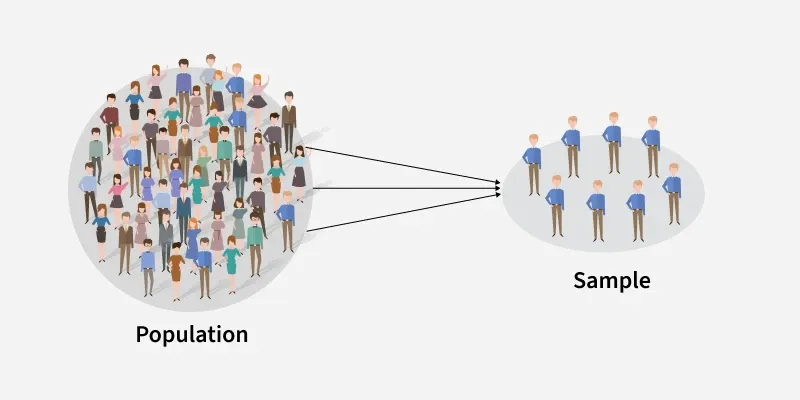
This figure illustrates how biased sampling produces a sample that does not represent the population. Individuals selected into the sample share similar characteristics, unlike the diverse population from which they were drawn. The image visually emphasizes how systematic favoritism leads to sampling bias. Source.
Why Identifying Bias Matters
Bias affects all subsequent steps in the statistical process—from describing data to performing inference. When bias is present, even large sample sizes cannot fix the underlying flaw, because the issue is rooted in how the sample was collected rather than how many individuals were measured. Recognizing biased sampling methods allows researchers to revise study designs, rely on chance-based selection, and improve the integrity of their conclusions.
Sources of Bias in Sampling
Bias can enter sampling through many pathways, especially when the method does not involve random selection. Key sources include:
Systematically Favoring Certain Groups
A method may unintentionally select individuals with shared characteristics. For example, surveying people in a single location or time frame may exclude important segments of the population.
Unequal Opportunity for Inclusion
If every member of the population does not have a realistic chance of being selected, the resulting sample may skew toward accessible, visible, or willing participants.
Human Choice in Selection
Whenever a researcher chooses participants based on judgment or convenience, the subjective decision-making process increases the chance of systematic error.
Recognizing Common Biased Sampling Methods
Several types of flawed sampling approaches frequently produce bias. Identifying them helps diagnose issues in study design.
Convenience Sampling
A convenience sample selects individuals who are easiest to reach. Because convenience often correlates with demographic, behavioral, or environmental factors, the resulting sample tends to misrepresent the population.
Voluntary Participation
Samples based on volunteers amplify the views of individuals with strong opinions or high motivation to respond, which often differ from those who choose not to participate.
Undercoverage
This occurs when some groups in the population are given less chance to be included due to limitations in the sampling frame. Undercoverage is particularly problematic when the omitted group differs meaningfully from those included.
Nonrandom Sampling Frames
A sampling frame that excludes part of the population from the start generates bias because individuals outside the frame cannot be selected at all.
How to Detect Bias in Sampling Methods
Identifying bias requires evaluating both the sampling design and the practical process of selecting individuals. Key diagnostic questions include:
Does every member of the population have a chance of being selected?
If not, there is potential for undercoverage or favoritism.Is chance used to select participants?
Methods that do not rely on chance increase the risk of systematic error.Does the method depend on self-selection?
Voluntary response sampling almost always leads to bias.Are certain locations, times, or groups excluded or overrepresented?
Biased representation leads directly to skewed results.Could researcher judgment influence which individuals are chosen?
Human choice introduces subjectivity, which can distort the sample.
The Impact of Sampling Bias on Statistical Analysis
Bias affects every stage of the statistical cycle. Its consequences include:
Distorted Estimates
If certain responses are systematically favored, calculated statistics such as means, proportions, or regression estimates will not reflect the true population values.
Compromised Generalizability
Biased samples cannot support valid generalizations because they do not accurately mirror the population.
Reduced Reliability of Inference
Core inferential tools assume random sampling. Biased sampling violates this assumption, making probability-based statements about the population invalid.
Misleading Patterns
Trends observed in biased samples may falsely suggest relationships or conceal real ones, guiding researchers toward incorrect conclusions.
Strategies to Avoid Sampling Bias
While identifying bias is important, preventing it is equally essential for producing credible results. Key strategies include:
Use random sampling techniques whenever possible.
This ensures chance determines selection, not convenience or preference.Construct a complete and accurate sampling frame.
Ensuring all population members are listed reduces the potential for undercoverage.Avoid convenience and voluntary response methods.
These approaches almost always introduce systematic error.Monitor the sampling process for consistency.
Ensuring that procedures are followed uniformly prevents unintentional favoritism.Pilot-test sampling methods.
Testing can reveal hidden sources of bias in the design before full implementation.
In contrast, random sampling methods use chance to choose individuals so that every member of the population has a known, nonzero probability of selection.

This diagram demonstrates a random sample where selected students are scattered throughout the classroom rather than clustered. The even distribution illustrates how chance-based selection supports representativeness. The image reinforces the role of randomness in reducing sampling bias. Source.
Understanding how to identify and avoid bias equips students to critically evaluate data sources, recognize flawed methodology, and design studies that use randomness to produce trustworthy insights.
FAQ
Random error is unpredictable variation that occurs naturally when selecting a sample, and it does not systematically favour any particular outcome.
Sampling bias, by contrast, consistently pushes results in a particular direction because certain groups are overrepresented or underrepresented.
Random error decreases with larger sample sizes, whereas sampling bias remains regardless of sample size unless the sampling method itself is corrected.
While you cannot directly compare the sample to the full population, you can look for warning signs in the selection process:
• Lack of randomisation
• Overreliance on a single location, time, or platform
• Self-selection or researcher choice influencing participation
You can also compare sample characteristics to known population benchmarks (e.g., census data) to detect potential imbalances.
A small sample increases variability but does not necessarily distort the truth if the sampling method is sound.
Sampling bias, however, distorts the results systematically, meaning the findings may be inaccurate even with a very large sample.
Large biased samples can create false confidence in misleading conclusions.
Weighting can reduce some types of bias by giving more influence to underrepresented groups, but it cannot fix fundamental flaws in the sampling method.
Weighting requires:
• Accurate knowledge of true population proportions
• Assumptions that remaining respondents represent nonrespondents
If the initial sample is severely biased, weighting cannot restore full representativeness.
Sampling at a single time of day or during specific hours may systematically exclude groups with different schedules, behaviours, or availability.
For example, a survey conducted only mid-morning might miss people who work full-time, leading to an unbalanced sample.
Using multiple time intervals or rotating sampling windows helps reduce this form of bias.
Practice Questions
Question 1 (1–3 marks)
A school wants to understand students’ opinions about the quality of food in the cafeteria. A staff member stands at the entrance during lunchtime and surveys the first 30 students who walk in.
(a) Identify the type of bias that may occur in this sampling method.
(b) Explain why this sampling method may produce biased results.
Question 1
(a)
• Identifies convenience sampling bias or undercoverage bias. (1 mark)
(b)
• Explains that only students arriving earliest or at a specific time are included. (1 mark)
• States that these students may not represent the entire student population or that their views may differ systematically. (1 mark)
Total: 3 marks
Question 2 (4–6 marks)
A local council wants to estimate how often residents use public parks. The council posts an online survey link on its website and invites residents to complete it voluntarily.
(a) Identify the primary source of sampling bias in this study.
(b) Explain how this bias may affect the conclusions drawn from the survey.
(c) Describe one method the council could use to reduce sampling bias and justify why it would be more appropriate.
Question 2
(a)
• Identifies voluntary response bias. (1 mark)
(b)
• Explains that people who choose to respond may have stronger opinions or may differ from non-respondents. (1 mark)
• States that the results may overrepresent individuals with particular views or usage patterns. (1 mark)
(c)
• Suggests a valid method to reduce bias (e.g., random sampling from the list of residents, postal survey with randomly selected households, stratified sampling). (1 mark)
• Provides a justification linked to representativeness or use of chance to select participants. (1–2 marks)
Total: 6 marks