AP Syllabus focus:
‘Critical examination of the potential for bias introduced by non-random sampling methods, such as convenience or voluntary response samples, which do not use chance to select individuals. Discussion will focus on the limitations of these methods and the importance of employing random sampling techniques to ensure sample representativeness.’
Non-random sampling methods threaten the credibility of statistical conclusions by allowing systematic influences to shape samples. Understanding how these methods create bias is essential for reliable data collection.
Understanding Bias from Non-Random Sampling Methods
Non-random sampling methods are approaches in which individuals are selected without the use of chance, meaning that some members of the population have a higher likelihood of being chosen than others. When chance is not involved, the resulting sample is often unrepresentative, reducing confidence that findings reflect the truth about the wider population.
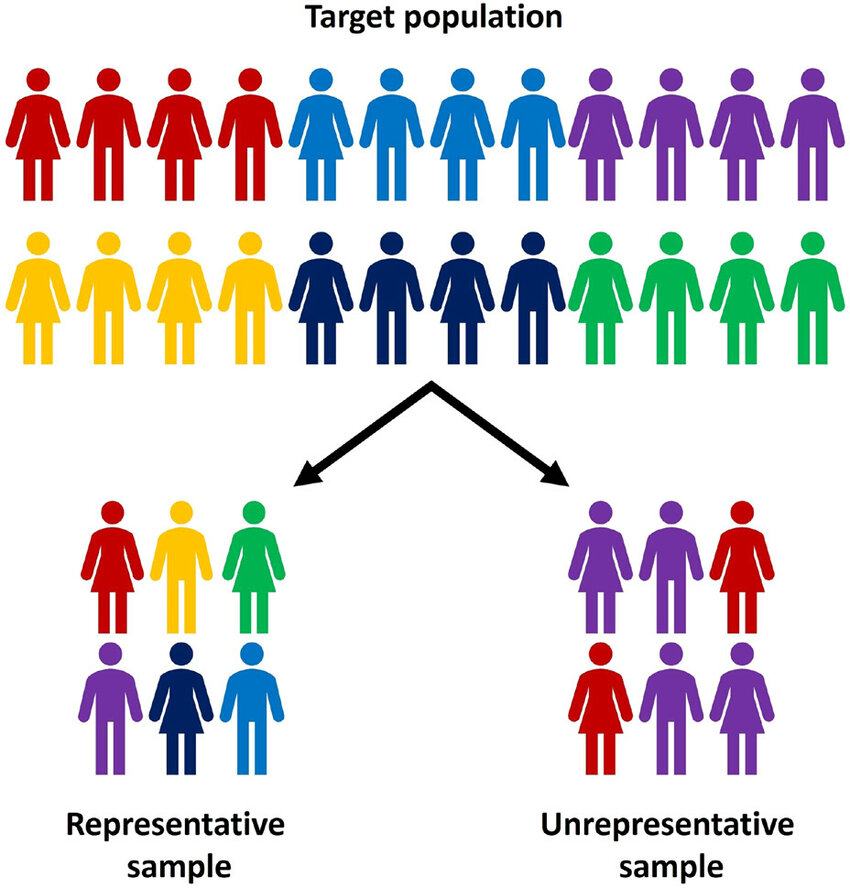
The diagram contrasts a representative and an unrepresentative sample by showing how closely or poorly each reflects the composition of the target population. The representative group maintains proportional characteristics, while the unrepresentative group distorts them. Although originally used in an AI/ML context, the visual concept directly aligns with statistical sampling principles. Source.
Bias: A systematic favoring of certain outcomes or individuals in a way that misrepresents the true characteristics of the population.
Because non-random sampling methods are common in everyday data collection—often used for convenience or due to limited resources—it is crucial to recognize their weaknesses and understand how they compromise the validity of inferences.
Why Non-Random Methods Create Bias
Non-random sampling methods lack mechanisms that equalize each individual’s chance of selection. Without randomization, the sample is influenced by patterns such as accessibility, self-selection, or the researcher’s choices. These influences can distort the sample in predictable ways.
Systematic Distortion of the Sample
Non-random sampling can result in:
Overrepresentation of easily accessible or particularly motivated individuals.
Underrepresentation of individuals who are harder to reach or less inclined to participate.
Skewed response patterns that differ meaningfully from overall population characteristics.
These distortions reduce sample representativeness, which is essential for statistical inference.
Representative Sample: A sample whose characteristics closely reflect those of the population from which it is drawn.
When representativeness is compromised, conclusions drawn from the data lack credibility.
Common Non-Random Sampling Methods
Several sampling techniques fall into this category, each associated with specific sources of bias. Understanding them helps in identifying threats to data validity.
Convenience Sampling
Convenience sampling involves selecting individuals who are easiest to access.
Characteristics include:
Reliance on proximity, availability, or ease of contact
High risk of excluding large portions of the population
Results that often generalize poorly due to narrow participation
Voluntary Response Sampling
Voluntary response sampling consists of participants who self-select into a study. This method systematically attracts individuals with strong opinions, time availability, or particular motivations.
These methods lack random selection, increasing the potential for biased conclusions.
How Non-Random Methods Undermine Statistical Inference
Statistical inference relies on the principle that findings from a sample can be generalized to a population only when the sample reflects that population. Non-random samples cannot meet this requirement.
Impact on Validity of Generalizations
Without chance-based selection:
The laws of probability do not apply to describe sample variation.
Sampling error cannot be measured reliably.
Confidence intervals and significance tests lose their intended interpretations.
Observed patterns may reflect sampling distortions rather than true population characteristics.
Threats to Reliability
Reliability refers to the consistency and stability of results. Non-random methods hinder reliability because repeating the sampling process under similar conditions may produce highly variable outcomes, depending on who was accessible or motivated at each attempt.
Identifying Non-Random Sampling Bias
To recognize when bias arises from non-random methods, researchers should examine how individuals were selected and whether all members of the population had equal or known chances of inclusion.
Key indicators include:
The sample includes disproportionately accessible groups.
Participation depends on a respondent’s willingness, interest, or availability.
The sampling frame omits sections of the population for practical reasons.
The rationale for choosing individuals is based on researcher judgment rather than random processes.
Strategies to Reduce Bias from Non-Random Sampling
Although some studies unavoidably use non-random methods due to constraints, the goal is always to minimize bias as much as possible.
Employing Random Sampling Techniques
Whenever feasible, researchers should use random sampling methods such as:
Simple random sampling, where every individual has an equal chance of selection
Stratified random sampling, which ensures representation across key subgroups
Cluster sampling, especially when populations are large or geographically dispersed
Random methods anchor sampling in probability, supporting accurate inference.
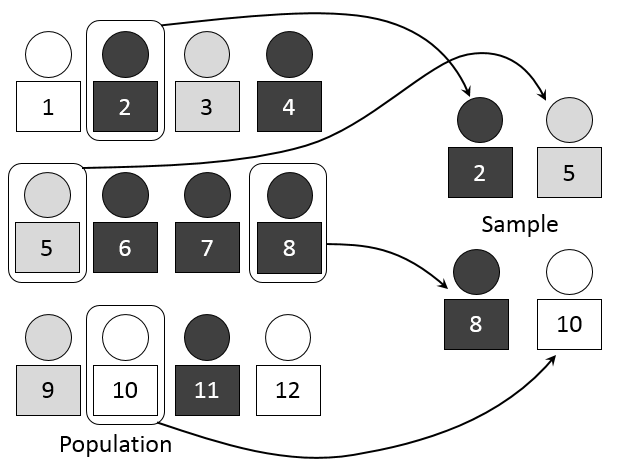
The figure shows a population of points with a randomly selected subset outlined to represent a simple random sample. Each individual has an equal probability of selection, making the resulting sample more likely to reflect the population accurately. This visual serves as a clear contrast to biased non-random sampling methods. Source.
Improving Access and Participation
When random sampling is not fully achievable, researchers can still reduce bias by:
Broadening the sampling frame
Providing multiple modes of contact
Reducing barriers to participation
Using follow-ups to improve response rates
Avoiding overly narrow or convenience-based recruitment channels
These strategies help produce a more balanced sample even without full randomness.
Importance of Recognizing Limitations
Understanding the limitations of non-random methods is essential for evaluating the quality of research. When samples rely on convenience or voluntary participation, conclusions must be interpreted cautiously. Clear awareness of potential bias allows researchers and students to critically assess how sampling choices shape what the data can—and cannot—reveal about a population.
FAQ
Non-random sampling bias often goes unnoticed when researchers focus on the sample size rather than the sampling method. A large but biased sample can still be unrepresentative.
Bias may also be overlooked when the sample appears diverse on the surface but still excludes key segments of the population, such as those who are difficult to contact or less inclined to participate.
Finally, time constraints and convenience can lead researchers to rely on accessible participants while assuming their views or characteristics apply broadly.
Non-random sampling may be acceptable when the aim is exploratory research, hypothesis generation, or gaining preliminary insights before a more rigorous study.
It is also used when the population is hard to reach, such as specific professional groups or people with rare conditions.
However, the findings from such samples should not be generalised to a wider population, and researchers must clearly state the limitations of their method.
External validity refers to how well study results apply to populations beyond the sample.
Non-random sampling undermines external validity because the sample may not reflect the broader group. This reduces confidence that observed patterns would appear in other populations or settings.
A study with strong internal validity but weak external validity cannot claim broad applicability, even if the analysis within the sample is accurate.
Researchers can compare the distribution of key characteristics in the sample with known population data, such as demographic information or behavioural patterns.
They may also:
• Conduct sensitivity analyses to see how results change under different assumptions.
• Examine participation patterns to identify overrepresented or underrepresented groups.
• Review the recruitment process for barriers that may have systematically filtered out certain individuals.
This assessment does not remove the bias but helps quantify its impact.
Voluntary response samples attract individuals who feel motivated to respond, often because they hold particularly positive or negative views.
People with neutral or indifferent opinions are less likely to invest time in responding, which skews the distribution of opinions toward extremes.
As a result, the sample reflects the intensity of feelings rather than the true balance of views in the population, making it unreliable for inference.
Practice Questions
Question 1 (1–3 marks)
A researcher surveys customers at the entrance of a single supermarket to estimate the average weekly grocery spending in the entire town.
a) Identify the sampling method used. (1 mark)
b) Explain why this method may lead to bias. (2 marks)
Question 1
a) 1 mark
• Correctly identifies the method as convenience sampling.
b) Up to 2 marks
• States that the sample may not represent the town’s entire population. (1 mark)
• Explains that people who shop at that particular supermarket or at that specific time may differ from other residents in spending habits. (1 mark)
Question 2 (4–6 marks)
A town council wants to gather residents’ opinions on a new recycling programme. They post an online announcement inviting residents to complete a voluntary survey. A statistician argues that the results should not be used to represent the views of all residents.
a) Identify the type of sampling method used. (1 mark)
b) Explain two reasons why this sampling method may produce a biased sample. (2–3 marks)
c) Describe one improvement the council could make to reduce bias in the study. (1–2 marks)
Question 2
a) 1 mark
• Identifies the method as voluntary response sampling or a self-selected sample.
b) Up to 3 marks
Award up to two of the following explanations:
• Only residents who feel strongly about the programme are likely to respond. (1 mark)
• Residents without internet access or who do not see the announcement are excluded. (1 mark)
• Respondents differ systematically from non-respondents, making the sample unrepresentative. (1 mark)
c) Up to 2 marks
Award one of the following improvements with justification:
• Use random sampling from a list of all households. (1–2 marks depending on clarity)
• Send invitations or surveys directly to randomly selected residents. (1–2 marks)
• Use multiple modes of contact (post, phone, in-person) to ensure wider participation. (1–2 marks)