AP Syllabus focus:
‘VAR-4.A.1: Define the sample space of a random process as the set of all possible, distinct outcomes. This fundamental concept serves as the basis for calculating probabilities, emphasizing that the sample space encompasses every conceivable outcome of a random event.’
Understanding the sample space is essential because it provides the complete set of all outcomes a random process can produce, forming the foundation for every probability calculation.
The Role of the Sample Space in Probability
The concept of the sample space is the starting point for describing uncertainty in statistics. When analyzing a random process—an action or phenomenon whose outcome cannot be predicted with certainty—it is necessary to identify all possible outcomes before assigning probabilities or interpreting results. The sample space formalizes this idea by giving a structured way to list every distinct event that may occur. This structure ensures that probability assignments are coherent, complete, and based on an accurate understanding of the random mechanism being studied.
Sample Space: The complete set of all possible, distinct outcomes of a random process.
Before probability can be meaningfully discussed, the components of the sample space must be identified clearly, and each outcome must be distinct and mutually exclusive. The sample space ensures that no potential outcome is overlooked, which would otherwise distort or misrepresent probability calculations.
Constructing a Sample Space
Constructing a sample space requires careful thought about how the random process operates.
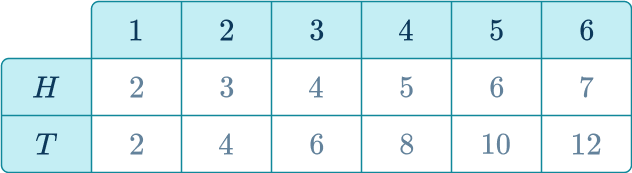
This table shows the sample space for rolling a fair die twice. Each cell represents one possible ordered pair of outcomes, illustrating how systematic listing ensures no outcomes are omitted. Source.
The clarity and accuracy of the sample space influence the reliability of any probability derived from it. A structured approach helps ensure that each outcome in the sample space is valid and represents a single measurable result of the random process.
Key Considerations When Building a Sample Space
Understand the random process fully. Identify what is being observed and what constitutes a single trial.
Determine what qualifies as a distinct outcome. Outcomes must not overlap and must represent unique possibilities.
Ensure completeness. The sample space must include all conceivable outcomes produced under the rules of the process.
Match the form of the sample space to the context. Sample spaces may be numerical, verbal, or symbolic, depending on the nature of the outcomes.
Avoid unnecessary complexity. The sample space should be as simple as possible while still capturing all outcomes precisely.
Each sample space is tailored to the specific random process. For example, the structure of the sample space will differ significantly depending on whether outcomes are counts, categories, or combinations of multiple components. Although sample spaces can be large, especially when multiple variables are involved, their completeness is what makes probability assignments coherent.
Types of Sample Spaces
Sample spaces vary by context, and understanding their forms helps students interpret random processes efficiently. The structure of the sample space influences how probabilities are computed and how events are defined.
Finite Sample Spaces
A finite sample space contains a countable number of outcomes, often associated with simple or discrete random processes.
These outcomes can be listed explicitly.
Each outcome is distinct and corresponds to one possible occurrence of the process.
Finite sample spaces often arise in settings where measurements or results fall into a limited and predetermined set.
Infinite Sample Spaces
An infinite sample space includes infinitely many outcomes. These outcomes may be countably infinite or uncountably infinite, depending on the nature of the random process.
Countably infinite spaces may involve processes like counting repeated trials until a condition is met.
Uncountably infinite spaces arise in contexts such as measuring time or distance, where values form a continuum.
Despite their size, infinite sample spaces still require that outcomes be distinct and collectively exhaustive.
Understanding the distinction between finite and infinite sample spaces supports deeper comprehension of probability models and ensures that students can accurately structure problems across different statistical settings.
Using the Sample Space to Support Probability
The sample space provides the foundation for defining events, assigning probabilities, and interpreting likelihoods. Every event in probability is a subset of the sample space, meaning events are meaningful only in relation to the complete set of possible outcomes.
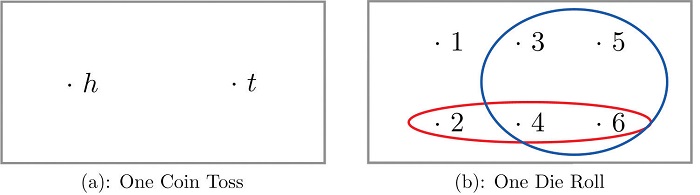
This diagram represents a sample space as a rectangle containing all outcomes, with events shown as ovals selecting specific subsets. The two panels illustrate how events may or may not overlap within a shared sample space. Extra detail is included by showing particular numerical events such as even numbers and numbers greater than two. Source.
Without the sample space, there is no coherent way to describe randomness or quantify uncertainty.
Because the sample space encompasses every possible result, it ensures that probability calculations are grounded in the entire spectrum of potential occurrences rather than a limited or biased view. Understanding the sample space also strengthens the ability to differentiate random variation from meaningful patterns, as it clarifies what could plausibly happen in a random process.
The sample space is therefore an indispensable tool in AP Statistics, forming the conceptual basis for all subsequent probability rules, models, and interpretations.
FAQ
An outcome is distinct if it represents a unique, non-overlapping result of the random process. Two outcomes are considered different when they describe meaningfully different final states.
For compound processes, outcomes must differ in at least one component, such as order, category, or value.
If the difference between two outcomes could change the event being studied, treat them as distinct.
Order matters when the sequence of events influences the interpretation of the result. For example, drawing two cards in sequence without replacement produces different outcomes depending on the first card.
Order does not matter when the random process only cares about the set of items selected, not their sequence, such as choosing two committee members from a group.
Yes. Sample spaces can contain verbal, categorical, or descriptive outcomes when the process produces non-numerical results.
Common examples include weather descriptions, types of transport chosen, or categories such as colours.
Using words is appropriate when numerical labels would be artificial or misleading.
Include enough detail to differentiate all possible results without introducing unnecessary complexity.
A useful guideline is:
• If additional information changes how events are defined, include it.
• If additional information does not affect probability assessments, omit it.
Aim for clarity: each outcome should be mutually exclusive and collectively exhaustive.
A complete sample space helps detect missing outcomes, duplicated outcomes, or incorrectly grouped events.
This prevents:
• Overestimating probabilities by double-counting outcomes.
• Underestimating probabilities by ignoring plausible outcomes.
• Misdefining events by overlooking combinations or categories.
By listing all outcomes systematically, reasoning becomes transparent and less prone to intuitive mistakes.
Practice Questions
Question 1 (1–3 marks)
A spinner is divided into four equal sections labelled A, B, C, and D.
(a) Define the sample space for a single spin of this spinner.
(b) Explain why this set represents a complete sample space.
Question 1
(a)
• 1 mark for correctly stating the sample space as {A, B, C, D}.
(b)
• 1 mark for explaining that the set includes all possible outcomes of one spin.
• 1 mark for noting that no other outcomes are possible or missing.
Question 2 (4–6 marks)
A school selects one student at random from a list of students in three year groups: Year 10, Year 11, and Year 12. Each selected student is classified as either a day student or a boarding student.
(a) Construct the sample space for this random process.
(b) Identify one event from your sample space and write down its corresponding outcomes.
(c) Explain why events must always be defined as subsets of the sample space.
Question 2
(a)
• 1 mark for recognising that there are two variables (year group and student type).
• 1 mark for constructing a complete sample space with all six combined outcomes:
{Year 10 day, Year 10 boarding, Year 11 day, Year 11 boarding, Year 12 day, Year 12 boarding}.
(b)
• 1 mark for identifying a valid event, e.g., "selecting a boarding student".
• 1 mark for listing all outcomes belonging to that event, e.g., {Year 10 boarding, Year 11 boarding, Year 12 boarding}.
(c)
• 1 mark for explaining that events must be subsets of the sample space because they are defined using the possible outcomes of the random process.
• 1 mark for noting that probabilities can only be assigned when outcomes are known and complete.