AP Syllabus focus:
‘VAR-4.A.4: Elaborate on the concept of complementary events, explaining that the probability of an event's complement (not E, denoted as E′ or CE) is 1 minus the probability of the event itself. Provide the formula in simple terms: Probability of E′ = 1 - Probability of E. This reinforces the concept that the sum of the probabilities of an event and its complement is always 1.’
Understanding complementary events is essential for interpreting probability in real-world contexts. This subsubtopic explains how complements work and why their probabilities always sum to one.
Complementary Events in Probability
Complementary events form one of the most fundamental structures in probability because they divide the sample space into two exhaustive possibilities: an event either occurs or it does not. When examining a random process, recognizing this paired structure allows students to quickly identify missing probability information, assess likelihoods, and understand how probability measures reflect certainty and impossibility.
When first considering an event E, its complement, commonly written as E′ or CE, represents every outcome in the sample space that is not part of E. The concept highlights the complete partitioning of outcomes and reinforces that probability accounts for all possible results.
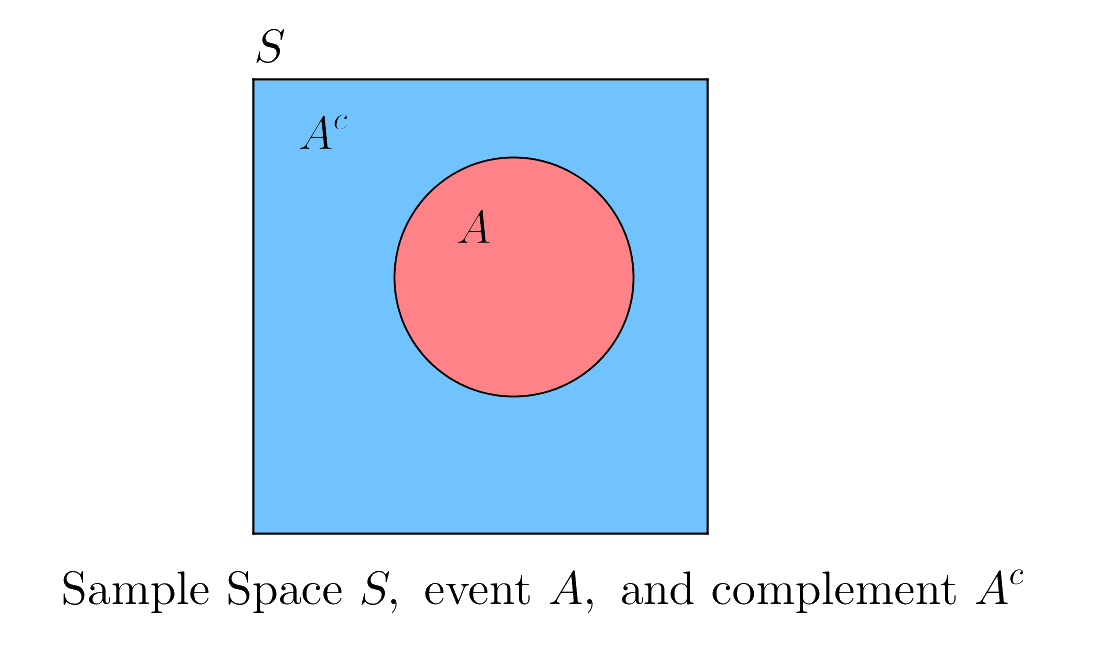
This diagram displays the sample space as a full rectangle, event A as a circle within it, and Aᶜ as the surrounding region, illustrating how complements partition all possible outcomes into two exhaustive sets. Source.
Complement of an Event (E′): The set of all outcomes in the sample space that are not included in event E.
Because complements together cover the entire sample space, probabilities associated with an event and its complement must always sum to one. This relationship emerges from the foundational rules of probability, which state that the sample space has a total probability of 1. Therefore, if the probability of an event is known, its complement can be directly determined.
The probability of a complement is expressed using a simple, universally applicable rule. This rule ensures that when one probability becomes larger, the other becomes proportionally smaller, preserving the total probability of the sample space.
EQUATION
= Probability of event E occurring
= Probability of event E not occurring
The complement rule thus formalizes the intuitive idea that if an event is unlikely, its complement must be likely, and vice versa.
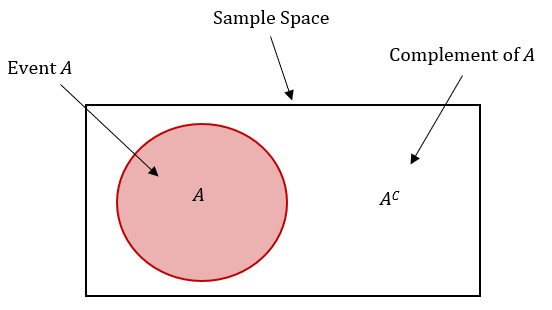
This diagram highlights event A inside the sample space and clearly marks the outside region as the complement Aᶜ, reinforcing the inverse nature of complementary probabilities. Source.
This relationship plays a vital role not only in theoretical probability but also in applied settings such as risk assessment, inferential statistics, and modeling uncertainty.
Using Complements to Understand Probability Structure
Complementary events help reinforce important ideas about how probability is distributed across possible outcomes. Since E and E′ are mutually exclusive and collectively exhaustive, they form a natural pair that supports efficient probability reasoning. These qualities make complements especially useful in simplifying probability calculations and verifying whether probability assignments make sense.
Key properties of complementary events include:
Exhaustiveness, meaning E and E′ include every outcome in the sample space.
Mutual exclusivity, meaning E and E′ cannot happen simultaneously.
Additivity, meaning their probabilities add to exactly 1.
Inverse relationship, meaning as increases, decreases.
These properties ensure that any random process can be viewed through the lens of an event and its opposite. This perspective deepens understanding of probabilistic certainty, providing clarity on how likely or unlikely any given event may be.
While the complement rule appears simple, its implications are far-reaching. In practice, identifying a complement often provides a faster, more intuitive path to solving probability questions, particularly when the direct calculation of an event is more complex than calculating its opposite.
Interpreting Complementary Probabilities
Interpreting the probability of an event’s complement requires understanding what the complement represents in the context of the situation. A student should clearly identify:
The event of interest.
The outcomes that fall outside that event.
The meaning of those outcomes in real-world terms.
Because probability is a measure of long-run relative frequency, gives insight into how often the event fails to occur across many repetitions of a random process. This perspective underscores why the complement rule is consistent with statistical reasoning grounded in repeated trials.
Complementary probabilities also serve as a check on the internal consistency of probability models. If a model assigns probabilities that do not sum to one, or assigns incompatible probabilities to an event and its complement, this signals an error in the construction or interpretation of the model. Complementary relationships therefore support the validation of probability assignments in simulations, empirical studies, and theoretical models.
Practical Uses of Complementary Events in Probability
Complementary reasoning is widely used across statistics because it provides efficient strategies for understanding uncertainty and structuring probability questions. For AP Statistics students, mastering this concept contributes to stronger analytical reasoning and a clearer understanding of probability fundamentals. Common scenarios that rely heavily on complements include:
Situations where it is difficult to find directly.
Probability models involving “at least one” or “none” conditions.
Checks for completeness and consistency in simulations and empirical data.
Understanding the balance of likelihood between an event occurring and not occurring.
Building confidence with complementary events allows students to better navigate more advanced topics in probability, where complements remain an essential tool for interpreting and calculating probabilities within larger statistical frameworks.
FAQ
The complement rule is most useful when the event itself has a complicated structure but its opposite is simple to describe.
Common examples include situations framed as “at least one”, “none”, or “not occurring”, where the direct calculation involves multiple sub-events.
Using the complement avoids unnecessary enumeration and reduces the chance of error.
Yes, but only when the event occurs half the time in the long run.
This often happens in symmetric scenarios, such as fair coin flips or balanced processes, where no outcome has an advantage.
When this occurs, both the event and its complement have probability 0.5, but this is a special case rather than the norm.
Look for phrasing that indicates the event failing to occur, even if not stated explicitly.
Useful indicators include:
• words like “otherwise”, “in all other cases”, or “anything except”
• descriptions that account for every outcome not named in the main event
• context suggesting that only two possibilities exist, one covering the event and one covering all remaining outcomes
No, they can never overlap.
By definition, the complement contains only the outcomes excluded from the event.
Any overlap would violate the requirement that they be mutually exclusive.
They must also be collectively exhaustive, meaning together they cover the entire sample space.
The size of the complement in the sample space directly affects the event’s probability.
A larger complement means more outcomes fall outside the event, reducing the event’s probability.
Conversely, a smaller complement indicates that the event covers most of the sample space, leading to a higher probability.
This relationship reflects how probability distributes across all possible outcomes.
Practice Questions
Question 1 (1–3 marks)
A certain website has a probability of 0.82 of loading correctly when accessed.
(a) Define the complement of this event.
(b) Calculate the probability that the website does not load correctly.
Question 1
(a)
• 1 mark: Correctly states that the complement is the event that the website does not load correctly, or wording equivalent.
(b)
• 1 mark: Uses the complement rule.
• 1 mark: Correct calculation: 0.18.
Question 2 (4–6 marks)
A survey finds that 46% of customers choose to purchase an extended warranty when buying a laptop.
(a) State what the complement of this event represents in context.
(b) Using the complement rule, determine the probability that a randomly selected customer does not purchase an extended warranty.
(c) Explain why the probabilities of an event and its complement must always sum to 1, referring to the structure of the sample space.
Question 2
(a)
• 1 mark: States that the complement represents customers who do not purchase an extended warranty.
(b)
• 1 mark: Applies complement rule.
• 1 mark: Correct value: 0.54.
(c)
• 1 mark: Explains that the sample space consists of all possible outcomes, split into the event and its complement.
• 1 mark: States that these two outcomes are mutually exclusive and exhaustive, so their probabilities must sum to 1.