

AP Syllabus focus:
‘Explain the concept of mutually exclusive (or disjoint) events, elaborating on VAR-4.C.2 that two events are considered mutually exclusive if they cannot occur at the same time, which mathematically means P(A ∩ B) = 0. This subsubtopic focuses on the criteria that define events as mutually exclusive and how this property affects the calculation of their probabilities.’
Defining Mutually Exclusive Events
Mutually exclusive events describe situations where two outcomes cannot happen together, highlighting an essential rule in probability that shapes how we interpret and calculate likelihoods.
Understanding the Core Idea
The concept of mutually exclusive events is central to interpreting how events behave within a probability framework. When two events cannot occur simultaneously, their relationship imposes structural constraints on how probabilities are combined. This subsubtopic focuses on ensuring that students grasp how such events function, why their separation matters, and how that separation influences probability calculations.
When studying random processes, it is important to recognize that some events inherently prevent others from occurring. This characteristic distinguishes mutually exclusive events from other event types and directly impacts the computation of combined probabilities.
What Makes Events Mutually Exclusive?
Two events are mutually exclusive when the occurrence of one event rules out the possibility of the other occurring at the same time.

This diagram illustrates two disjoint sets, emphasizing the absence of any overlapping region. In probability terms, each set represents an event that cannot occur simultaneously. The visual reinforces the defining property of mutually exclusive events. Source.
Mutually Exclusive Events: Two events are mutually exclusive (or disjoint) if they cannot occur simultaneously, meaning they share no common outcomes.
This condition implies that the intersection of the two events contains no outcomes. Because probability is fundamentally tied to the presence or absence of outcomes within sets, this absence has important analytical implications.
When events satisfy this condition, their mathematical relationship becomes more straightforward. Specifically, the probability of their intersection is always zero, because there are no shared outcomes to contribute to that probability.
EQUATION
= The intersection of events A and B, representing outcomes common to both
The expression emphasizes that no overlap exists between the events. This clarity allows students to better distinguish mutually exclusive situations from those involving partial overlap or independence, both of which behave differently under probability rules.
Distinguishing Mutually Exclusive Events from Other Event Types
Understanding mutually exclusive events requires careful separation from related concepts in probability. Three major distinctions support accurate reasoning:
Mutually Exclusive vs. Non-Mutually Exclusive
Non-mutually exclusive events can occur at the same time. Their intersection contains at least one possible outcome. This contrasts with mutually exclusive events, where overlap is impossible. While both types involve understanding how sets interact, only mutually exclusive events eliminate shared outcomes entirely.
Mutually Exclusive vs. Independent Events
A common misconception is that mutually exclusive events are the same as independent events. In fact, they differ significantly:
Independent events are defined by the idea that the occurrence of one event does not change the probability of the other.
Mutually exclusive events inherently affect each other because if one occurs, the other cannot. This means mutually exclusive events are never independent, unless one event has probability zero.
Clarifying this distinction helps prevent errors when selecting appropriate probability rules.
How Mutually Exclusive Events Affect Probability Calculations
When working with mutually exclusive events, probability rules simplify because there is no risk of double-counting overlapping outcomes. This simplification arises from the structural condition that their intersection has probability zero.
The probability of either event A or event B occurring—formally, the probability of their union—becomes the sum of their individual probabilities. This property is rooted in the fact that there is no overlap between the events that would otherwise need to be subtracted.
EQUATION
= The union of events A and B, representing outcomes in A, in B, or in both
Because for mutually exclusive events, the general addition rule simplifies. Students should understand that this form of the addition rule applies only when events are known to be mutually exclusive.
This streamlined approach supports efficient probability calculations in contexts where outcomes naturally exclude one another, such as drawing a single card or observing one result of a trial.
Identifying Mutually Exclusive Events in Practice
Although this subsubtopic does not include worked examples, it is essential to know which characteristics signal mutual exclusivity. Common indicators include:
No shared outcomes in the sample space
Physical impossibility of simultaneous occurrence
A direct contradiction if both events were claimed to occur together
Students should be able to evaluate events within a scenario and determine whether they meet these criteria.
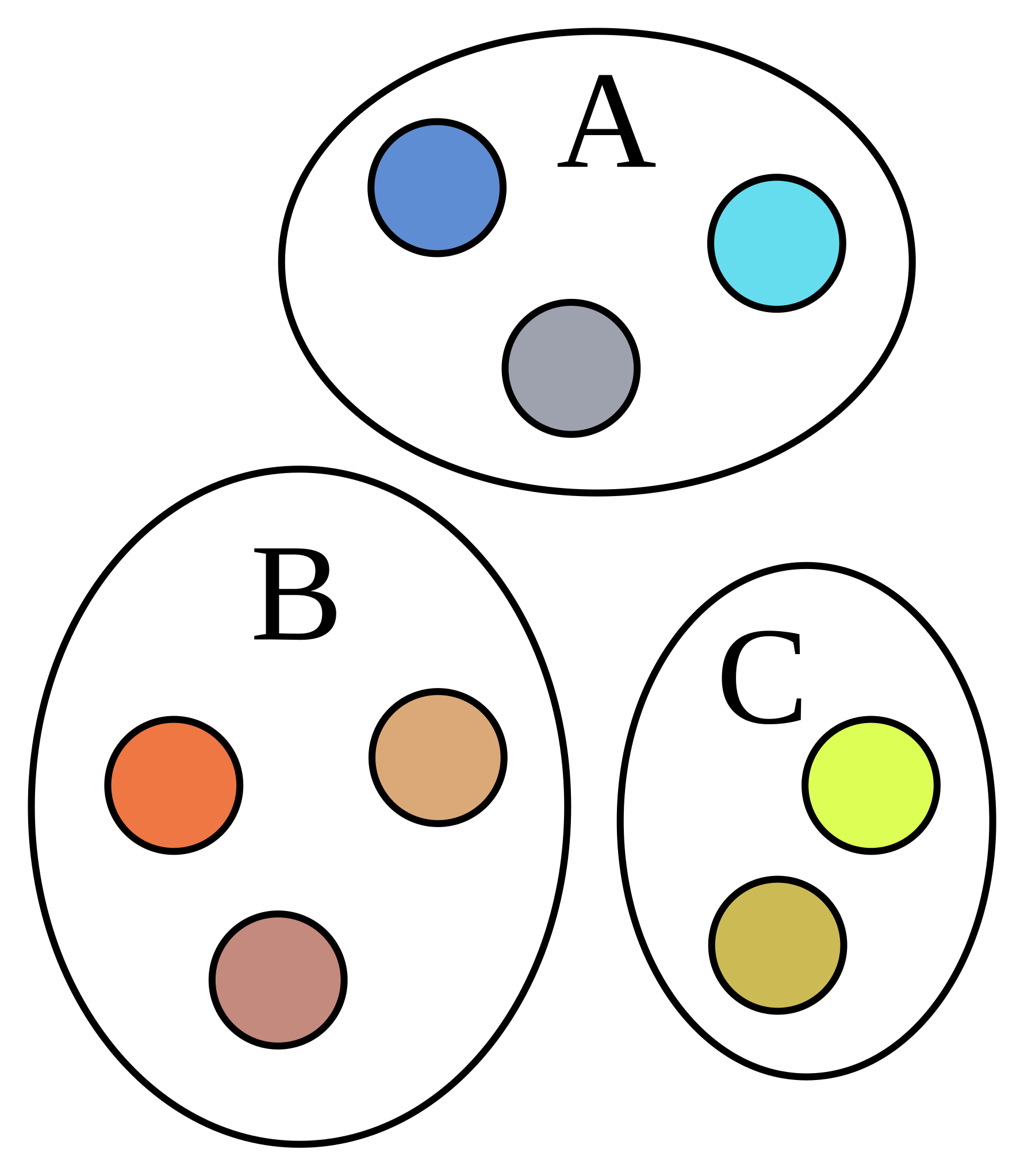
This figure shows three disjoint sets, demonstrating that none of the regions overlap. In probability contexts, each set may represent a different mutually exclusive event. The image reinforces that events with no shared outcomes cannot occur together in a single trial. Source.
This ability to identify the structure of events enhances overall clarity when selecting probability rules.
Key Indicators to Recognize
Only one event can occur in any single trial.
The sample space can be partitioned so the two events lie in separate, non-overlapping subsets.
Observing one event instantly confirms the other did not occur.
Understanding these characteristics equips students with the conceptual tools needed to navigate probability problems with accuracy and confidence.
The Importance of Mutual Exclusivity in Probability Reasoning
Mutually exclusive events represent a foundational structure in probability theory. By identifying when events cannot occur together, students strengthen their analytic reasoning and avoid common mistakes in combining probabilities. This concept supports deeper insight into how events interact and how real-world randomness can be modeled using probability rules.
FAQ
Look for whether any single outcome could satisfy both events at once. If no such outcome exists, the events are mutually exclusive.
A practical approach involves:
Listing or describing the structure of possible outcomes.
Checking whether descriptions of the events logically overlap.
Considering whether a scenario could ever produce both outcomes together.
This reasoning works even when the sample space is not easily enumerated, such as in multi-step processes.
No. Opposites refer to complementary events, where one event must occur if the other does not. Mutually exclusive events simply cannot occur together.
For example, choosing crisps and choosing chocolate are mutually exclusive but not opposites, because other choices may also exist.
Complementary events form a complete partition of the sample space, whereas mutually exclusive events often represent only part of it.
Yes. A group of events can be pairwise mutually exclusive if none of them share any outcomes.
For example, in a single roll of a die, Events “roll a 1”, “roll a 2”, and “roll a 3” are mutually exclusive as only one number can appear.
When analysing multiple events:
Check whether each pair has no overlap.
Confirm that only one event could ever occur per trial.
A frequent misconception is confusing mutually exclusive events with independent events. Mutually exclusive events cannot occur together, while independent events can.
Another misconception is assuming mutually exclusive events cover the entire sample space. They may form only a subset of all possible outcomes.
Students may also incorrectly believe that mutually exclusive events always have equal probabilities, which is not required.
Mutually exclusive events help structure sample spaces into clear, non-overlapping categories, reducing ambiguity in probability calculations.
They are particularly useful when:
Constructing simple probability trees.
Creating categories that represent distinct, incompatible outcomes.
Ensuring probabilities in a model do not double-count shared results.
Designers of models often rely on mutually exclusive events to maintain consistency and avoid contradictory assumptions.
Practice Questions
Question 1 (1–3 marks)
A single card is drawn from a standard deck of 52 playing cards.
Let Event A be “the card drawn is a heart” and Event B be “the card drawn is a club.”
a) State whether Events A and B are mutually exclusive.
b) Justify your answer.
Question 1
a) 1 mark
Correctly states that A and B are mutually exclusive. (1 mark)
b) 1–2 marks
States that the two events cannot occur at the same time when drawing a single card. (1 mark)
Explains that a card cannot be both a heart and a club simultaneously. (1 mark)
Maximum: 3 marks
Question 2 (4–6 marks)
A game spinner is divided into four equal sections labelled Red, Blue, Green, and Yellow. Only one colour is landed on per spin.
Let Event C be “the spinner lands on Red” and Event D be “the spinner lands on Blue.”
a) Explain why Events C and D are mutually exclusive.
b) Calculate the probability of Event C or Event D occurring.
c) Explain why the addition rule used here does not require subtracting the intersection of C and D.
Question 2
a) 1–2 marks
Correctly states that Events C and D are mutually exclusive. (1 mark)
Explains that only one colour can be landed on per spin, so landing on Red prevents landing on Blue. (1 mark)
b) 1–2 marks
States that each section has probability 1/4. (1 mark)
Calculates the probability of C or D as 1/4 + 1/4 = 1/2. (1 mark)
c) 1–2 marks
States that the events have no overlap. (1 mark)
Explains that the intersection is zero, so the addition rule simplifies to adding the individual probabilities. (1 mark)
Maximum: 6 marks
