

AP Syllabus focus:
‘VAR-4.D.1: Discuss the concept of conditional probability as the likelihood of event A occurring given that event B has already occurred, denoted as P(A'
Conditional probability helps quantify how the likelihood of an event changes when new information is known. It refines probability assessments by focusing only on outcomes consistent with a given condition.
Understanding Conditional Probability
Conditional probability is a foundational idea in probability theory, describing how the chance of an event changes when another event has already happened.
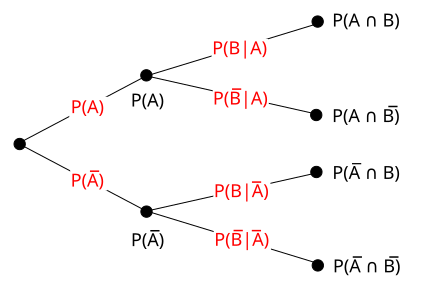
This tree diagram displays sequential events with conditional probabilities on the second-level branches, illustrating how probabilities update when earlier events have occurred. The structure reinforces the meaning of notation such as P(B∣A)P(B \mid A)P(B∣A). The full paths also encode joint probabilities, connecting conditional reasoning to broader probability relationships. Source.
The AP specification emphasizes that conditional probability represents the likelihood of event A occurring given that event B has already occurred, written using the notation P(A | B). This relationship focuses attention on a restricted portion of the sample space—only those outcomes in which event B has taken place.
Conditional Probability: The probability that event A occurs given that event B has already occurred, written as P(A | B).
Conditional probability is essential in statistical reasoning because many real-world situations rely on updated or contextualized information. Instead of considering all possible outcomes, conditional probability narrows the analysis to a subset in which the condition is satisfied.
Why Conditional Probability Matters
Conditional reasoning allows statisticians to incorporate context, new information, and dependencies between events. The specification underscores that conditional probability is not simply a new formula; it is an interpretive shift that changes how we view uncertainty.
Some key motivations for using conditional probability include:
Focusing on relevant outcomes when certain events have already occurred.
Reassessing likelihoods when circumstances provide partial information.
Identifying relationships between events, such as dependence or independence.
Modeling real-world decision-making, where information evolves over time.
Conditional probability appears in areas such as medical testing, weather prediction, genetics, reliability engineering, and risk analysis. In each of these fields, knowing one event has happened meaningfully alters the likelihood of others.
Mathematical Structure of Conditional Probability
Because conditional probability is based on a restricted sample space, it requires a mathematical structure that reflects this narrowed focus. The probability of “A given B” accounts only for the outcomes in B, measuring the proportion of those outcomes that also fall within A.
EQUATION
= Probability that both A and B occur
= Probability that event B occurs (and must be greater than 0)
When event B has zero probability, the conditional probability P(A | B) is undefined, because no meaningful restriction can be applied. This reinforces the importance of defining events carefully and ensuring that conditions reflect realistic possibilities.
A sentence separating blocks: Conditional probability equations express how probabilities redistribute when additional information is known.
Interpreting the Notation
The notation P(A | B) is read as “the probability of A given B.” The vertical bar represents the idea of conditioning or restricting attention to a particular circumstance. Students should interpret this notation as a signal that:
We are no longer using the original sample space.
All outcomes inconsistent with the condition are excluded.
Probabilities must be recalculated relative to the reduced context.
Understanding this notation prepares students for more advanced probability, including independence, Bayes’ rule, and probability models for real-world processes.
Conceptualizing How Conditioning Works
To conceptualize conditional probability, it often helps to imagine that event B has already happened. Once B is known to occur:
Every outcome outside of B becomes irrelevant.
Probabilities are recalculated by looking only within B.
The likelihood of A depends on how much of B overlaps with A.
This framing highlights that conditional probability is not about adding new information to the original problem but rather about redefining the sample space around event B.
Visual and Structural Thinking
Although these notes do not include diagrams, it is helpful for students to mentally picture Venn diagrams or restricted frequency tables. Visual reasoning reinforces key relationships:
The region representing A ∩ B corresponds to cases where both events occur.
The region representing B forms the new sample space.
The ratio of the overlap to the total area of B conveys the conditional probability.
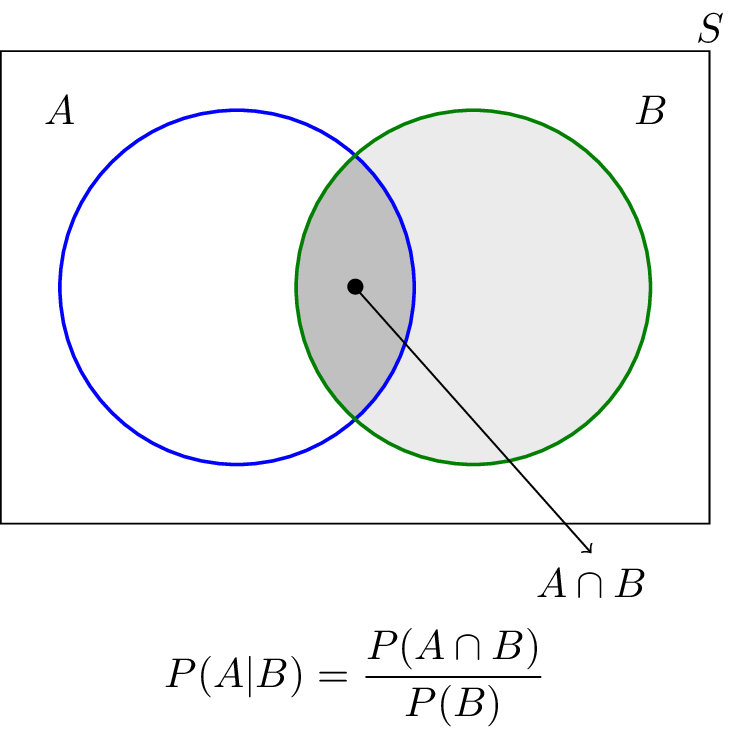
This Venn diagram illustrates events A and B within a sample space, with the intersection A∩BA \cap BA∩B highlighted. It visually demonstrates that conditional probability considers only the outcomes inside B and measures what fraction of those also fall within A. This corresponds directly to the expression P(A∣B)=P(A∩B)P(B)P(A \mid B) = \frac{P(A \cap B)}{P(B)}P(A∣B)=P(B)P(A∩B). Source.
Such structural thinking deepens understanding of why P(A | B) fundamentally differs from P(A).
Key Points for AP Statistics
Students should remember the following high-utility ideas aligned with the specification:
Conditional probability applies when the likelihood of an event changes because new information is available.
The notation P(A | B) indicates that the probability is calculated under the assumption that B has already occurred.
Conditional probability focuses on the intersection relative to the condition.
The concept provides the basis for analyzing statistical dependence and real-world contextual reasoning.
Understanding conditional probability supports later work with independence, probability rules, and inferential thinking.
FAQ
When the overlap between two events is very small, the conditional probability becomes sensitive to small changes in data. Even slight fluctuations in the intersection can noticeably change the value of the conditional probability.
This occurs because the conditional probability focuses on the proportion of event B that also lies in event A, so a narrow intersection can amplify differences. This is especially important when working with small sample sizes or rare events, where limited data can lead to unstable estimates.
Conditional probability restricts the sample space, and humans often instinctively reason using the full set of possible outcomes rather than a subset. This mismatch leads to misconceptions.
Some common sources of confusion include:
• Ignoring the condition entirely.
• Focusing on joint probability rather than probability within the restricted sample.
• Overestimating the impact of unlikely events.
Real-world contexts with emotionally charged or unfamiliar scenarios can make this effect more pronounced.
Two-way tables provide counts that can be used to compute conditional probabilities by dividing the frequency of an intersection by the total in a row or column.
To find the conditional probability of A given B:
• Identify the row or column corresponding to event B.
• Use only the frequencies within that row or column.
• Calculate the proportion of those cases that also fall under event A.
This method helps students visualise the restricted sample space.
Conditional probability can mislead when the conditioning event is rare or poorly measured. A small denominator can exaggerate the apparent likelihood of event A.
It may also be misleading when:
• The data contain confounding variables not accounted for.
• The order of conditioning is reversed, creating incorrect interpretations.
• The sample is non-representative, making conditional relationships appear stronger or weaker than they truly are.
Careful study design and transparent reporting reduce these issues.
If the conditional probability of A given B differs meaningfully from the unconditional probability of A, this suggests that the occurrence of B may influence the likelihood of A.
A simple comparison can reveal this:
• If P(A | B) is close to P(A), independence is plausible.
• If P(A | B) differs substantially, the events are likely dependent.
While this does not establish causation, it provides an initial indication that further analysis may be necessary.
Practice Questions
Question 1 (1–3 marks)
At a wildlife reserve, 25% of visitors attend an educational talk. Of those who attend the talk, 80% go on to join a guided tour.
(a) State what is meant by conditional probability.
(b) Identify which probability in the context represents the conditional probability of joining a guided tour given that a visitor attended the educational talk.
Question 1
(a)
• 1 mark: States that conditional probability is the probability of an event occurring given that another event has already occurred.
(b)
• 1 mark: Identifies the correct conditional probability: probability of joining a guided tour given attendance at the talk (80%).
• 1 mark: Must correctly indicate the direction of conditioning (tour given talk).
Total: 2–3 marks depending on clarity.
Question 2 (4–6 marks)
A transport authority tracks whether bus drivers complete a safety refresher course (event C) and whether they receive a safety warning within the next six months (event W). Data from the past year show that:
• 55% of drivers completed the refresher course.
• 11% of all drivers both completed the course and received a safety warning.
• 35% of drivers who did not complete the course received a safety warning.
(a) Explain what the conditional probability P(W | C) represents in this context.
(b) Calculate P(W | C).
(c) Comment on whether completing the refresher course appears to affect the likelihood of receiving a safety warning. Justify your answer with reference to probabilities.
Question 2
(a)
• 1 mark: States that P(W | C) is the probability that a driver receives a safety warning given that they completed the refresher course.
• 1 mark: Acknowledges that the calculation considers only drivers who completed the course.
(b)
• 1 mark: Uses correct method: P(W | C) = P(W and C) / P(C) (even if expressed verbally).
• 1 mark: Substitutes values 0.11 / 0.55.
• 1 mark: Produces correct answer (0.20 or equivalent rounding).
(c)
• 1 mark: Compares P(W | C) to the warning probability for drivers without the course (0.35).
• 1 mark: Gives a reasoned conclusion (e.g., completing the course appears to reduce the likelihood of receiving a warning).
Total: 5–6 marks depending on completeness and justification.
