

AP Syllabus focus:
‘Null Hypothesis (H0): There is no difference between the population proportions (p1 - p2 = 0). - Alternative Hypothesis (Ha): A specified direction of the difference between the population proportions, which could be less than (p1 - p2 < 0), greater than (p1 - p2 > 0), or not equal to (p1 - p2 ≠ 0) zero for a one-sided or two-sided test, respectively.’
Formulating hypotheses for two population proportions establishes the foundation for inference by clearly stating the assumed claim and the competing claim supported by sample evidence.
Formulating Statistical Hypotheses for Two Proportions
When comparing two population proportions, the hypothesis framework clarifies the question being tested and determines the structure of the statistical procedure. In AP Statistics, hypotheses compare proportions from two distinct populations or groups, each measured on a categorical variable. These statements guide the inferential process by identifying the claim treated as the default assumption and the claim supported only if the sample provides sufficient evidence. Because hypothesis testing evaluates whether an observed difference in sample proportions is likely due to chance, precise and correctly structured hypotheses are essential for valid conclusions.
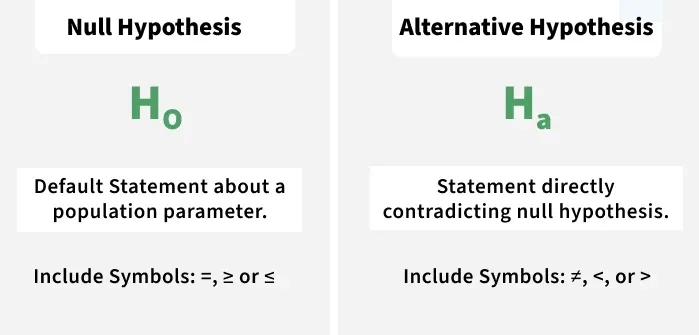
This diagram contrasts the null hypothesis, which states no difference or effect, with the alternative hypothesis, which asserts a directional or non-directional difference. Although not specific to proportions, the structure aligns with hypothesis formulation for two-population proportion tests. Source.
The Role of the Null Hypothesis (H0)
The null hypothesis is the statement assumed true unless strong evidence contradicts it. It represents no difference between the population proportions being compared. In the context of two proportions, the null hypothesis takes the form H0: p1 − p2 = 0, meaning both populations share the same true proportion. This hypothesis acts as the benchmark against which the evidence from sample data is evaluated.
Null Hypothesis (H0): A statistical claim stating that there is no effect, no difference, or no association between variables; it is tested for possible rejection.
Because the null hypothesis asserts equality, it always contains an equals sign. This reflects the idea that the test begins by assuming no meaningful difference exists between the two population proportions.
Identifying the Alternative Hypothesis (Ha)
The alternative hypothesis represents the claim for which the researcher seeks evidence. It proposes that a difference exists between the population proportions, and its structure depends on the research question’s direction. The choice of alternative hypothesis defines the type of test.
Alternative Hypothesis (Ha): A statistical claim that contradicts the null hypothesis and represents the effect, difference, or direction the researcher aims to support with evidence.
A normal sentence must appear here to maintain proper spacing between definition blocks. The alternative hypothesis uses an inequality symbol, never an equals sign, because it represents a directional claim rather than a default assumption.
Forms of the Alternative Hypothesis
The syllabus emphasizes three possible forms for Ha, corresponding to different research goals:
Two-sided alternative: Ha: p1 − p2 ≠ 0
Used when the interest lies in detecting any difference, regardless of direction.
One-sided (greater than): Ha: p1 − p2 > 0
Suggests population 1 has a larger proportion than population 2.
One-sided (less than): Ha: p1 − p2 < 0
Suggests population 1 has a smaller proportion than population 2.
These formulations ensure that the hypothesis aligns precisely with the research question, avoiding ambiguity and supporting valid interpretation.
Structuring Hypotheses with Population Proportion Notation
Hypotheses must be written using population parameters, not sample statistics. In the context of this subsubtopic, the parameters are p1 and p2, representing the true population proportions for groups 1 and 2, respectively. Hypotheses never include sample proportions because the goal of inference is to make claims about populations, not describe the sample. Clear notation reinforces the distinction between what is known from data and what is being inferred.
Why p1 − p2 = 0 Represents No Difference
Stating the null hypothesis as p1 − p2 = 0 captures the idea that any observed difference p^1−p^2\hat{p}_1 - \hat{p}_2p^1−p^2 is due solely to sampling variability. Under H0, the test procedure assumes the two populations share the same true proportion. This assumption supports constructing a pooled estimate of the proportion during later steps of the two-proportion z-test, although those procedures belong to another subsubtopic. Here, what matters is understanding that the null hypothesis formalizes the concept of “no real difference,” forming the basis for evaluating evidence.
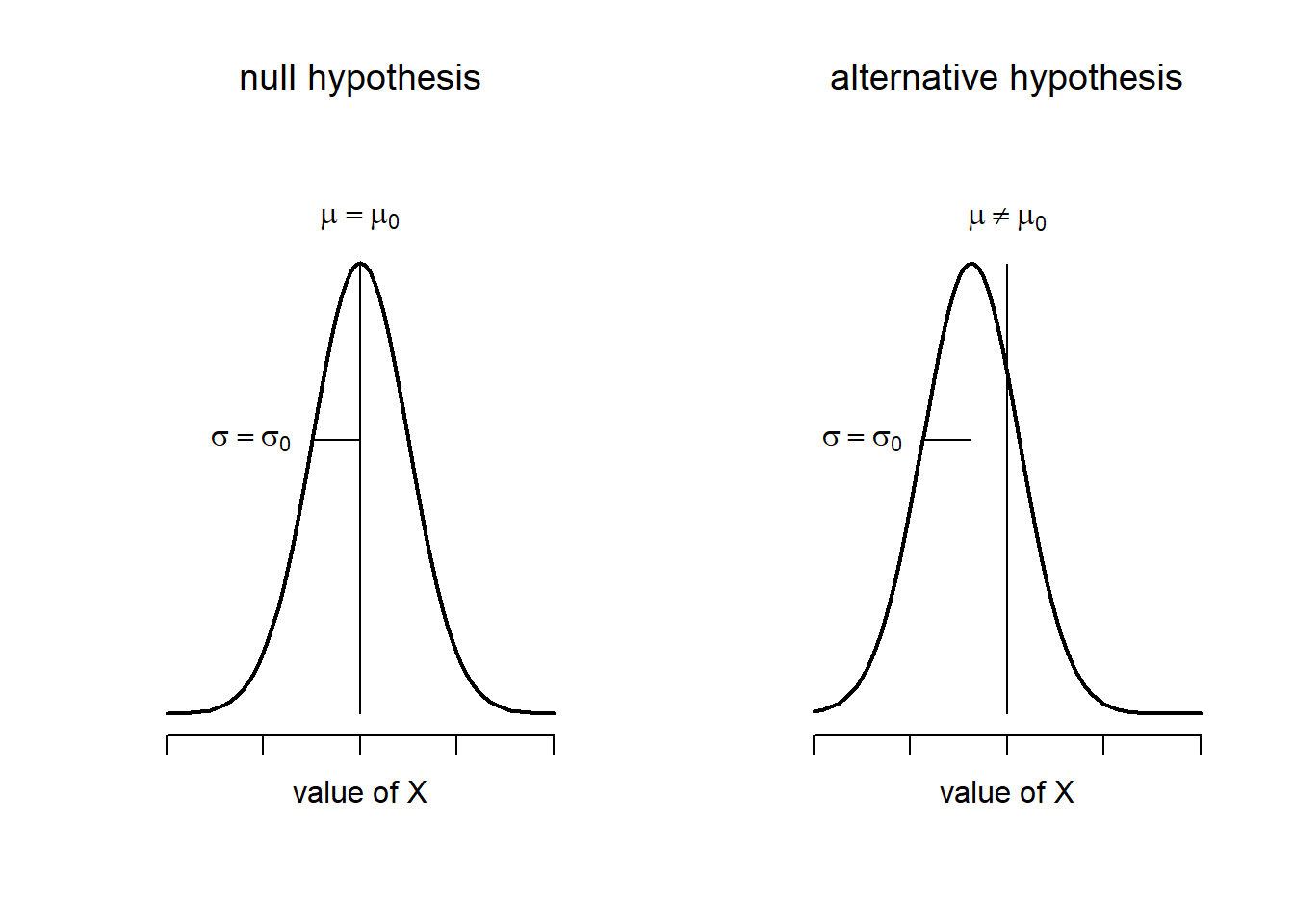
This visual contrasts sampling distributions under the null and alternative hypotheses, emphasizing that the test evaluates whether observed data align better with equal parameters or differing parameters. Although illustrated for means, the same logic applies to comparing two population proportions. Source.
Importance of Directionality in Hypothesis Formation
The direction stated in Ha affects:
The critical region for evaluating evidence.
The interpretation of p-values.
The sensitivity of the test to identify a difference in the specified direction.
Because statistical tests search for evidence supporting the alternative hypothesis, choosing the correct direction is essential. A poorly chosen or ambiguous Ha can invalidate conclusions, even if computations are correct.
Guidelines for Writing Hypotheses in Context
To ensure hypotheses are meaningful and aligned with AP expectations, the following practices are essential:
Use clear population labels for p1 and p2 to reflect the study groups.
State H0 and Ha fully and symbolically.
Match the direction of Ha to the study’s research question.
Avoid statements involving sample proportions or predictions about sample results.
Ensure the hypotheses address a difference in population proportions, as required by the syllabus focus.
Hypothesis formulation is not merely symbolic; it is a conceptual step that shapes the entire inference procedure. Clear, contextually grounded hypotheses enable valid, interpretable, and statistically sound conclusions about whether population proportions differ.
FAQ
There is no mathematical requirement for which group must be p1 or p2, but choosing the group mentioned first or the group expected to have the higher proportion as p1 helps maintain clarity.
If the research question is directional, assigning p1 to the group of primary interest prevents confusion when writing the inequality in the alternative hypothesis.
Consistency is the priority: once labels are chosen, they must be used throughout the entire inference procedure.
Hypotheses describe claims about populations, not the specific sample observed. Sample proportions are known quantities and therefore cannot be the subject of a hypothesis.
Using population proportions ensures the test evaluates evidence about the underlying parameter, which is the purpose of inferential statistics.
Yes, the two forms are algebraically equivalent and both are accepted in AP Statistics.
However, writing p1 − p2 = 0 can make the structure clearer when constructing later parts of the inference procedure, such as test statistics or confidence intervals.
The key requirement is that the null hypothesis expresses equality and the alternative hypothesis uses the correct inequality direction.
The wording of the research question determines direction.
Use a two-sided alternative when the question asks whether the proportions differ without specifying a direction.
Use a one-sided alternative only when the question explicitly indicates interest in a higher or lower proportion in one group.
Vague phrases such as “compare” or “investigate differences” do not justify a one-sided test.
If Ha does not directly contradict H0, the test cannot meaningfully evaluate evidence because the two statements do not define mutually exclusive possibilities.
Clear contradiction allows the p-value to quantify how surprising the data would be if the null hypothesis were true.
This structure ensures that rejecting H0 genuinely supports Ha, rather than merely indicating inconsistency or ambiguity in the hypothesis formulation.
Practice Questions
Question 1 (1–3 marks)
A researcher wants to test whether the proportion of customers who prefer Brand A differs between two cities, City 1 and City 2. Let p1 represent the true proportion in City 1 and p2 represent the true proportion in City 2.
(a) State appropriate hypotheses for this investigation.
(b) Explain why the alternative hypothesis must use an inequality symbol rather than an equals sign.
Question 1
(a) 2 marks total
• 1 mark for correct null hypothesis: H0: p1 − p2 = 0 or equivalent wording of no difference.
• 1 mark for correct alternative hypothesis: Ha: p1 − p2 ≠ 0.
(b) 1 mark
• 1 mark for stating that the alternative hypothesis expresses a directional claim about a difference and therefore must use an inequality symbol, not an equals sign.
Question 2 (4–6 marks)
A school administrator wants to know whether the proportion of students who support a new uniform policy is higher among sixth form students (Group 1) than among the rest of the school (Group 2). Let p1 be the true proportion of supportive sixth form students and p2 the true proportion of supportive non–sixth form students.
(a) Formulate suitable null and alternative hypotheses for this research question.
(b) State which group should be designated as p1 and justify this choice.
(c) Explain how the wording of the research question determines whether the test should be one-sided or two-sided.
(d) A student writes the null hypothesis as H0: p1 > p2. Explain why this is incorrect.
Question 2
(a) 2 marks total
• 1 mark for correct null hypothesis: H0: p1 − p2 = 0.
• 1 mark for correct alternative hypothesis: Ha: p1 − p2 > 0 (higher proportion in Group 1).
(b) 1 mark
• 1 mark for explaining that p1 should represent sixth form students because the research question compares their proportion to the rest of the school, making them the focal group.
(c) 2 marks total
• 1 mark for recognising that the phrase “higher among sixth form students” indicates a directional claim.
• 1 mark for stating that this requires a one-sided test with Ha indicating p1 > p2.
(d) 1 mark
• 1 mark for identifying that the null hypothesis must always include equality and cannot be stated using an inequality sign, because it represents the assumption of no difference.
