AP Syllabus focus:
‘Conditions for Statistical Inferences
- For independence: Data should be collected using a simple random sample.
- For homogeneity: Data should be collected using a stratified random sample or randomized experiment.
- When sampling without replacement, the sample size n should be less than 10% of the population size N (n ≤ 10% of N).
- Accuracy and Counts
- The tests become more accurate with larger counts. All expected counts should be greater than 5 for conservative accuracy.’
Verifying conditions for chi-square tests ensures that the statistical conclusions drawn from categorical data are trustworthy, accurate, and grounded in appropriate sampling and distributional assumptions.
Verifying Conditions for Chi-Square Tests
Before conducting any chi-square procedure, analysts must confirm that the data collection method and distributional requirements meet the assumptions underlying the test. These conditions ensure that the chi-square statistic follows its theoretical distribution closely enough for valid inference.
Sampling Requirements for Chi-Square Tests
Proper sampling protects the reliability of chi-square results by ensuring that observed patterns reflect population behavior rather than procedural bias.
For the chi-square test for independence, the syllabus requires that data come from a simple random sample, introduced here as a selection process in which every individual in a population has an equal chance of being chosen.
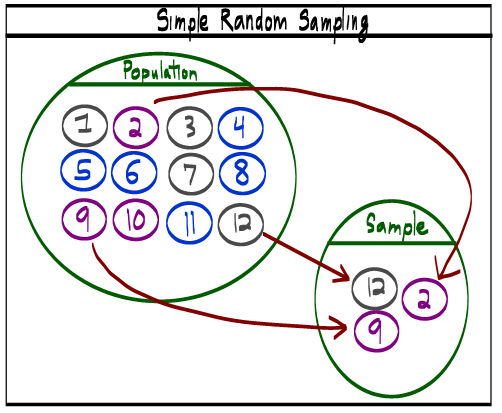
Diagram of a simple random sample drawn from a population of labeled units, illustrating that every individual has the same chance of selection. The image reinforces the sampling condition required for chi-square tests of independence. Additional contextual examples on the source page exceed AP requirements and may be ignored. Source.
Simple Random Sample: A sampling method in which every possible sample of a given size has an equal probability of being selected.
For the chi-square test for homogeneity, data must arise from a stratified random sample or randomized experiment, meaning observations are collected across predefined groups or treatments using random assignment or structured sampling.
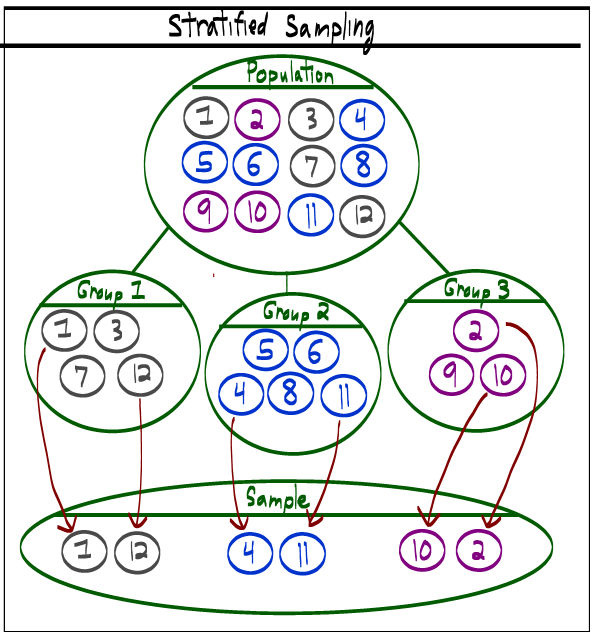
Diagram illustrating stratified sampling, where the population is partitioned into homogeneous subgroups and sampled within each stratum. This supports the sampling requirement for chi-square tests of homogeneity. Labels showing specific sampled balls provide extra detail not required for AP Statistics. Source.
A second sampling requirement applies when sampling without replacement. The 10% condition states that the sample size should be no more than 10% of the population size. Meeting this threshold keeps individual selections nearly independent and maintains the validity of probability calculations.
Ensuring Accuracy Through Expected Counts
Chi-square procedures rely on comparing observed counts to expected counts, and the accuracy of this comparison increases when expected category sizes are sufficiently large.
Expected Count: The value predicted for a category under the null hypothesis, representing what would occur if the hypothesized model were true.
The syllabus specifies that all expected counts should exceed 5 for conservative accuracy.
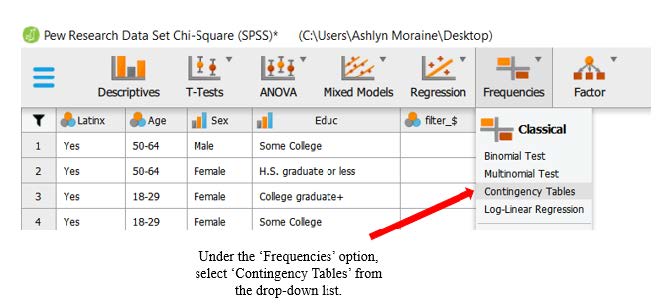
JASP output displaying observed and expected frequencies, with expected counts highlighted to verify whether each exceeds five. This visualization clarifies how to check the large-count condition before interpreting chi-square test results. Interface details visible around the table extend beyond AP expectations but can be disregarded. Source.
This rule ensures that the distribution of the chi-square statistic approximates the theoretical chi-square curve closely. Too-small expected counts can distort this distribution, compromising p-value calculations and inference results.
Why Expected Counts Must Be Large
Expected counts greater than 5 reduce skewness in the chi-square distribution and help stabilize the ratio of squared deviations to expected values. Because the chi-square statistic is computed using the formula shown below, values near zero or extremely small denominators can disproportionately influence the overall statistic.
EQUATION
= Chi-square statistic, measuring discrepancy between observed and expected counts
= Observed count in a category
= Expected count in the same category
Expected counts that are too small inflate the statistic or behave unpredictably, creating misleading evidence for or against the null hypothesis. Ensuring adequate counts protects against these distortions and supports accurate significance testing.
Independence Considerations in Sampling
Chi-square procedures assume that individual observations are independent, meaning the value of one observation does not influence another. Independence is largely guaranteed through proper sampling design but must still be conceptually verified before performing the test.
Independent Observations: A condition in which the occurrence of one event does not alter the probability of another event occurring.
When sampling without replacement, independence weakens slightly because each selection changes the composition of the remaining population. This is precisely why the 10% condition is required—keeping samples small relative to the population preserves near-independence.
Practical Checklist for Verifying Conditions
To ensure chi-square tests operate under appropriate assumptions, analysts should systematically confirm the following:
Sampling Method Requirements
Independence test → simple random sample
Homogeneity test → stratified random sample or randomized experiment
Independence in Sampling
When sampling without replacement, verify the 10% condition:
Sample size ≤ 10% of population
Accuracy of Expected Counts
All expected counts must be greater than 5
Check each cell individually in a two-way table
Appropriateness for Categorical Data
Variables must represent counts in discrete categories
These conditions collectively maintain the validity of chi-square inference and uphold the assumptions that allow the chi-square statistic to follow its theoretical distribution.
FAQ
Expected counts reflect what the distribution would look like if the null hypothesis were true, and the chi-square distribution relies on how these theoretical values behave. Small observed counts may simply reflect random sampling variation, but small expected counts indicate that a category is inherently too rare for the chi-square approximation to work reliably.
Because the chi-square formula divides by expected counts, very small expected values can overinflate the statistic, producing misleading evidence against the null hypothesis.
The 10% threshold is a rule of thumb to ensure observations behave as though they are independent. Slight violations rarely cause major problems if the sample is still a very small fraction of the population.
However, substantial violations increase dependence between observations, making probability calculations less stable and reducing the reliability of chi-square inference.
If only one cell slightly misses the threshold (for example, expected count around 4.8), many statisticians still proceed, especially when:
• The overall sample size is large
• The remaining expected counts comfortably exceed 5
• The result is supported by additional evidence or sensitivity checks
Nonetheless, the AP syllabus treats the guideline conservatively, so it is safest to meet the condition fully in exam contexts.
Chi-square statistics accumulate information across multiple categories, and dependency between observations can distort this accumulation.
If observations influence each other, patterns in the contingency table may reflect structural dependence rather than genuine associations between variables, causing the test to overstate or understate evidence.
Independence ensures that each count contributes valid, non-overlapping information to the chi-square statistic.
Independence is established at the design stage rather than through numerical checks. Researchers can ensure it by:
• Using random sampling procedures
• Avoiding selecting multiple individuals from tightly linked units (e.g., same household) unless designed appropriately
• Preventing participants from influencing one another’s responses
• Randomly allocating treatments in experiments
Clear documentation of the sampling or assignment method is the strongest evidence that the independence condition is satisfied.
Practice Questions
Question 1 (1–3 marks)
A researcher plans to use a chi-square test for independence to analyse whether two categorical variables are associated in a population. Before carrying out the test, the researcher checks the expected counts in the two-way table and finds that several expected counts are less than 5.
(a) Explain why this violates a required condition for the chi-square test.
(b) State one consequence of proceeding with the test despite this issue.
Question 1
(a)
• 1 mark for stating that the chi-square test requires all expected counts to be greater than 5.
• 1 mark for explaining that small expected counts make the chi-square approximation unreliable.
(b)
• 1 mark for identifying a valid consequence (e.g., increased risk of incorrect p-value, invalid inference, or misleading significance).
Question 2 (4–6 marks)
A school is investigating whether students’ preferred study method (online, textbook, or group study) is associated with year group (Year 10 or Year 11). Data are collected using a simple random sample of students from each year group.
Before running a chi-square test for independence, the school wishes to verify that the required conditions are met.
(a) State the sampling condition for independence and explain whether it is satisfied in this study.
(b) State the 10% condition and explain its purpose.
(c) The expected counts for all cells are greater than 5. Explain why this is important for the accuracy of the chi-square test.
Question 2
(a)
• 1 mark for stating the sampling condition: data must come from a simple random sample for independence tests.
• 1 mark for explaining that the condition is satisfied because the school used a simple random sample of students from each year group.
(b)
• 1 mark for stating the 10% condition: the sample should be less than 10% of the population when sampling without replacement.
• 1 mark for explaining that the purpose is to maintain approximate independence between observations.
(c)
• 1 mark for stating that expected counts greater than 5 allow the chi-square statistic to follow its theoretical distribution accurately.
• 1 mark for explaining that this ensures p-values and significance conclusions are valid.