

AP Syllabus focus:
‘Detailed criteria for selecting the correct inference procedure. This includes considerations such as the type of categorical data (one-sample, two-sample), the goals of the analysis (comparing proportions, testing independence), and the assumptions underlying each test. Emphasis on understanding the conditions that must be met for each test, including sample size requirements, randomness of sampling, and expected counts in contingency tables.’
Selecting the correct categorical inference procedure requires understanding the research question, the structure of the data, and the assumptions supporting each statistical test. These criteria guide analysts toward valid, defensible conclusions.
Determining the Type of Categorical Data
A central step in selecting an appropriate procedure is recognizing the structure of the categorical variable(s) involved. Analysts must distinguish whether the setting involves one-sample, two-sample, or multivariable categorical data.
One-Sample Categorical Data
One-sample settings involve a single categorical variable measured for one population or group. These situations typically prompt questions about whether the observed distribution aligns with a proposed model.
Two-Sample Categorical Data
Two-sample structures arise when comparing categorical distributions across two independent groups. The focus is often on determining whether group differences reflect sampling variation or true underlying differences.
Clarifying the Goal of the Analysis
The intended purpose of the statistical investigation directly influences which inference procedure is appropriate. Careful alignment between the research question and the available methods is essential.
Comparing Proportions Versus Testing Independence
Consider whether the goal is to compare category proportions across groups or to evaluate relationships between variables.
Comparing proportions involves assessing whether differences in category frequencies across groups are meaningful.
Testing independence evaluates whether two categorical variables in a single population are associated or operate independently.
Each goal requires different statistical procedures because the underlying hypotheses and interpretations differ.
Linking Questions to Specific Procedures
Understanding analytical goals helps guide selection among the major categorical inference procedures.
Goodness-of-Fit Procedures
The chi-square goodness-of-fit test evaluates whether a single categorical variable follows a specified distribution. This test is appropriate when expected proportions are known and only one variable is under study.
Tests for Independence
A chi-square test for independence examines whether two variables measured within one sample are related. It is chosen when both variables are categorical and the interest lies in potential associations rather than group comparisons.
Tests for Homogeneity
A chi-square test for homogeneity investigates whether multiple populations share the same categorical distribution. Although the statistic is computed similarly to the independence test, the sampling design distinguishes the two.
Selecting among these procedures requires both conceptual clarity and awareness of the data collection process.
Identifying Required Assumptions and Conditions
Inference procedures rely on specific assumptions to ensure accuracy. Analysts must confirm that the conditions for a chi-square–based method are satisfied before proceeding.
Random Sampling Requirements
Randomization supports the validity of inference about populations.
For independence, data must come from a simple random sample of a single population.
For homogeneity, data arise from multiple populations or treatment groups produced by stratified random sampling or random assignment.
Because sampling processes directly influence interpretation, confirming proper randomization is essential before selecting a procedure.
Large Sample Requirements
Chi-square procedures depend on sufficiently large samples for reliable approximations.
Expected Count: The theoretical count anticipated in each cell of a categorical table under the null hypothesis, computed using hypothesized proportions or marginal totals.
To use a chi-square method appropriately, all expected counts must exceed 5. This condition ensures the chi-square distribution provides an accurate model for the test statistic.
Confirming adequacy of sample size prevents distortions from small expected frequencies and maintains the integrity of the inferential conclusion.
Considering Structure of Two-Way Tables
When evaluating relationships or comparing distributions, the form and size of a two-way table influence the degree of freedom and test sensitivity. Analysts must ensure the categorical variables have clearly defined, mutually exclusive categories and that observations fall into only one cell of the table. You can think of these criteria as a decision process that starts with the research question and moves through the structure of your data.
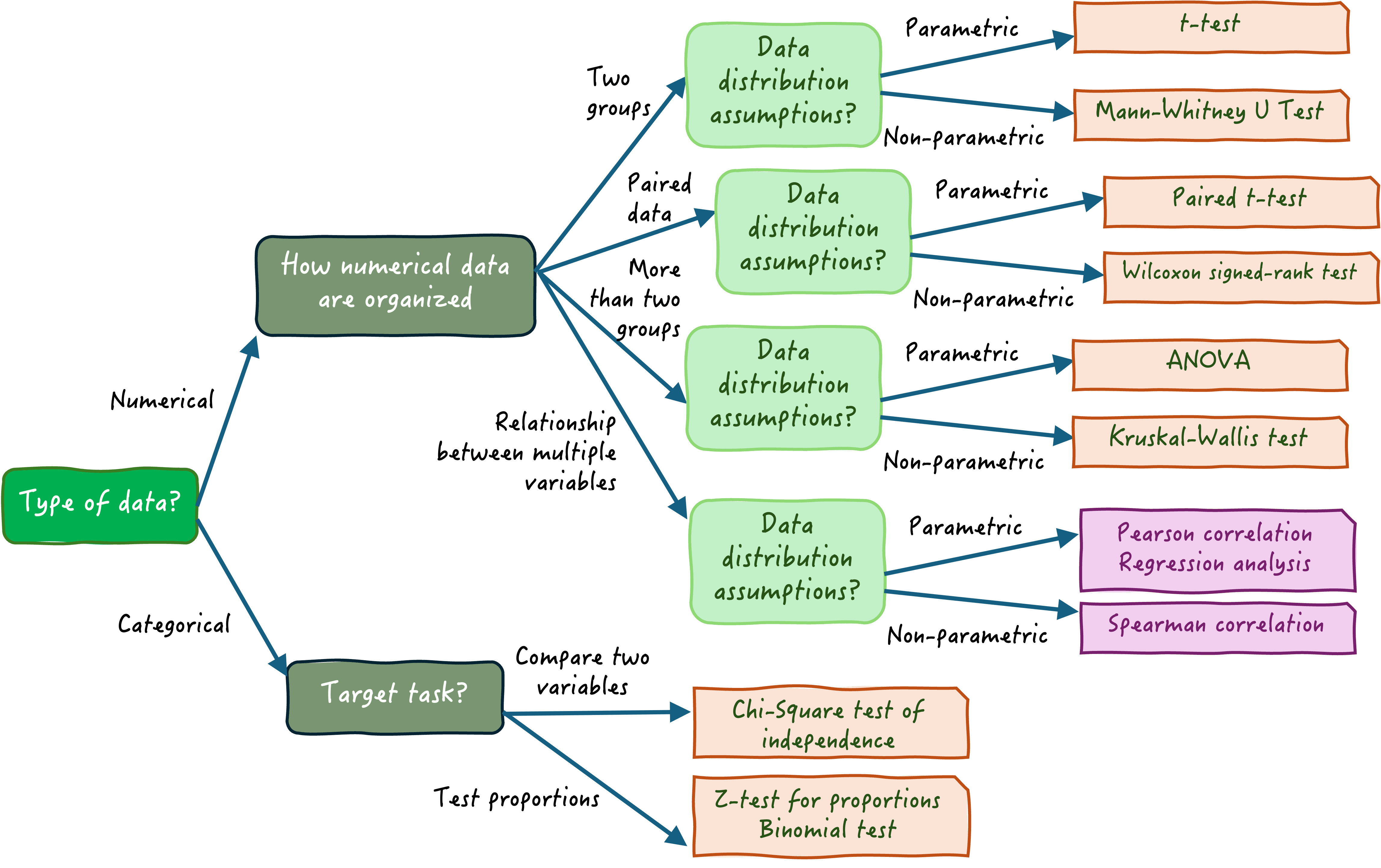
A decision-tree diagram guiding the choice of statistical test based on the type of data and the goal of the analysis. The flowchart shows where chi-square tests for independence and tests for proportions arise when working with categorical data. The diagram also includes additional tests for numerical data that extend beyond this subsubtopic but help place chi-square procedures in a broader inferential context. Source.
Ensuring Independence of Observations
Because chi-square methods assume independent observations, the sampling design must prevent individuals or units from contributing more than once. Violation of this assumption compromises both test validity and interpretation.
Aligning Research Questions With Conditions
Once conditions are checked, the analyst can link the research question to the most appropriate test.
Use goodness-of-fit when analyzing one categorical variable against a predicted distribution.
Use independence when analyzing whether variables in a single population are related.
Use homogeneity when comparing distributions from multiple populations or treatments.
This alignment ensures that results are meaningful within the intended context.
Evaluating Practical Considerations
Beyond statistical requirements, analysts should verify that categories are clearly defined, that sample sizes across groups are adequate, and that the inference procedure reflects the real-world question being asked. The combination of structured decision-making and adherence to assumptions supports valid inference and strengthens the quality of statistical reasoning.
In a chi-square test for independence or homogeneity, data are usually organized in a two-way table, with one variable forming the rows and the other forming the columns.
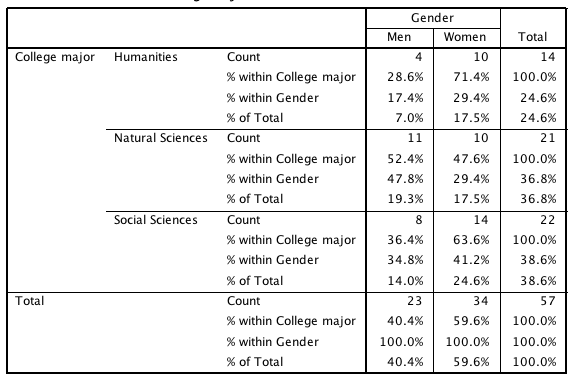
A two-way contingency table showing college major by gender, including cell counts and multiple types of percentages. This structure mirrors the tables used when selecting chi-square tests for independence or homogeneity to analyze categorical associations. Some percentage formats exceed the syllabus requirements but remain consistent with typical AP Statistics presentations. Source.
FAQ
A common issue is assuming that any table of categorical counts automatically calls for a chi-square test for independence. If the data come from multiple populations rather than one, the correct test is homogeneity instead.
Misidentifying whether the sample represents one population or several can change both the hypotheses and interpretation, so confirming the sampling design is essential.
Both tests use identical chi-square calculations, so the distinction lies entirely in how the data were collected.
To choose correctly, ask:
• Were all observations taken from one random sample? → Independence
• Were data collected from multiple groups or treatments? → Homogeneity
If the sampling design is unclear, the inference context must be clarified before proceeding.
Expected counts indicate whether the chi-square approximation will be reliable for the planned test. If many expected counts fall below 5, the chi-square test may produce misleading p-values.
Checking expected counts early prevents choosing a procedure that is invalid for the available sample size, prompting the analyst to revise categories or seek alternative methods.
More categories increase the degrees of freedom, which generally improves the accuracy of the chi-square approximation but also increases the amount of data needed.
If the sample is small relative to the number of categories, expected counts may become too low. In such cases, analysts may need to:
• Combine logically related categories
• Reconsider whether the planned inference question is feasible
If categories are ambiguous or overlapping, the assumptions of chi-square procedures are violated because observations may not fall into mutually exclusive classes.
Clear definitions ensure that the data structure truly matches the conceptual requirements of independence or homogeneity testing. This step also prevents misclassification that could distort expected counts and bias conclusions.
Practice Questions
Question 1 (1–3 marks)
A researcher collects data on two categorical variables from a single random sample of 500 individuals. The research question is whether the two variables are associated.
(a) State the most appropriate inference procedure for this analysis and briefly justify your choice.
Question 1
(a)
1 mark for identifying the chi-square test for independence.
1 mark for stating that the test is appropriate because two categorical variables are measured within a single population.
1 mark for indicating that the research question concerns whether the variables are associated or independent.
Question 2 (4–6 marks)
A school district compares the distribution of students’ preferred study methods (Group revision, Independent study, Online tutoring) across three different schools.
(a) Identify the categorical data structure involved.
(b) State the appropriate chi-square inference procedure and explain why it is suitable.
(c) List the conditions that must be verified before carrying out this procedure and briefly explain why they matter.
Question 2
(a)
1 mark for identifying a two-way table structure or stating that the data compare distributions across multiple populations.
(b)
1 mark for stating that the appropriate procedure is the chi-square test for homogeneity.
1 mark for explaining that this test compares categorical distributions across several groups or populations.
(c)
1 mark for stating the random sampling or random assignment requirement (stratified or independent samples for homogeneity).
1 mark for stating the expected counts condition (all expected counts should be greater than 5).
1 mark for explaining why the conditions matter (to ensure accuracy of the chi-square approximation and validity of inference).
