AP Syllabus focus:
‘Focus on evaluating the effectiveness and appropriateness of selected inference procedures in different scenarios. Concepts to be Covered:
- Discussion on how to evaluate the results obtained from various inference procedures for quantitative data related to slopes.
- Critical analysis of case studies where different inference procedures were selected and applied, assessing their effectiveness in answering research questions or achieving study objectives.
- Guidance on how to critically assess the alignment between the chosen inference procedure, the data characteristics, and the research objectives, ensuring the most accurate and informative outcomes.’
Evaluating inference procedures for regression slopes requires judging whether the method used, its assumptions, and its conclusions genuinely address the research question with statistical integrity.
Understanding the Purpose of Evaluating Inference Procedures
Evaluating inference procedures involves determining whether a chosen method for analyzing quantitative data related to slopes appropriately reflects the structure of the data and the research goals.
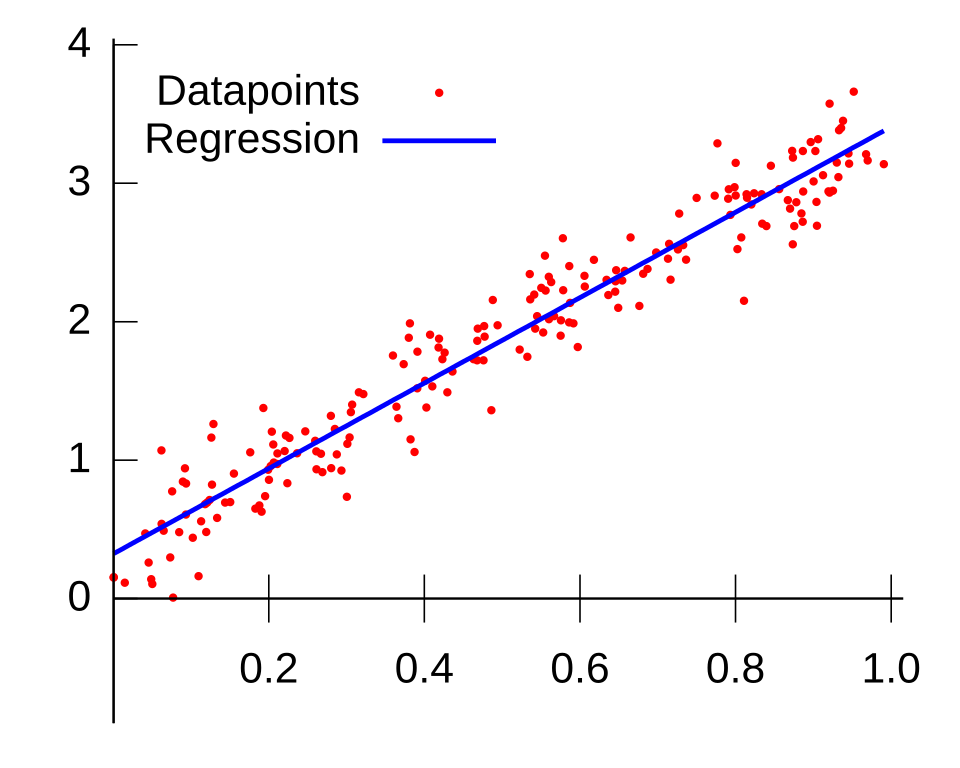
The figure displays a basic linear regression fit, illustrating how a straight-line model summarizes the trend in the data and supports evaluation of model appropriateness for slope inference. Source.
This subsubtopic emphasizes the ability to assess whether procedures such as confidence intervals for the slope, significance tests for the slope, or broader regression inference tools were correctly selected and effectively applied.
Key Considerations When Evaluating Inference Procedures
When examining the results of an inference procedure, students must judge how well the method aligns with the research objective and whether conclusions about the population slope are justified. This evaluation involves checking that:
The procedure chosen directly answers the stated research question.
All necessary statistical conditions were met before performing the procedure.
The results are interpreted within the context of the sample and the population it represents.
Assessing the Effectiveness of an Inference Procedure
The effectiveness of an inference procedure depends on how well it supports the intended claim about the relationship between variables. Effective procedures provide interpretable, statistically valid statements about the slope or associated uncertainty.
Evaluating Method Selection
A central task is determining whether the correct inference procedure was chosen. For slope-related questions, this usually involves either a confidence interval (for estimation) or a significance test (for hypothesis testing). Students should assess whether the chosen method fits the research aim, such as estimating the true slope or evaluating whether evidence suggests a nonzero slope.
Conditions and Their Role in Evaluation
Evaluating an inference procedure always requires inspecting whether essential conditions were satisfied.
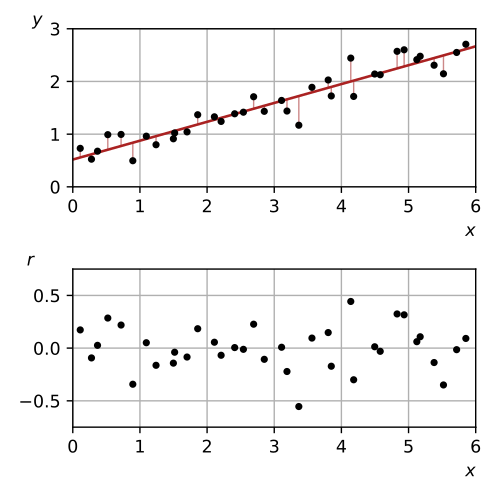
The panels illustrate both the fitted regression model and its residuals, demonstrating how linearity and constant variability conditions can be evaluated when assessing the suitability of inference procedures. Source.
These include:
Linearity between the explanatory and response variables, verified by examining residual patterns.
Constant variability of residuals across values of the explanatory variable.
Independence of observations, supported by random sampling or experimental design.
Normality of the conditional distribution of the response variable, relevant when sample sizes are moderate or small.
If these conditions were not checked or were violated, students must recognize that conclusions may lack reliability.
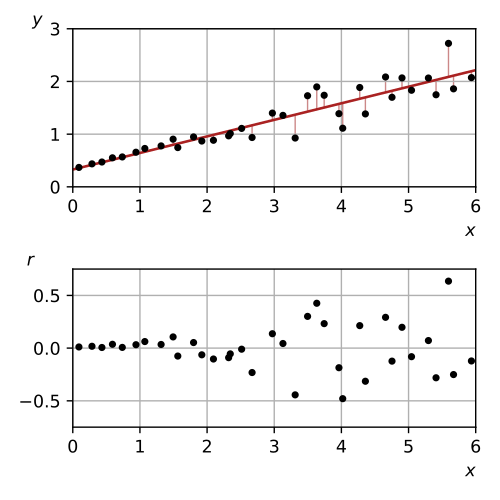
The graphic highlights increasing residual spread, indicating a violation of the constant-variability assumption. Such patterns help students evaluate the reliability of inference procedures for the slope. Source.
Aligning Data Characteristics With the Research Objective
Assessment requires confirming alignment among the data structure, the research question, and the inference method. A procedure is appropriate only when it meaningfully addresses the claim being made and respects the limitations of the dataset.
Components of Alignment
Students should reflect on several layers of alignment:
Whether the sample represents the population of interest.
Whether the form of the data supports linear modeling.
Whether the chosen inference method captures the type of uncertainty relevant to the research objective.
Critical Analysis of Results From Inference Procedures
Critical analysis involves examining how well the reported results answer the research question, considering both statistical reasoning and contextual interpretation.
Evaluating Confidence Interval Results
A confidence interval gives a range of plausible values for the population slope. Students should evaluate whether:
The interval meaningfully informs the research question.
The width of the interval reflects reasonable precision given the sample size.
The interpretation references the population and acknowledges the probabilistic nature of interval estimation.
Evaluating Significance Test Results
For a significance test, evaluation focuses on whether the test statistic, p-value, and conclusions logically support or fail to support the claim about the slope. Students should also consider whether the significance level used is appropriate and clearly stated.
Criteria for Determining the Appropriateness of an Inference Procedure
Using structured criteria helps ensure a robust evaluation. Students should examine the following:
Whether the research question pertains to estimation or hypothesis testing.
Whether the statistical method directly produces the type of information needed.
Whether assumptions were verified and justified.
Whether the conclusions stay within the limits of the data and analytical method.
List of Evaluation Steps
Students can apply the following steps when evaluating any inference procedure involving slopes:
Identify the research objective and determine whether it aligns with the chosen inference method.
Check whether all required conditions were assessed and met.
Determine whether the interpretation of results correctly references the slope in context.
Evaluate whether the selected method and conclusions appropriately reflect data limitations.
FAQ
A procedure may be overly complex if the research question only requires a descriptive summary rather than a formal inference about the population slope.
A simpler approach may be appropriate when:
• The goal is exploratory rather than confirmatory
• The dataset is extremely small or not intended for generalisation
• The relationship is clearly non-linear, making slope-based inference irrelevant
Evaluating complexity helps ensure that the analytical method matches the purpose of the study.
Representativeness affects whether conclusions about the population slope are credible. Even if all statistical conditions for regression are met, a non-representative sample can lead to misleading inference.
Considerations include:
• Whether certain groups are systematically over- or under-sampled
• Whether the selection mechanism could bias the slope estimate
• Whether contextual factors limit generalisability
Inference is only useful when the sample reflects the target population.
Sometimes diagnostic plots do not all tell the same story. For example, residuals may appear linear but show mild increasing spread.
When indicators conflict:
• Prioritise violations that most strongly affect standard errors, such as heteroscedasticity
• Consider whether the sample size compensates for minor assumption issues
• Assess whether transformation or alternative modelling would provide a more reliable slope
The goal is not perfect diagnostics but defensible inference.
Usefulness depends on how clearly the procedure answers the research question and how precisely it quantifies uncertainty.
Criteria include:
• Precision of interval estimates or clarity of hypothesis results
• Sensitivity to assumption violations
• Transparency of interpretation for the study context
• Alignment with the intended inference (estimation versus testing)
A procedure is more informative when it provides clear, contextually meaningful insight into the population slope.
Borderline issues require judgement rather than automatic rejection of the procedure.
Possible approaches:
• Assess whether the violation meaningfully shifts the slope estimate or inflates the standard error
• Evaluate robustness given the sample size
• Consider reporting limitations alongside conclusions
• Explore alternative methods only if the violation clearly undermines reliability
The emphasis is on responsible interpretation rather than rigid rule-following.
Practice Questions
Question 1 (1–3 marks)
A researcher fits a linear regression model to investigate whether average daily temperature predicts electricity usage in a city. The resulting residual plot shows a curved pattern rather than random scatter.
(a) Based on this residual pattern, evaluate whether a linear regression inference procedure for the slope is appropriate.
(b) State one implication this has for interpreting any confidence interval or significance test for the slope.
Question 1
(a) 1 mark for identifying that the procedure is not appropriate because the curved pattern indicates non-linearity.
1 mark for recognising that linearity is a required condition for valid inference about the slope.
(b) 1 mark for stating an implication such as: the confidence interval or test for the slope may be unreliable, biased, or may misrepresent the true relationship.
Total: 2–3 marks (award 3 if both points in part a are fully stated and part b is answered clearly).
Question 2 (4–6 marks)
A study investigates whether time spent practising a musical instrument each week predicts performance score on an assessment. A random sample of 45 students is used. A regression model is fitted and a 95% confidence interval for the slope is reported as 0.12 to 0.58 points per hour.
(a) Evaluate whether this confidence interval appropriately supports the claim that increased practice leads to higher performance.
(b) Discuss two considerations that should be checked to judge whether the inference procedure used is appropriate for this dataset.
(c) Explain how a violation of one of these considerations could affect the conclusions drawn from the interval.
Question 2
(a) Up to 2 marks:
1 mark for noting that the entire interval is positive, suggesting evidence that greater practice is associated with higher scores.
1 mark for stating that this supports, but does not prove, the claim due to sampling uncertainty and model assumptions.
(b) Up to 2 marks:
Award 1 mark each for any two appropriate considerations, such as:
Linearity between practice time and performance.
Constant variability of residuals.
Independence of observations.
Normality of residuals or appropriateness of sample size.
(c) Up to 2 marks:
1 mark for describing how a violation (e.g., non-linearity or heteroscedasticity) undermines the validity of the interval.
1 mark for explaining that conclusions about the slope could be misleading, imprecise, or invalid due to incorrect standard error estimation.
Total: 4–6 marks