Contents
Understanding the principle of conservation of linear momentum is essential for comprehending various physical phenomena, especially in the realm of collisions and motion. In physics, particularly in mechanics, this principle provides a cornerstone for problem-solving. These notes delve into the conservation of linear momentum, focusing on its application in one-dimensional collision scenarios, such as those involving direct impacts and coalescing bodies.
Conservation of Momentum
Basics of Conservation of Linear Momentum
- What It Is: If no outside forces act on a system, its total momentum doesn't change.
- Formula: Total momentum = sum of each particle's momentum , where is mass and is velocity.
One-Dimensional Collisions
- Use Case: Helps predict outcomes in straight-line collisions (like car crashes).
- Example Problem: Two-Car Collision
- Initial Setup: Car A , Car B .
- Step 1: Initial momentum = .
- Step 2: Conservation of momentum = Initial momentum = Final momentum.
- Step 3: Final velocity = .
- Conclusion: Both cars move together at after collision.
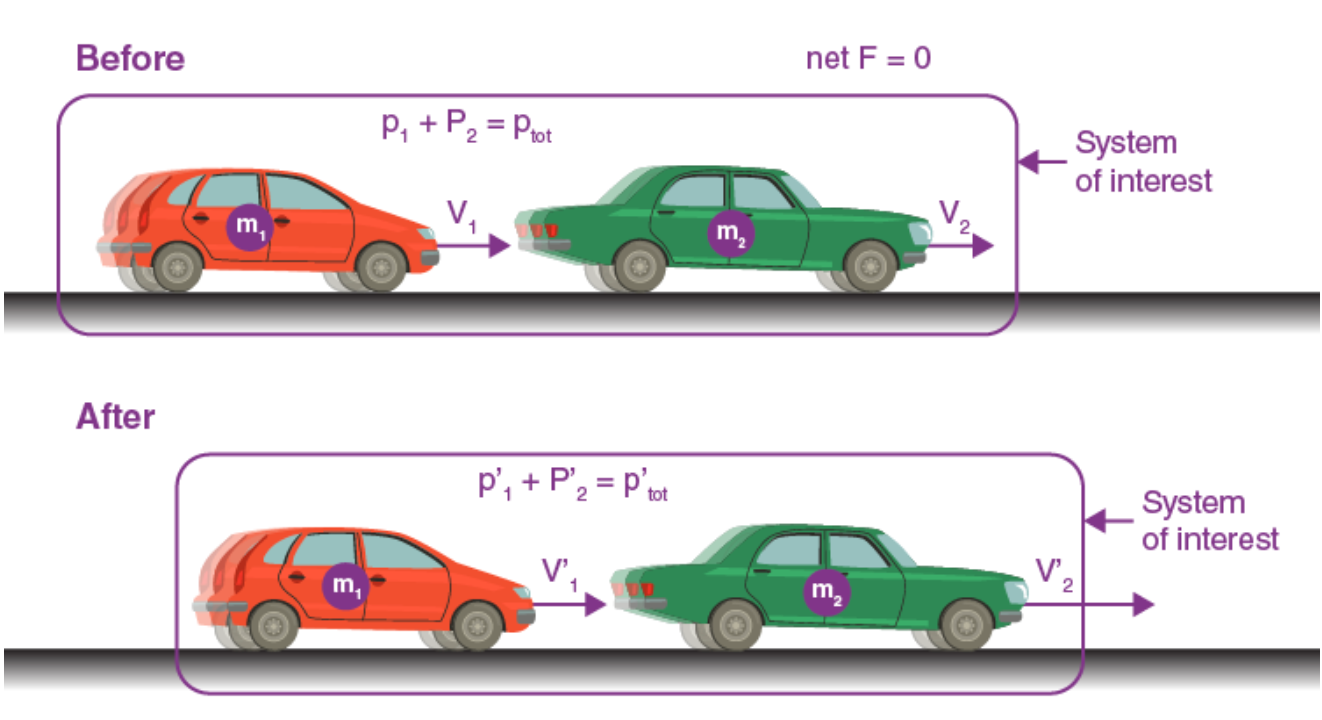
Image courtesy of BYJUS
Collisions Leading to Coalescence
- What Happens: Objects stick together and move as one after collision.
- Analysis: Use momentum conservation to find final velocity.
- Example Problem: Colliding Balls
- Initial Setup:
- Ball 1: mass , velocity
- Ball 2: mass , velocity (stationary)
- Step 1: Initial momentum is calculated as = = =
- Step 2: Conservation of momentum states that
- Step 3: The final velocity is then
- Conclusion:
- Both balls move together at after the collision.
- Initial Setup:
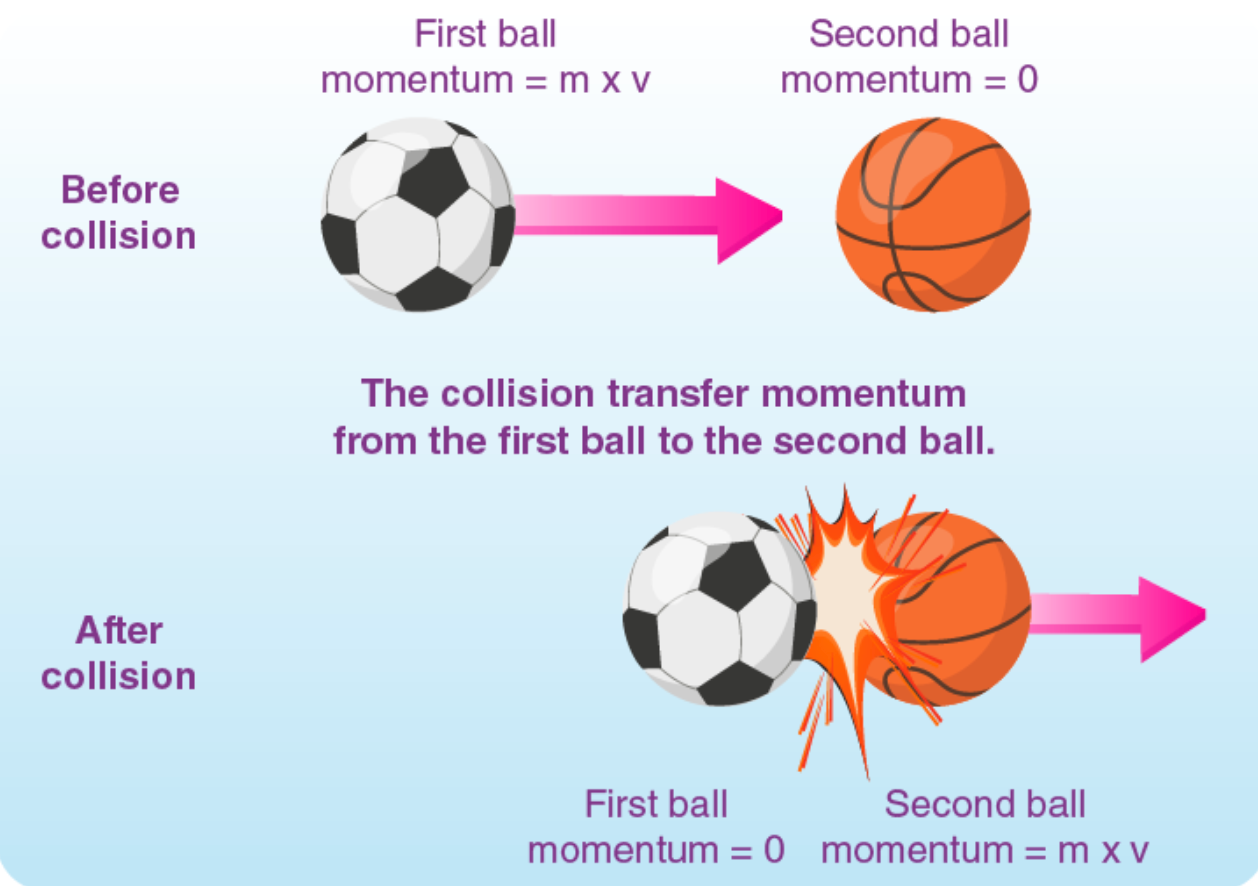
Image courtesy of BYJUS