
Questions
Question 1
Bolaria and the global lithium market
Table 1: Balance of payments for Bolaria (millions of USD), 2025
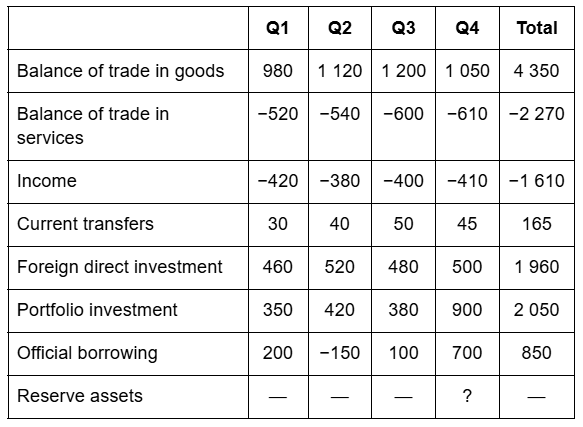
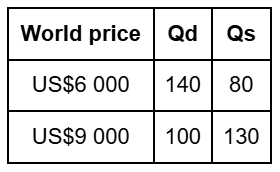
Table 2: Lithium in Bolaria — demand and supply at two world prices
(Price in USD per tonne; quantities in thousand tonnes)
Lithium extraction in Bolaria has expanded rapidly. However, community groups report brine-water depletion in salt-flat regions and tailings runoff that harms nearby grazing lands. Indigenous communities also claim reduced access to traditional water sources used for small-scale agriculture and herding.
Using Table 1, calculate Bolaria’s current account balance for Q3 2025.
The financial account balance for Q4 2025 was 1 800 million USD. Using Table 1, calculate the change in reserve assets for Q4 2025 and state whether reserve assets increased or decreased.
Using Table 2, calculate the change in domestic spending on lithium (P×Qd) when the world price rises from 6 000 USD to 9 000 USD per tonne.
Using Table 2 and the midpoint method, calculate the price elasticity of demand (PED) for lithium in Bolaria when price rises from 6 000 USD to 9 000 USD per tonne.
Using Table 2, calculate the change in the net export value of lithium (exports − imports) for Bolaria when the world price rises from 6 000 USD to 9 000 USD per tonne.
Using an international trade diagram, explain how an export subsidy could be used to increase the quantity of lithium exports from Bolaria.
Define the term common access resources.
Using an externalities diagram and the information provided, explain how lithium extraction in Bolaria can result in market failure.
Using the text/data provided and your knowledge of economics, recommend a policy the government of Bolaria could introduce to address the market failure in lithium extraction.