
Questions
Question 1
The diagram shows five small graphs on the same axes grid. Use the sketches to answer the questions.
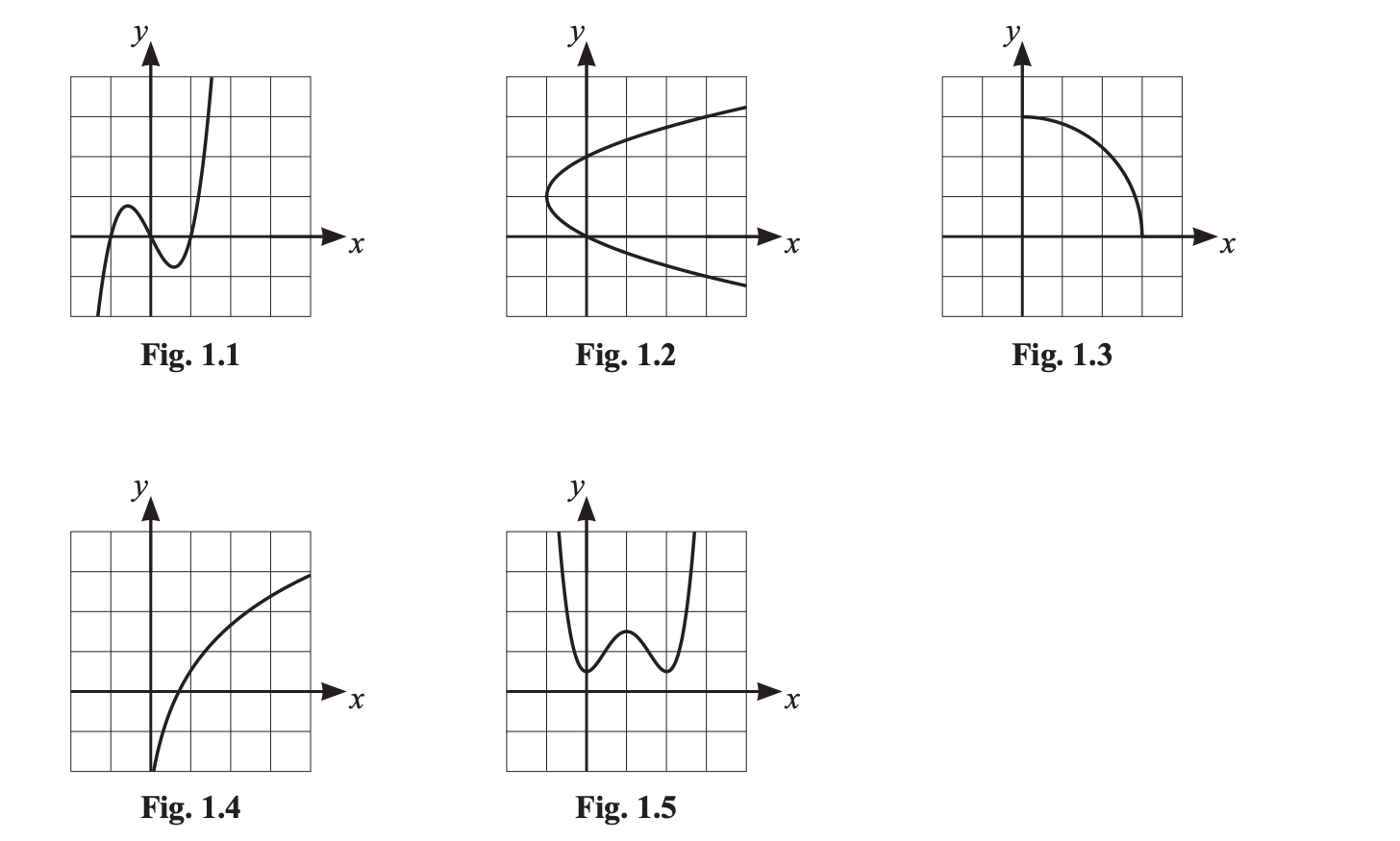
From the set of five sketches, select all the relations that are functions. Give a brief reason using the vertical line test.
From those that are functions, select any one that is not one-to-one and explain why using the horizontal line test.
For one graph that is a one-to-one function, state its domain and range as suggested by the sketch and describe how the graph of its inverse would relate to it. No sketch required.
Question 2
The diagram shows the curve with a point , its normal at , and the origin .
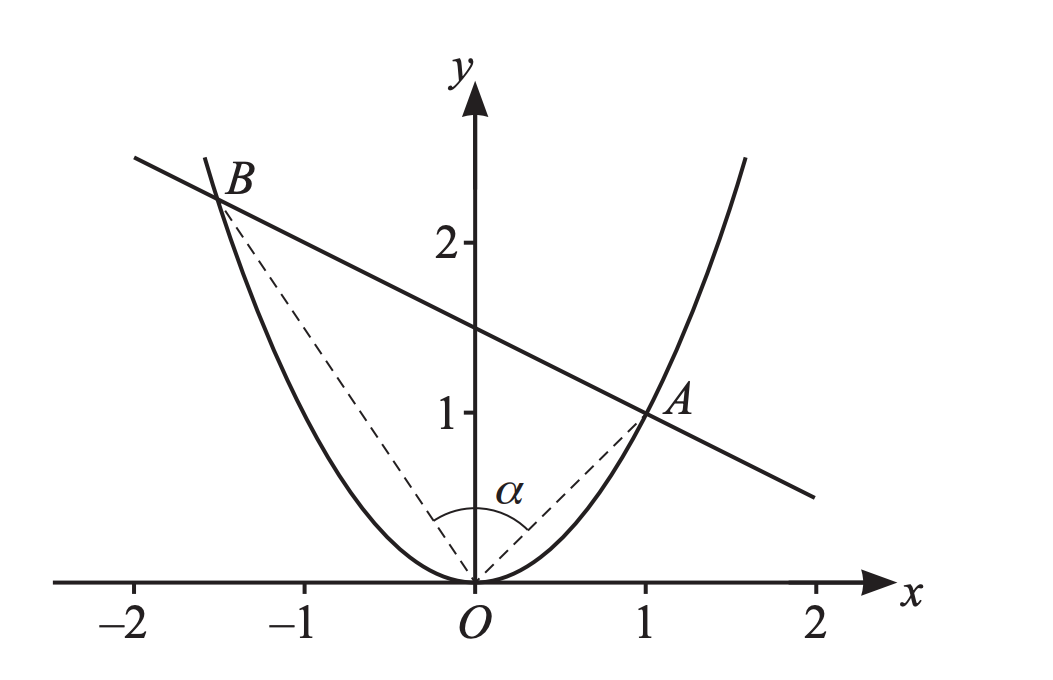
Find the equation of the normal to at .
The normal meets the parabola again at . Find the coordinates of .
Let be the angle (the angle between and ). Show that .
Question 3
The diagram shows a circle with centre , radius , and arc subtending angle at . Point is the midpoint of , so .
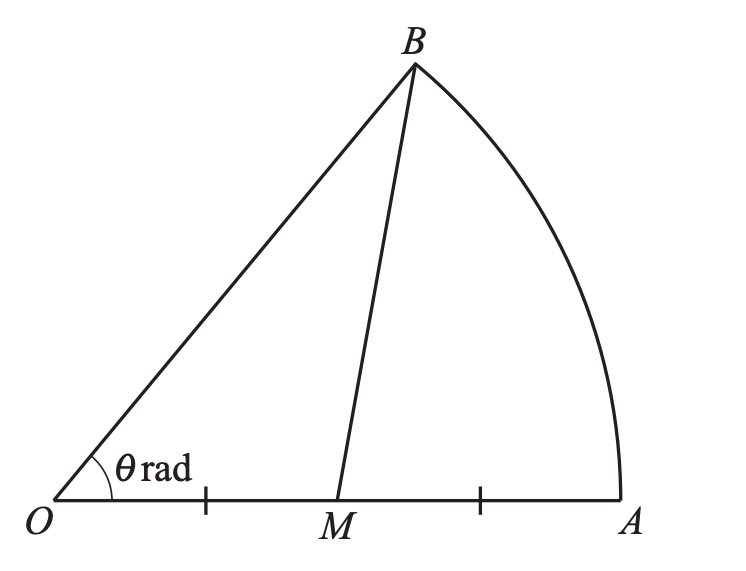
Write down, in terms of and (radians), the length of arc and the area of sector .
Consider the smaller, concentric sector of radius and angle . Show that , where denotes the annular sector between radii and .
If and arc has length , find and hence the area of region .
Question 4
Solve for : .
Solve for : , given .
Question 5
A small sample of seven measurements (in mm) is:
4, 7, 8, 9, 10, 10, 25
Find the median and the interquartile range (IQR).
Using the rule, decide whether is an outlier. Show working.
If all values were decreased by 3, state the new mean and state what happens to the standard deviation.
Question 6
A quadratic function has vertex and passes through .
Write in vertex form and then in expanded form.
Find the discriminant and hence the number of real roots.
Solve exactly.
Question 7
The diagram shows the curves and . They intersect at the point on the -axis. The shaded region is bounded by the curves and the -axis.
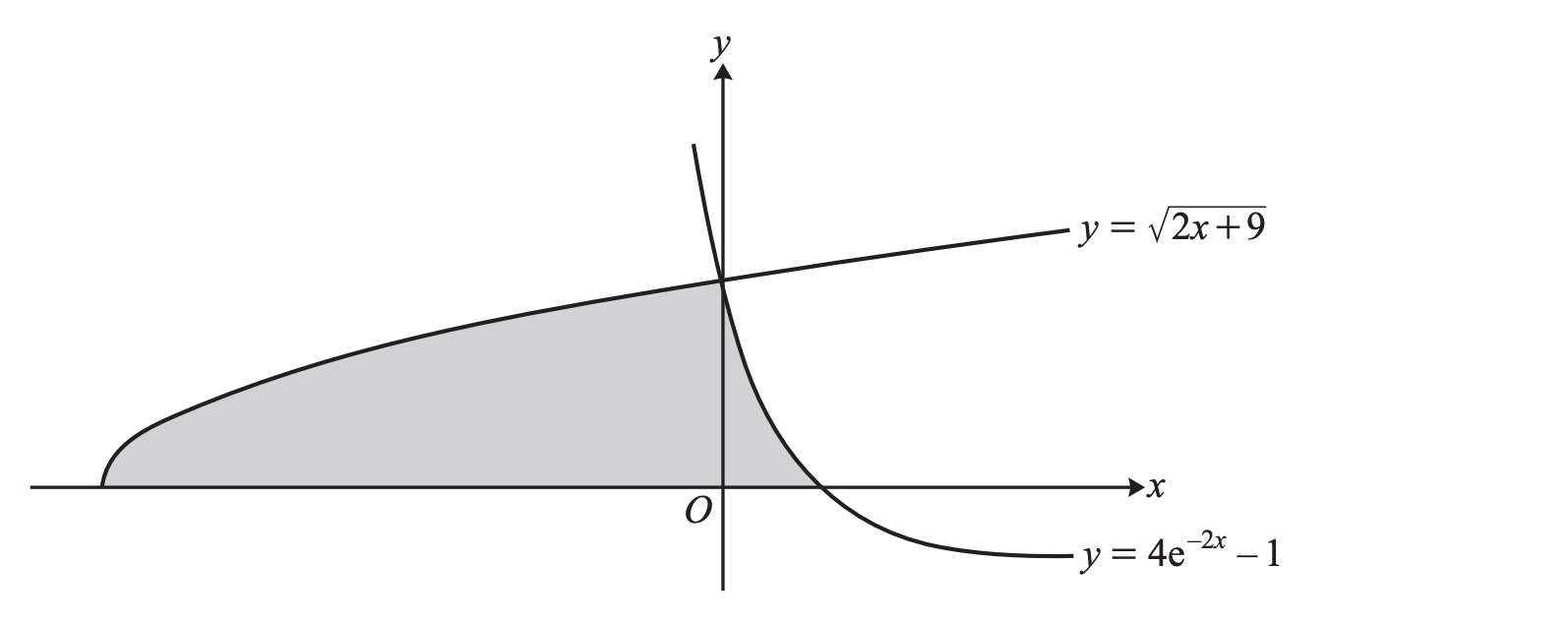
Show that the curves intersect at .
Find the -intercepts of each curve.
Write an exact expression, as a sum of definite integrals, for the total shaded area.
Hence find the exact value of the shaded area.
Question 8
Let .
State the amplitude, the midline, and the period of .
Find the maximum value of and one -value in at which it occurs.
Solve for in . Give exact values.
Question 9
A rectangle has its upper vertices on the curve and its base on the -axis. The rectangle is symmetric about the -axis.
Show that if the right-hand upper vertex is with , then the area of the rectangle is .
Find the value of that maximises and the maximum area.
Determine the -coordinate of the rectangle’s upper side at maximum area.