
Questions
Question 1
The diagram shows the curve . Point P lies on the curve where the tangent has gradient .
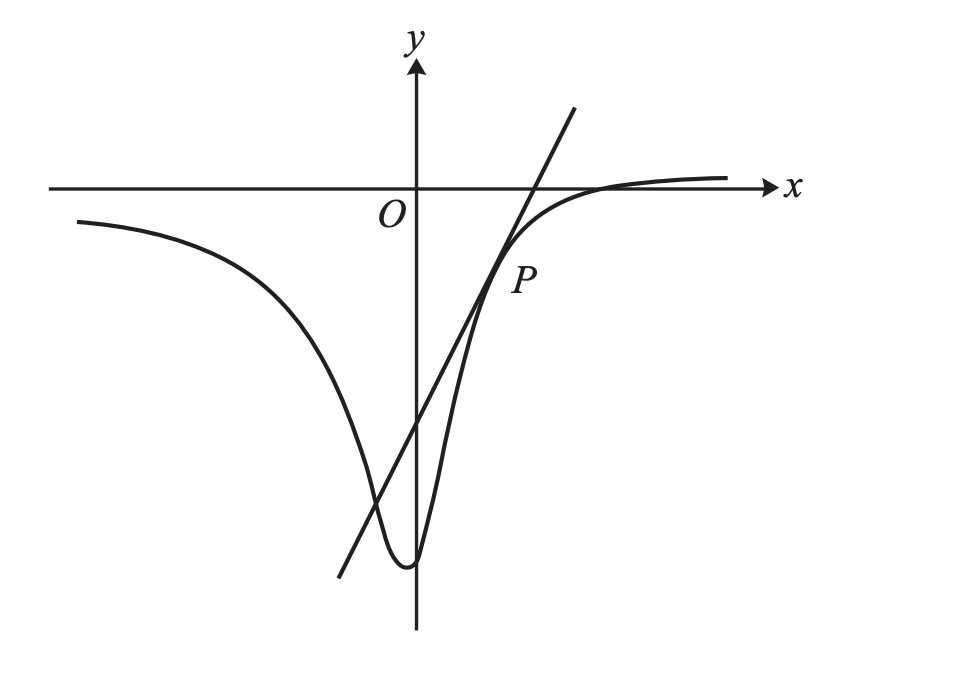
Find the coordinates of P, given that .
Find the equation of the tangent at P. Give your answer correct to significant figures.
State the horizontal asymptote of the curve.
Question 2
The diagram shows sector AÔB of a circle with centre O, radius and angle AÔB radians.
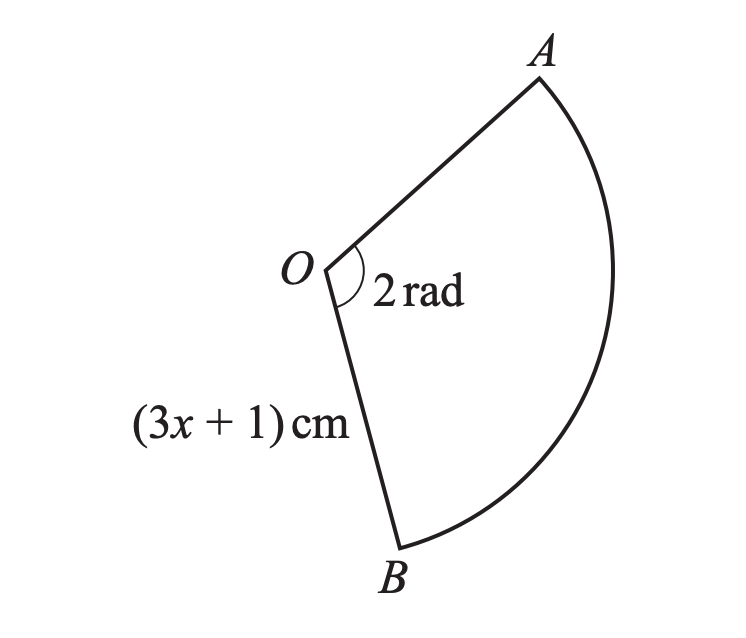
Given that the area of the sector is less than , find the set of possible values of .
For , find the length of arc AB.
Question 3
The table shows paired observations from a calibration experiment.
: , , , , , , ,
: , , , , , , ,
Using technology, find , and the population standard deviations of and , each correct to significant figures.
Using technology, find the Pearson correlation coefficient and the regression line of on .
Interpret the slope of your regression line in this context.
Question 4
Consider the equation for .
Use technology to find the solution in the interval , correct to significant figures.
Let . Show that on and hence justify that the solution is unique.
Question 5
Consider the quadratic equation , where is a real number.
In terms of , determine the discriminant and hence the values of for which the equation has
(i) two distinct real roots;
(ii) a repeated real root;
(iii) no real roots.
For , solve the equation.
Question 6
The curves and intersect at and .
Find the exact area of the region enclosed by the two curves.
Find the equation of the tangent to that is parallel to the line .
Question 7
The diagram shows the curve , where is a positive integer. At points P and Q on the curve, the tangents are parallel to the y-axis.
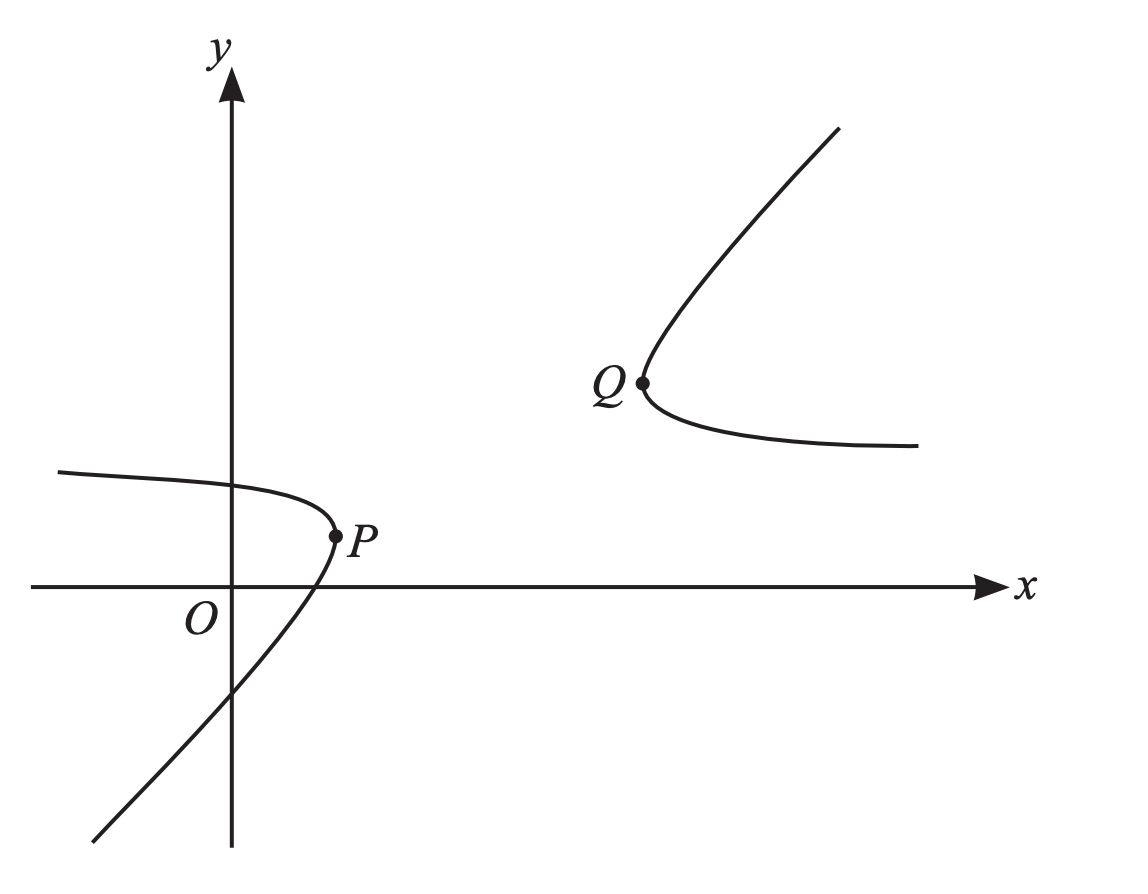
Express as a function of and hence show that the y-coordinates of P and Q satisfy .
Deduce that, at P and Q, .
Hence find all positive integers for which there are two distinct points where the tangent is parallel to the y-axis, and give the two y-values in terms of .
For , find the coordinates of P and Q, and the equations of the vertical tangents at these points.
For , write down the equation of the normal at P.
Question 8
Consider the function for .
Show that has a unique maximum on .
Find the x-coordinate of the maximum and the maximum value.
Solve for , correct to significant figures, using technology.
Question 9
Let for real .
State the amplitude, midline, period and phase shift of .
Solve for .
Solve for .