
Questions
Question 1
A geometric sequence has first term and common ratio ().
Find in terms of .
Given that , find .
Hence find .
Question 2
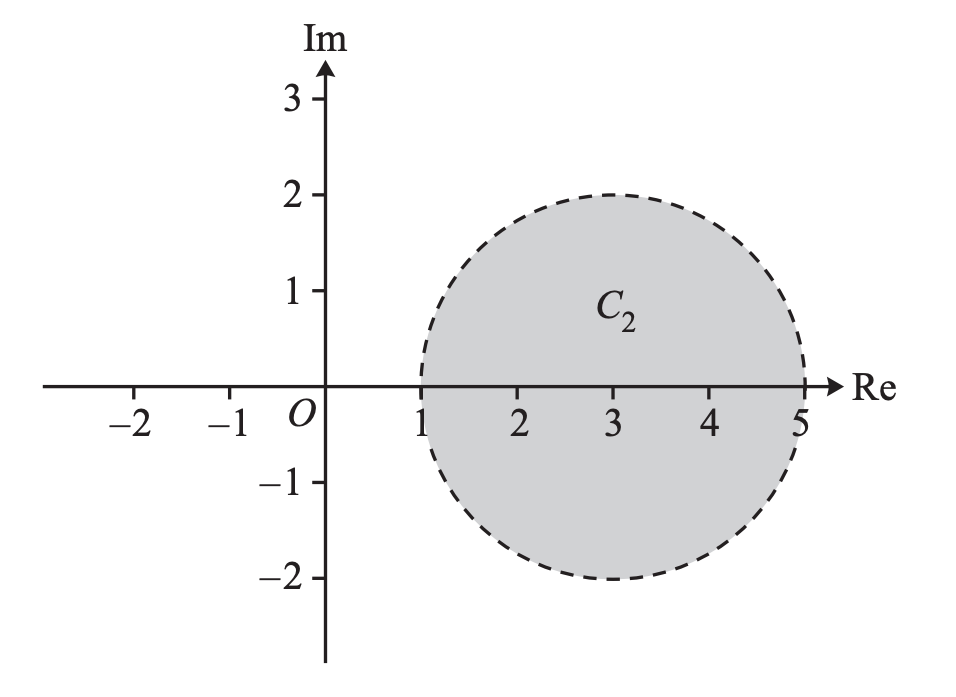
The Argand diagram shows the interior of the circle centred at on the real axis with radius .
Let .
Write as an inequality in and , where .
From the diagram, state the maximum and minimum values of on the boundary.
Find the range of for points on the boundary above the real axis.
A point lies in with and . Find the largest possible value of .
Question 3
Consider the system of equations and .
Write the system in the form and find .
Hence solve for .
Verify your solution using technology (GDC), showing appropriate working.
Question 4
Define
for ,
for .
Find and so that is continuous and differentiable at .
With those values, find for the branch , stating its domain.
Question 5
A data set is shown below.
:
:
Use your GDC to find Pearson’s correlation coefficient and the equation of the least-squares regression line of on .
Interpret the value of in context.
Use the regression line to predict when , commenting on the reasonableness of your prediction.
Question 6
The curve has equation . The line passes through and meets at . The shaded region lies between and from to .
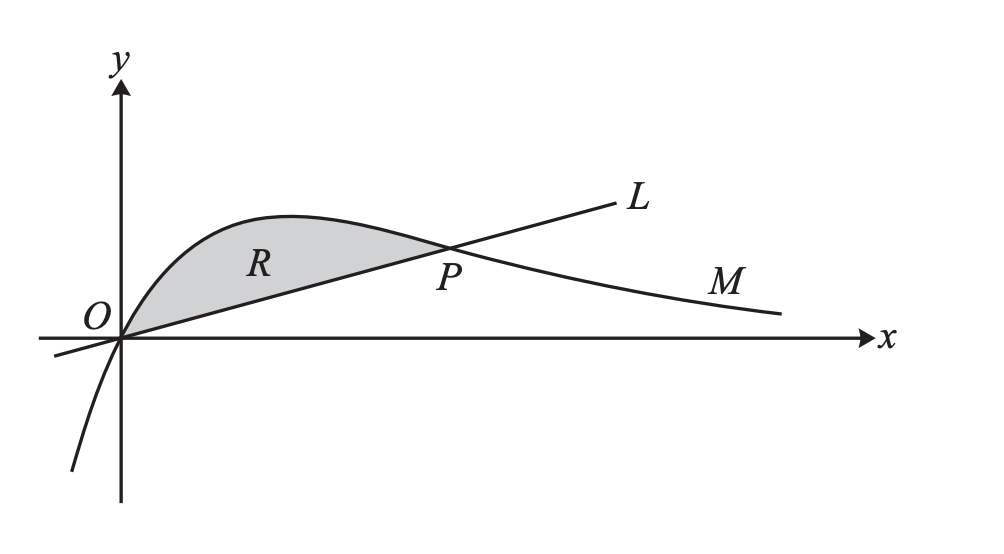
Show that the gradient of at is . Hence write an equation for the tangent at .
Using your GDC, find the -coordinate of the intersection of with the line .
Find the exact area under between and .
Hence evaluate .
Question 7
A machine produces components independently with probability of being non-defective.
Find the probability that, in a sample of components, at least are non-defective.
Find the expected number of non-defective components in trials.
Comment on whether a binomial model is suitable in this context.
Question 8
Let for .
Find and solve .
Show that the stationary point is a maximum.
Find the maximum value of .
Question 9
Let and .
Find the angle between and .
Find the component of in the direction of .
Find a unit vector perpendicular to both and .
Question 10
Calls arrive at a switchboard according to a Poisson process with mean rate per hour, independently.
Find the probability that in a -minute interval there are exactly calls.
Two independent lines have rates per hour and per hour. Find the mean and variance of the total number of calls per hour.
Briefly justify why a Poisson model is appropriate here.
Question 11
The diagram shows a weighted graph on vertices and its symmetric weighted matrix.
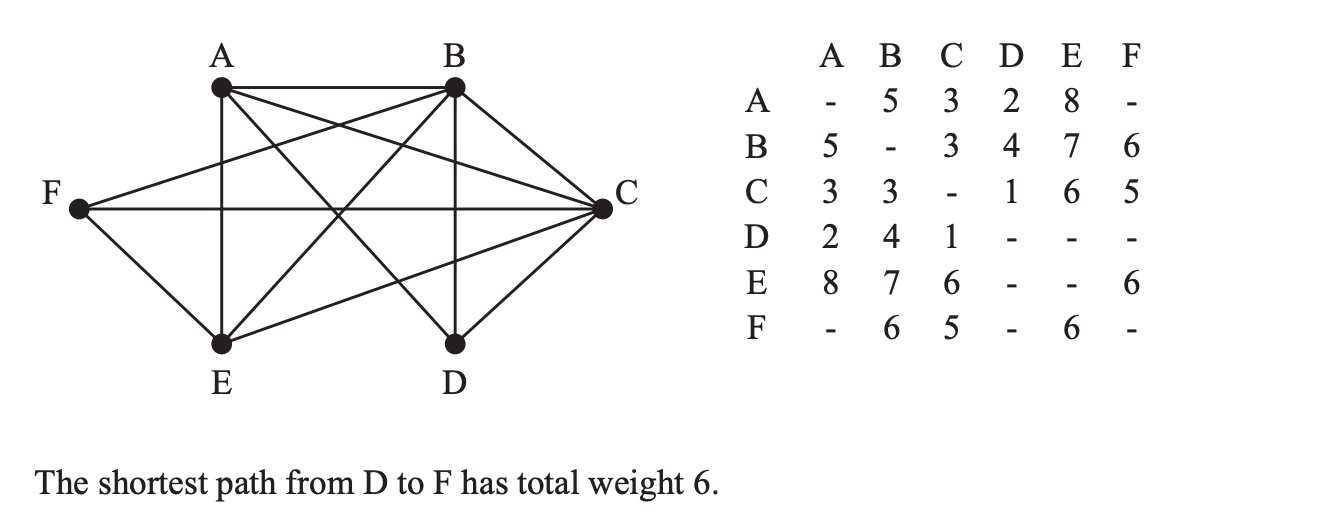
Using the matrix, list the neighbours of vertex and their edge weights.
Verify the statement in the image: “The shortest path from to has total weight ” by giving one such path and showing its weight.
Use Dijkstra’s algorithm (or a clear GDC table) to find the shortest distances from to all vertices. State the distance to .
Question 12
The figure shows part of the curve .
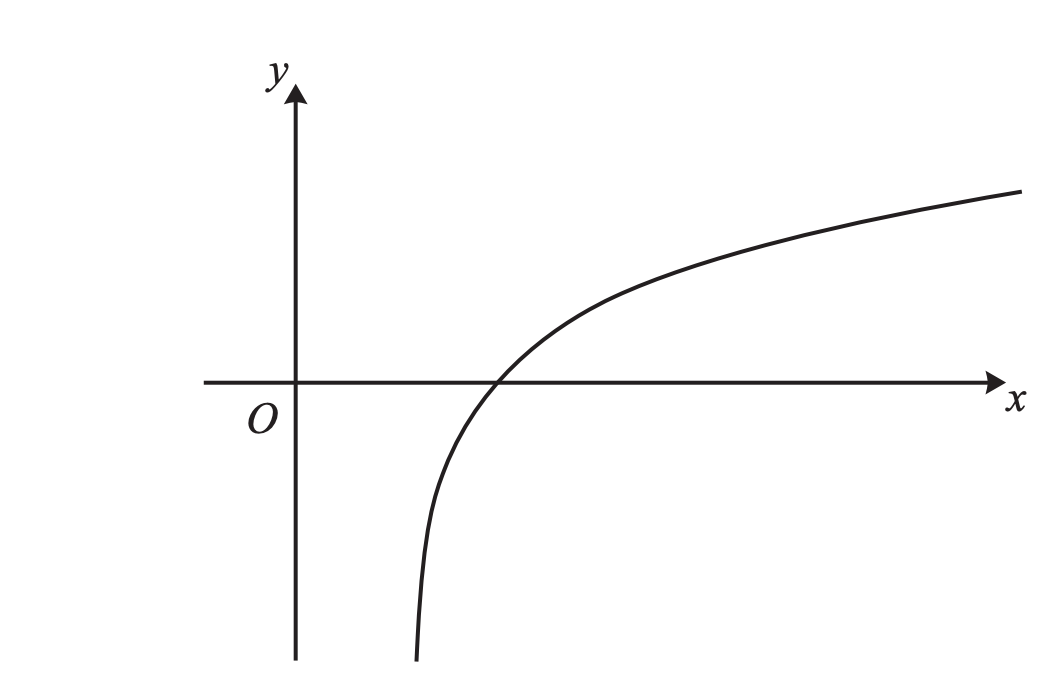
From the graph, state the equation of the vertical asymptote and the -intercept.
Describe the transformation that maps to .
Solve .
Find .
Question 13
A culture’s mass (grams) is measured at times (hours):
:
:
Assume .
Use your GDC to find the least-squares exponential regression and state and , correct to three significant figures.
Predict at . State the units.
Comment on extrapolation in this context.
Question 14
A quantity satisfies with . Given and :
Find .
Write the model for . You may give exactly or as a decimal.
Question 15
Item weights are distributed as grams.
Find . Use your GDC appropriately and show the -calculation.
A sample of items is taken. Find a confidence interval for the mean weight.
Interpret your interval in the context of item weights.
Question 16
A two-state Markov chain has transition matrix .
The initial state is .
Find and .
Find the steady-state vector and state its meaning in context.