
Questions
Question 1
A small ball is projected from point with speed at an angle to the horizontal, where and . Point is above horizontal ground. The ball first lands at point on the ground. Let . Take the horizontal through as the -axis (positive to the right) and the vertical through as the -axis (positive upwards). is the point on the ground vertically below .
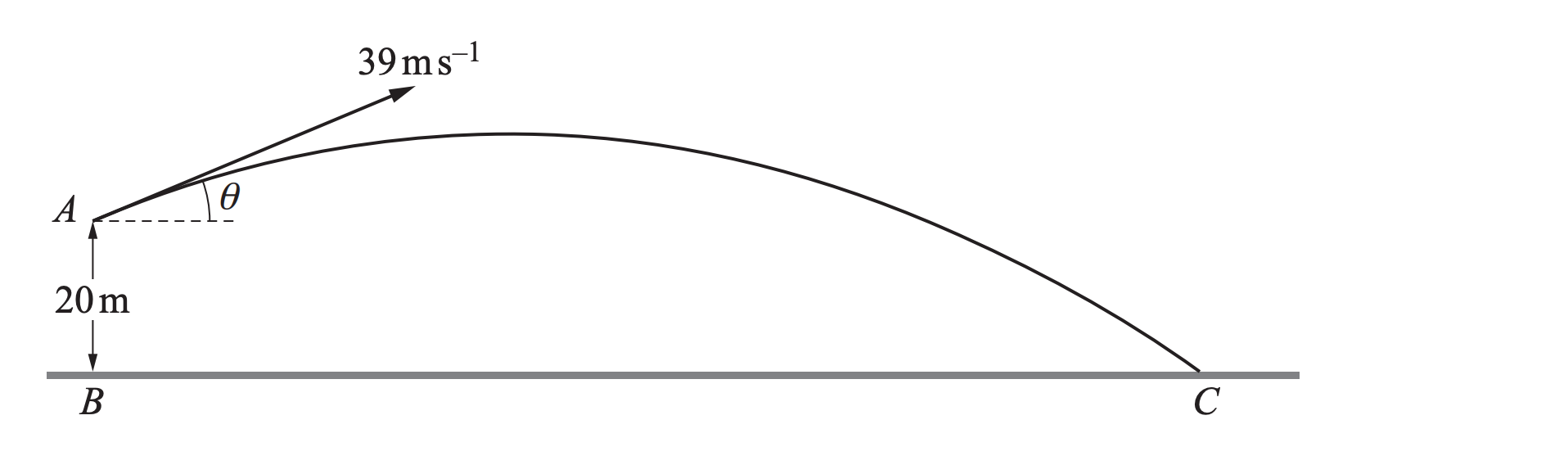
Resolve the initial velocity into horizontal and vertical components.
Show that the vertical position satisfies . Hence find the time of flight to , giving your answer to significant figures.
Find the horizontal distance . Give your answer to significant figures.
Find the maximum height above the ground reached by .
Find the speed and the angle to the horizontal of on impact at (angle below the horizontal). Give both to significant figures.
Question 2
An inverted conical tank has semi-vertical angle and height . It is initially full of water. The outflow is modelled by , where is the volume of water and is the depth.

Express as a function of .
Using , derive a differential equation for and hence find in terms of .
Solve your differential equation to obtain , given that .
Find (i) the time taken for the tank to empty; (ii) the value of when . State appropriate units.
Question 3
Consider the region bounded by the curve , the -axis, and the vertical lines and . Distances are in centimetres.
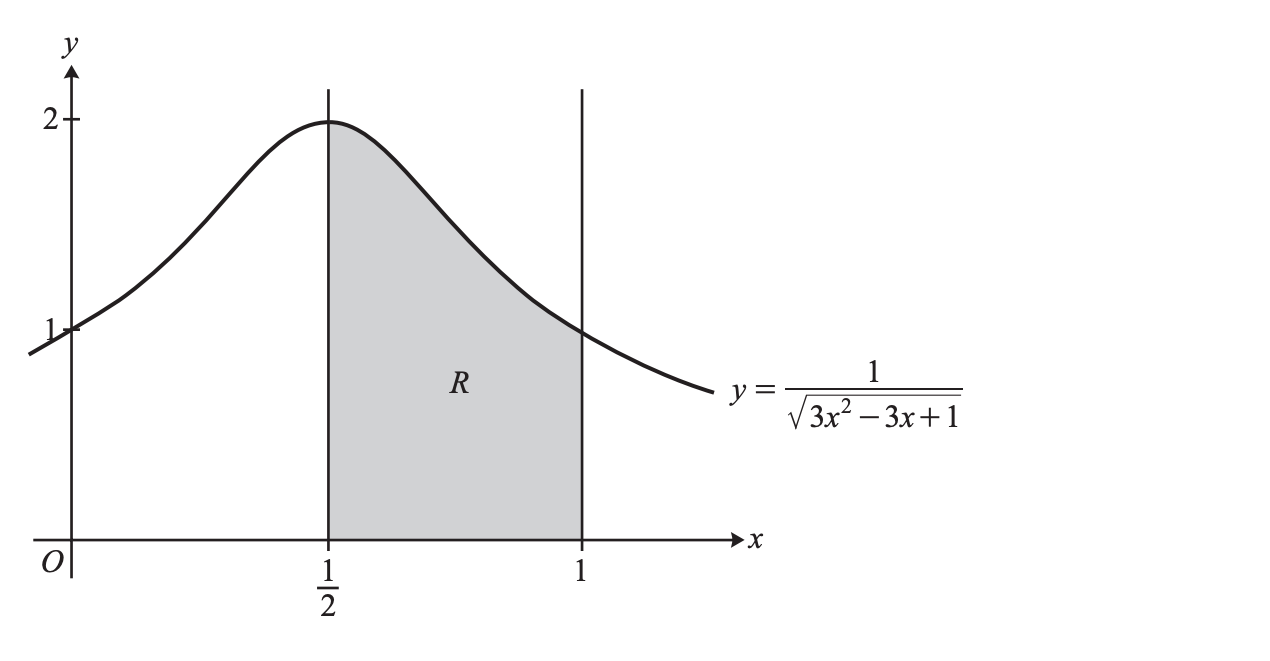
Show that for all real .
The pendant is formed when is rotated radians about the -axis. Show that
,
and evaluate exactly.
Using your GDC, find the surface area , giving your answer to significant figures.
Question 4
Two curves intersect on the -axis and a shaded region is bounded by the curves and the -axis. The curves are and .
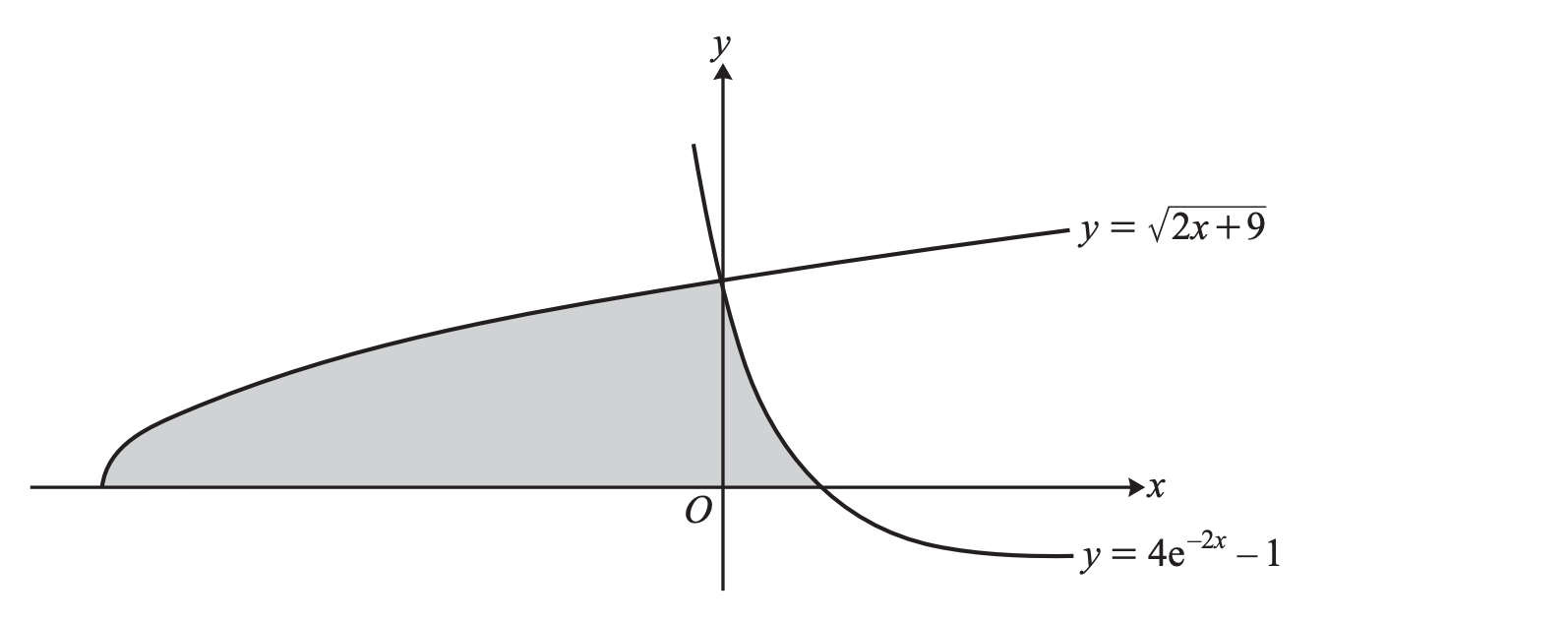
Verify that the curves meet at .
Find the -intercepts of each curve.
Write , the total shaded area, as a sum of definite integrals and evaluate exactly.
Using your GDC, plot both curves on the interval with an appropriate viewing window, and state which curve lies above the other on .
Question 5
The velocity–time graph “Velocity-Time Graph for Two Cars_OCR.png” shows two cars and moving along a straight, level road. At , car is travelling at and is overtaken by car travelling at . From to , decelerates uniformly to , then continues at thereafter.
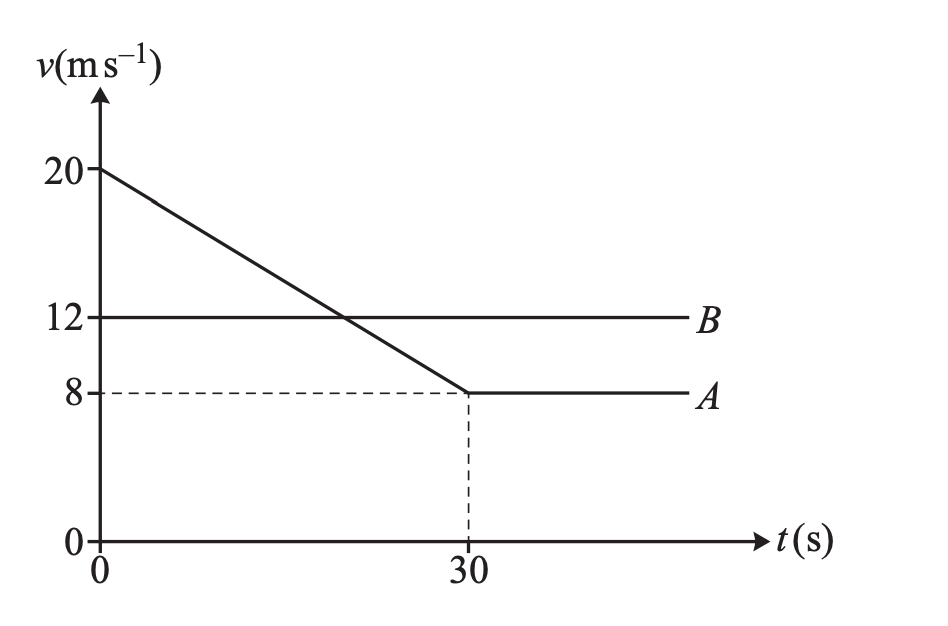
Find the deceleration of car in .
Find the distance travelled by each car in the first .
Determine the time after when next overtakes (i.e., the next time their positions are equal).
Find the distance from the start at the instant of overtaking in part (c).
Question 6
A system switches between two states and each minute. The transition matrix is
,
where is the probability of moving from state to state in one minute.
Starting in with certainty, write the initial state vector and find and .
Find the steady-state vector exactly.
Show that has eigenvalues and . Find a corresponding eigenvector for each eigenvalue.
Explain why as , and interpret this result in context.