
Internal vs external growth
Internal growth, or organic growth, occurs when a business expands using its own resources and activities.
Internal growth can involve increasing output, opening new locations, attracting more customers or expanding the range of products sold.
External growth, or inorganic growth, involves expansion through another organization, such as combining, purchasing or cooperating with another business.
Internal growth is normally slower and easier to control, helping a business preserve its culture and existing management systems.
External growth can achieve rapid expansion and access new resources or markets, but creates greater integration, financial and organizational risks.
External economies of scale
External economies of scale are cost advantages created by growth of the wider industry or business cluster rather than growth of one individual firm.
A larger industry can create a greater pool of skilled and specialized labour, reducing recruitment and training difficulties.
Growth of an industry can encourage specialist suppliers to locate nearby, improving access to inputs and supporting lower costs.
Improved infrastructure and supporting services may develop around major business clusters, benefiting firms operating there.
Businesses may also benefit from knowledge, expertise and innovation spillovers when related organizations are concentrated in one location.
Unlike internal economies, these benefits may be available to several businesses in the same industry or region.
Reasons businesses grow
Growth may provide economies of scale, lowering average costs and strengthening price competitiveness or profit margins.
A business may seek a greater market share and stronger influence over customers, suppliers and competitors.
Growth can increase sales revenue and profit potential by reaching more customers or entering additional markets.
Larger businesses may gain improved access to finance, employees, technology and other resources.
Expansion can spread risk across more products, customers or markets and reduce dependence on one source of revenue.
Growth may also strengthen long-term survival and competitiveness, although larger size does not automatically guarantee improved performance.
Mergers, acquisitions and takeovers
Method | How it works | Potential advantages | Potential disadvantages |
|---|---|---|---|
Merger | Two businesses agree to combine into one larger organization. | Rapid growth, shared resources, possible synergies and larger market share. | Culture clashes, integration difficulties and possible diseconomies of scale. |
Acquisition | One business purchases a controlling interest in another with agreement from the target business. | Fast access to established customers, employees, technology or markets. | High purchase cost, integration problems and risk of overestimating benefits. |
Takeover | One business gains control of another without the target board's prior agreement or approval. | Rapid control of assets, capacity and market share. | Resistance, damaged employee morale, high costs and difficult integration. |
Franchising
Franchising allows a franchisee to operate using the brand, products and business system of a franchisor.
For the franchisor, it can enable rapid external growth using much of the franchisees' capital rather than financing every outlet directly.
The franchisor can receive initial fees and continuing payments, while expanding brand presence across additional locations.
The franchisee gains an established brand and proven business model, often with training, marketing and operational support.
The franchisor risks inconsistent quality or service damaging the entire brand and has less direct control over individual outlets.
The franchisee faces fees, contractual restrictions and reduced freedom to change products or business practices.
Checklist: can you do this?
Can you distinguish between internal growth and external growth?
Can you explain different internal and external economies of scale?
Can you explain why internal and external diseconomies of scale can increase average costs?
Can you evaluate reasons for a business to grow or stay small?
Can you distinguish between a merger, acquisition and takeover?
Can you compare a joint venture with a strategic alliance?
Can you explain advantages and disadvantages of franchising for both parties?
Can you evaluate which external growth method is most suitable for a given business?
Internal economies of scale
Economies of scale occur when average cost per unit falls as the scale of production increases.
Average cost can be expressed as , where total cost is spread across the quantity produced.
Purchasing economies arise when bulk buying enables larger businesses to negotiate lower input prices.
Technical economies result from using specialist machinery, technology and large-scale production more efficiently.
Managerial and specialization economies occur when larger businesses employ specialist managers and workers with greater expertise.
Financial and marketing economies can arise through cheaper finance and spreading advertising or promotional costs across greater output.
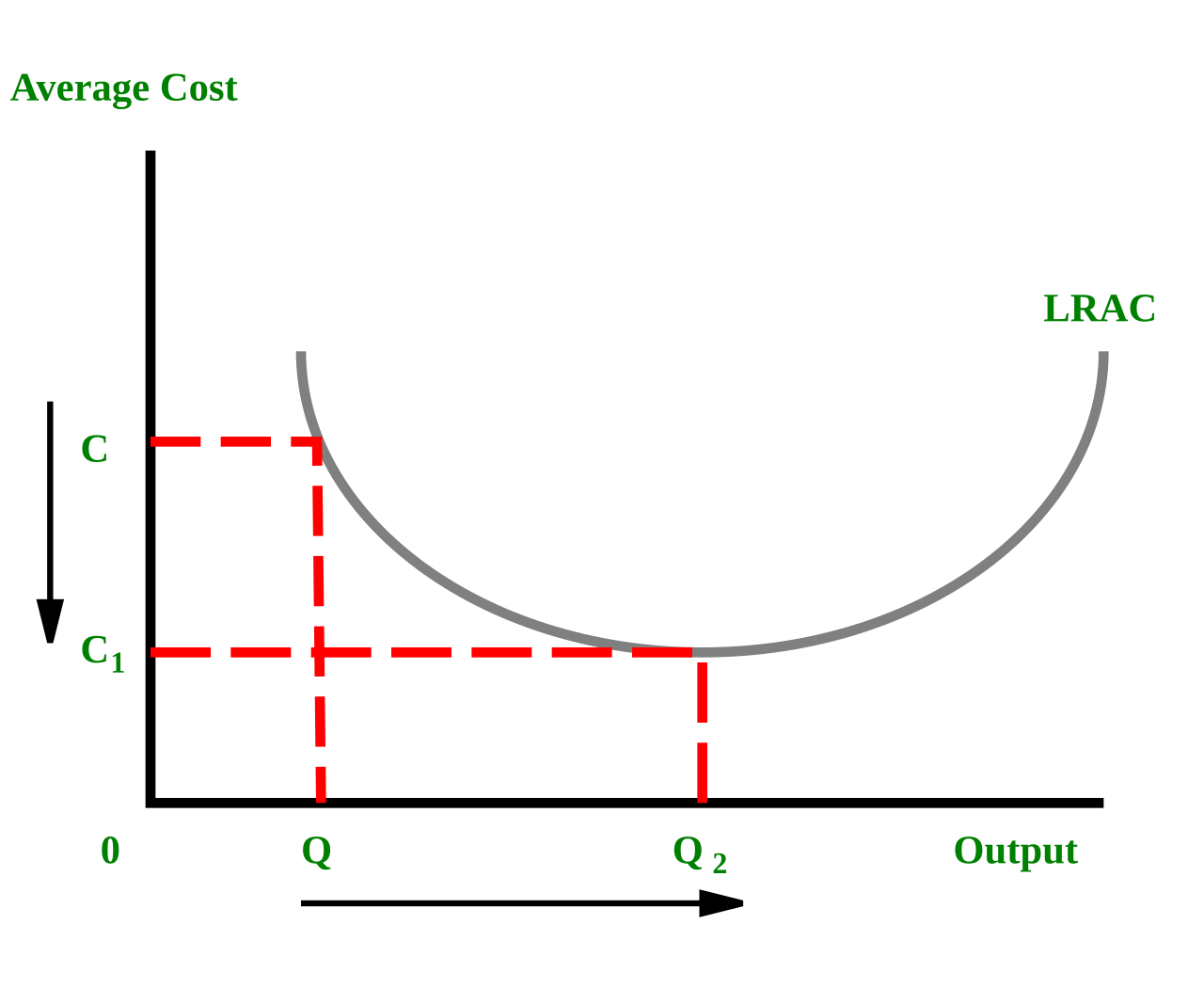
The diagram shows how increasing output can reduce average cost per unit. Students should connect the downward movement in average cost with the cost advantages generated by economies of scale. Source
Internal and external diseconomies of scale
Diseconomies of scale occur when average cost per unit rises as a business or industry becomes excessively large.
Internal diseconomies originate within the organization and may include poor communication as additional layers and departments develop.
Greater size can cause coordination and control problems, slowing decisions and making activities harder to monitor.
Employees may experience weaker motivation or feel less connected to decision-makers in very large organizations.
Excessive bureaucracy can increase administration and reduce responsiveness, raising operating costs.
External diseconomies can arise when industry growth creates labour shortages, higher wages or rents, congestion and pressure on local infrastructure.
Reasons businesses stay small
Small businesses can provide personalized customer service and build close relationships that larger competitors may struggle to replicate.
Operating in a niche market may mean demand is too limited to justify major expansion.
Owners may prefer to retain control and independence rather than introduce additional managers, partners or investors.
Smaller organizations can often remain flexible and responsive, allowing faster adaptation to changing customer preferences.
Growth may require significant finance and expose owners to greater financial risk or cash-flow pressure.
Remaining small can also avoid some diseconomies of scale, including bureaucracy, communication difficulties and loss of employee motivation.
Joint ventures and strategic alliances
Feature | Joint venture | Strategic alliance |
|---|---|---|
Structure | Partner businesses establish a separate organization or business entity for a shared activity. | Businesses cooperate while remaining separate organizations without establishing a new business entity. |
Advantages | Shares costs and risks while combining expertise, resources and local knowledge. | Provides cooperation, expertise and market access with greater independence and flexibility. |
Disadvantages | Partners may disagree over objectives, control, profits or decision-making. | Partners may have conflicting priorities, share sensitive knowledge or contribute unequally. |
Best suited to | Projects requiring substantial shared investment and commitment. | Cooperation where businesses want mutual benefits without fully combining operations. |
Choosing an external growth method
The most suitable growth method depends on the business's objectives, resources and circumstances rather than one method always being superior.
Consider the required speed of growth: mergers, acquisitions and takeovers may provide faster expansion than developing capacity internally.
Assess the desired level of control because joint ventures, alliances and franchising require some sharing or delegation of decisions.
Consider financial cost and risk, including purchase costs, investment requirements and potential liabilities.
Evaluate compatibility between organizations, particularly their cultures, objectives, employees and management systems.
Strong examination answers apply benefits and drawbacks to the specific business context before reaching a justified conclusion.