
Newton’s laws and translational equilibrium
Newton’s first law: a body remains at rest or moves with constant velocity when the resultant force is zero.
Translational equilibrium therefore requires the forces acting on a body to have zero resultant.
Newton’s second law: for constant mass, the resultant force is related to acceleration by .
Newton’s third law: interacting bodies exert a force pair on one another; the two forces act on different bodies.
For every dynamics problem, first identify the body or system and then determine its resultant force.
Newton’s first law must be applied to translational equilibrium, and third-law force pairs must be identifiable in different situations.
Normal force, friction and tension
The normal force is the component of contact force perpendicular to a surface.
Friction acts parallel to the plane of contact and opposes relative motion or its tendency.
For a stationary body, static friction satisfies .
For a moving body, dynamic friction is given by .
and are the coefficients of static and dynamic friction, respectively.
Tension is a contact force transmitted through a connecting string, rope or similar connector.
Field forces
Field forces do not require direct contact between the interacting bodies.
The gravitational force is the body’s weight and is calculated using .
The specified field forces also include electric force and magnetic force .
When drawing a free-body diagram, include only the field forces that actually act on the selected body.
Collisions, explosions and energy
In an isolated interacting system, total linear momentum is conserved.
An elastic collision conserves both total momentum and total kinetic energy.
An inelastic collision conserves total momentum but does not conserve total kinetic energy.
An explosion separates initially interacting bodies while the system momentum remains governed by momentum conservation.
Always consider both momentum and the relevant energy changes when distinguishing collisions and explosions.
Solving simultaneous conservation-of-momentum and conservation-of-energy equations for collisions is not required.
Circular motion
A body moving at constant speed in a circle has centripetal acceleration directed radially towards the centre.
Its magnitude is .
Centripetal force acts perpendicular to the instantaneous velocity and produces the change in direction.
A body can therefore accelerate even when the magnitude of its velocity remains constant.
Linear speed and angular velocity are related by .
Situations can involve uniform or non-uniform circular motion in horizontal or vertical planes.
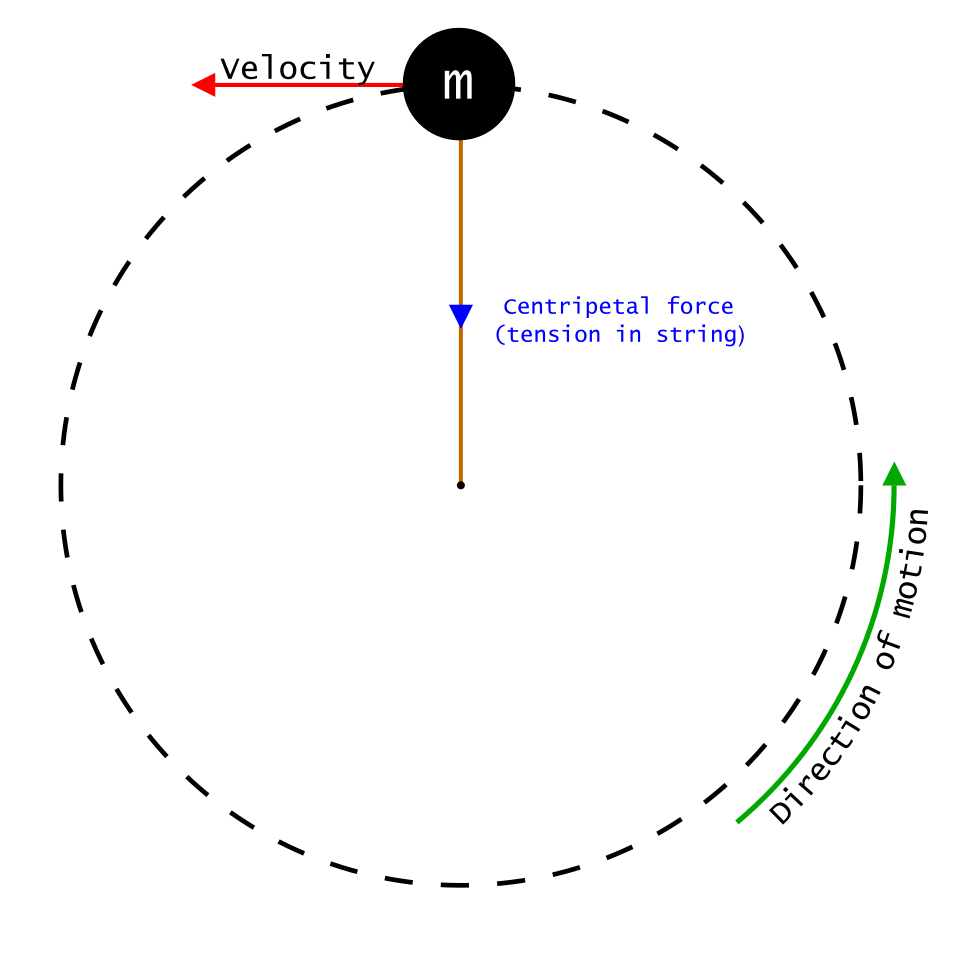
The physical force directed towards the centre supplies the centripetal force. Because this force is perpendicular to the instantaneous velocity in uniform circular motion, it continually changes the direction of motion.
Checklist: can you do this?
Can you explain and apply Newton’s three laws to force problems?
Can you construct and interpret a free-body diagram and determine the resultant force?
Can you distinguish and use normal force, friction, tension, elastic force, drag and buoyancy?
Can you calculate momentum using and impulse using ?
Can you apply conservation of momentum to collisions and explosions?
Can you distinguish the energy behaviour of elastic and inelastic collisions?
Can you calculate centripetal acceleration and relate , , and ?
Can you identify which physical forces provide the required centripetal force?
Free-body diagrams and resultant force
A free-body diagram represents all forces acting on one chosen body.
Draw each force as a vector and label it using an accepted force name or symbol.
The resultant force is obtained by combining the force vectors acting on the body.
Resolve forces into perpendicular components when analysing a two-dimensional situation.
Free-body diagram questions are limited to one-dimensional and two-dimensional situations.
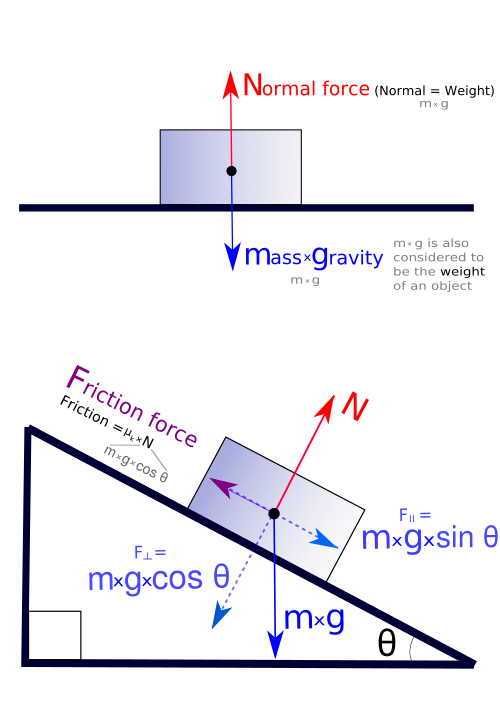
A free-body diagram isolates a body and shows the forces acting on it. The inclined-plane example demonstrates how weight, normal force and friction can act in different directions.
Elastic force, viscous drag and buoyancy
The elastic restoring force follows Hooke’s law: .
The negative sign shows that the restoring force acts opposite to the displacement .
For a small sphere moving through a fluid, viscous drag opposes motion and is .
In the drag equation, is fluid viscosity, is sphere radius and is its velocity through the fluid.
Buoyancy arises from displaced fluid and is given by , where is the displaced fluid volume.
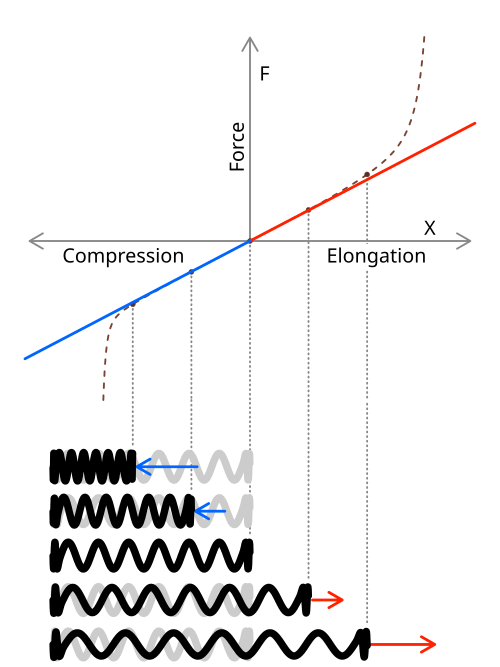
Within the Hooke’s-law region, applied force varies linearly with spring displacement. The restoring force acts in the direction opposite to the displacement, represented by .
Momentum, impulse and changing momentum
Linear momentum is given by .
The momentum of a system remains constant unless a resultant external force acts on it.
An external resultant force acting for a time interval produces an impulse .
Here, is the average resultant force and is the contact time.
The applied external impulse equals the change in momentum, so .
assumes constant mass, whereas can be used when mass changes.
HL Only: Quantitative two-dimensional collisions and explosions
A.2 contains no separate additional higher level understandings, but its quantitative collision scope differs by level.
At standard level, quantitative collisions and explosions are restricted to one-dimensional situations.
At higher level, quantitative problems can involve two-dimensional situations.
For a two-dimensional interaction, conservation of momentum must hold independently in perpendicular directions.
Common exam errors and syllabus limits
Do not treat centripetal force as an additional physical force; identify which real forces provide the inward resultant.
In vertical non-uniform circular motion, quantitative force analysis away from the top or bottom of the path is not required.
A quantitative treatment of banked surfaces is not required.
For friction, do not automatically write ; static friction can take any value up to .
Keep Newton’s third-law forces on different interacting bodies, rather than placing both on one free-body diagram.
Use accepted force names or symbols and determine resultants only in one or two dimensions.