The Squeeze Theorem, also known as the Sandwich Theorem, plays a pivotal role in calculus for determining the limits of functions that are difficult to evaluate directly. It relies on the concept of "squeezing" a function between two others to find its limit.
📚 Introduction to the Squeeze Theorem
The theorem is founded on a simple yet powerful premise: if a function is always caught between two other functions and near a certain point, and the limits of and at that point are equal, then the limit of at that point must exist and be equal to the same value. This principle is crucial for dealing with functions that oscillate or approach indeterminate forms.
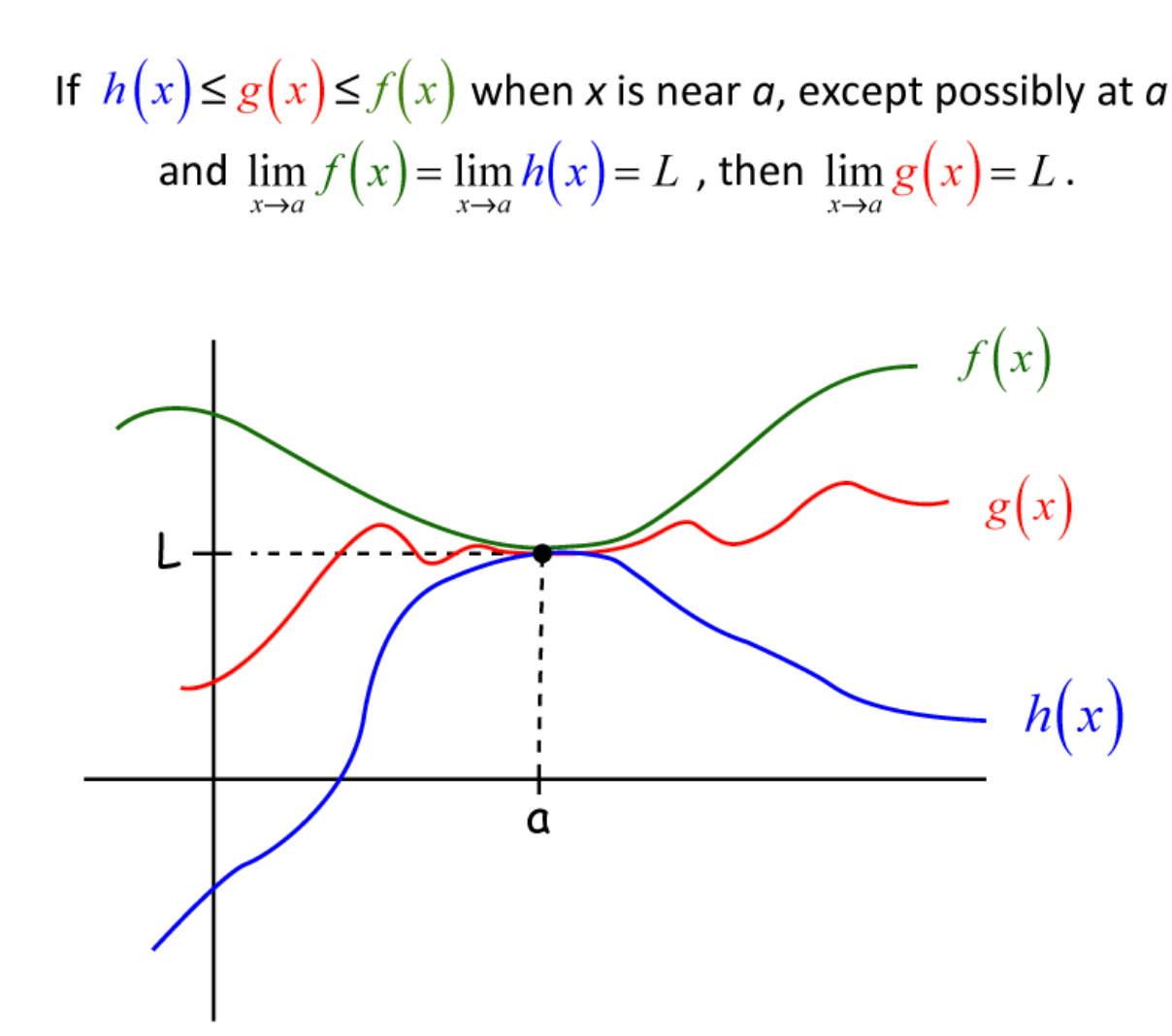
Image courtesy of Calcworkshop
💡 Prerequisites for Applying the Squeeze Theorem
Functions and must bound near the point of interest.
Limits of and at the point must exist and be equal.
💡 Significance in Calculus
Dealing with Indeterminate Forms: Offers a method to evaluate limits of functions that are otherwise challenging to approach directly.
Understanding Oscillations: Enables the calculation of limits for functions that oscillate within a certain range.
Worked Examples
🔍 Example 1: Evaluating a Basic Limit
Consider the functions for , and and evaluate .
Step 1: Establish the inequalities for all near 0.
Step 2: Calculate the limits of and as approaches 0.
Step 3: Apply the Squeeze Theorem to conclude that .
🔍 Example 2: Oscillating Function
Evaluate .
Step 1: Identify the bounding functions. Here, and .
Step 2: Note that for all .
Step 3: Calculate the limits of the bounding functions as approaches 0.
Step 4: By the Squeeze Theorem, .
These examples illustrate the theorem's utility in resolving limits that are not straightforward to evaluate directly. By setting up appropriate bounding functions and applying the Squeeze Theorem, students can tackle a wide range of problems involving limits.
✏️ Practice Questions
📝 Question 1
Evaluate the limit .
📝 Question 2
Determine the limit .
✅ Solutions to Practice Questions
🧩 Solution to Question 1
Step 1: Identify the function to be evaluated: for .
Step 2: Choose appropriate bounding functions. Since for all , we can use and as the lower and upper bounds, respectively.
Step 3: Evaluate the limits of the bounding functions as approaches 0.
Step 4: Apply the Squeeze Theorem. Since and both and approach 0 as approaches 0, by the Squeeze Theorem, also approaches 0.
🧩 Solution to Question 2
Step 1: Consider the function for .
Step 2: For bounding functions, use and , leveraging the fact that .
Step 3: Calculate the limits of and as approaches 0.
Step 4: By the Squeeze Theorem, since and the limits of and as approaches 0 are both 0, the limit of as approaches 0 must also be 0.
Other:
Final stored value at location 10: 8# Simple simulation of the Fetch-Execute Cycle
# Example program stored in memory (a list of instructions)
memory = [
"LOAD 5", # Load the number 5 into the accumulator
"ADD 3", # Add 3 to the accumulator
"STORE 10", # Store the result at memory location 10
]
# Simple registers
program_counter = 0 # Holds the address of the next instruction
accumulator = 0 # Holds the result of calculations
memory_store = [0] * 20 # Create a simple memory store with 20 locations
while program_counter < len(memory):
# FETCH
instruction = memory[program_counter]
# DECODE
parts = instruction.split()
operation = parts[0]
value = int(parts[1])
# EXECUTE
if operation == "LOAD":
accumulator = value
elif operation == "ADD":
accumulator += value
elif operation == "STORE":
memory_store[value] = accumulator
# Move to the next instruction
program_counter += 1
# Output final result stored in memory
print("Final stored value at location 10:", memory_store[10])