

AP Syllabus focus: 'The electric potential energy of two charged objects is described by the general relationship U = kq1q2/r.'
This subsubtopic focuses on the equation used to calculate the electric potential energy of a two-charge system and on how charge and separation control the result.
Core relationship
Electric potential energy describes the energy associated with the electrical interaction of a pair of charged objects. For this subsubtopic, the important idea is that the energy of the two-object system is set by three things: the value of each charge and the distance between them.
Electric potential energy: The energy associated with the electrical interaction of a system of charged objects.
For a system made of exactly two charged objects, the electric potential energy follows one general algebraic relationship.
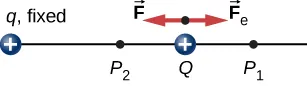
Two point charges separated by a distance (with the separation explicitly shown) illustrate the basic geometry behind . The diagram emphasizes that the relevant distance is the straight-line separation between the charges in the two-charge system. Source
This relationship is especially important because it shows that the sign of the charges matters just as much as their sizes.
= electric potential energy of the two-charge system, joules
= Coulomb constant,
= first charge, coulombs
= second charge, coulombs
= separation between the charges, meters
This is a scalar equation, so the result has magnitude and sign, but no direction.
Interpreting each part of the equation
Charge magnitude
The electric potential energy depends on the product .
If the magnitude of either charge increases, the magnitude of increases.
If one charge is doubled while the other charge stays the same, doubles.
If both charges are doubled, becomes four times as large because the product becomes four times larger.
This makes the equation very useful for comparison questions. You do not always need a full numerical calculation; often, a change in one variable tells you immediately how changes.
Separation
The electric potential energy is inversely proportional to the separation .
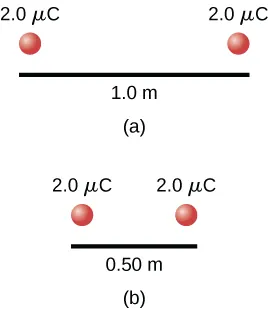
Two like charges shown at two different separations (1.0 m and 0.50 m) visually demonstrate the dependence: decreasing increases for same-sign charges. This is a good reference figure for comparison questions where you infer how changes without recalculating from scratch. Source
If the distance doubles, becomes half as large.
If the distance triples, becomes one-third as large.
If the distance decreases, the magnitude of increases.
A very common mistake is to use a square on the distance. For electric potential energy between two charges, the relationship is , not .
Sign of the charges
The sign of comes directly from the sign of the product .
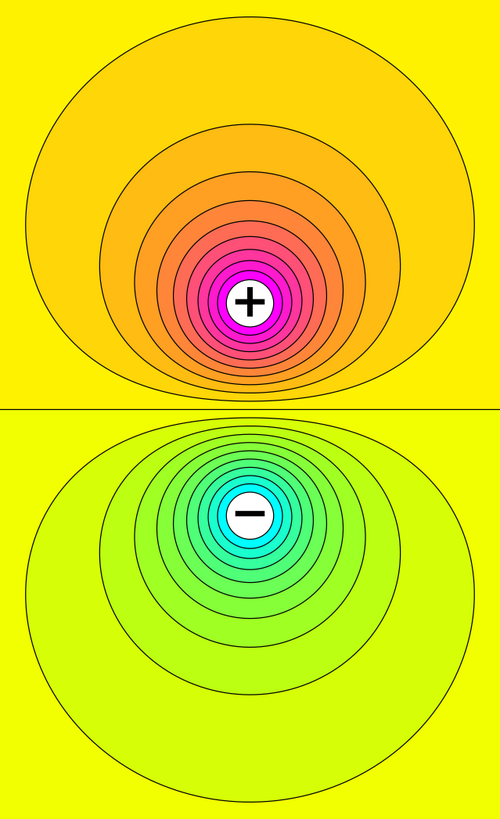
A dipole-style visualization shows positive potential (purple) near the positive charge and negative potential (blue) near the negative charge, with equipotential contours drawn as black curves. This reinforces that electrostatic quantities are signed scalars and that opposite-sign charge configurations correspond to a qualitatively different (lower/negative) energy landscape than like-charge configurations. Source
If both charges have the same sign, then is positive, so is positive.
If the charges have opposite signs, then is negative, so is negative.
This means the sign of electric potential energy is not optional or decorative. It is a real part of the answer and should be kept throughout the calculation.
Using the equation correctly
When you use , treat it as an equation for the entire two-charge system, not for just one object by itself. The answer represents the energy of the pair in that particular arrangement.
A reliable method is:
write each charge with its correct sign
convert all charges into coulombs
convert the separation into meters
substitute directly into the equation
keep the sign from the product
report the answer in joules
Unit conversion matters a great deal. In many AP Physics 2 Algebra problems, the charges are given in microcoulombs or nanocoulombs. If those are not converted to coulombs before substitution, the final answer will be incorrect by a large factor.
The separation must match the distance used by the model. In most standard problems, it is the straight-line separation between the two charged objects.
What the value of tells you
The numerical value of electric potential energy gives information about the electrical state of the pair of charges at that separation.
A positive value means the product is positive. A negative value means the product is negative. A value with a larger absolute magnitude, such as compared with , means the electrical interaction of the pair is more significant in that configuration.
It is also useful to compare cases with the same distance:
same-sign charges give a positive value
opposite-sign charges give a negative value
if the charge magnitudes are the same in both cases, the magnitudes of are the same but the signs are opposite
Common errors to avoid
Students often lose points on this topic because of a small setup error rather than a physics misunderstanding.
Watch for these common mistakes:
dropping the sign of one charge and calculating only a positive answer
using charge values in microcoulombs without converting to coulombs
using centimeters instead of meters for separation
using instead of the correct dependence
treating the answer as if it belongs to one charge alone instead of the two-charge system
forgetting that a negative answer can be completely correct
Careful attention to signs, units, and the exact form of the equation is the key to success on this subsubtopic.
Practice Questions
Two charged objects have and . They are separated by .
Calculate the electric potential energy of the two-charge system.
1 mark for using
1 mark for correct substitution with the negative sign included
1 mark for or an equivalent value such as
Two charged objects have and . The separation is .
(a) Calculate the electric potential energy of the system.
(b) The separation is increased to , with both charges unchanged. Determine the new electric potential energy and explain how the equation shows this change.
(c) Instead, return the objects to the original separation of and change the second charge to . Determine the new electric potential energy and compare its sign and magnitude with your answer to part (a).
(a)
1 mark for correct use of
1 mark for or an equivalent value
(b)
1 mark for recognizing that doubling halves
1 mark for with a correct explanation based on the relationship
(c)
1 mark for or an equivalent value
1 mark for stating that the magnitude is the same as in part (a) but the sign is opposite
FAQ
Because multiplication is commutative, $q_1q_2=q_2q_1$.
That means the order of the two charges does not matter in $U=\dfrac{kq_1q_2}{r}$. The system is the same pair of charges, so the electric potential energy stays the same either way.
Potential energy always depends on a reference choice.
For two isolated charges, choosing $U=0$ at very large separation is convenient because it leads to the standard form $U=\dfrac{kq_1q_2}{r}$. It gives a consistent way to compare different charge arrangements without changing the physics.
This formula works best when the problem models each object as if its charge is concentrated at a single location.
That is usually reasonable when:
the objects are very small compared with the distance between them, or
the problem explicitly says to model them as point charges, or
the charge distribution is symmetric enough for the model to apply.
Not with the usual reference choice used in AP Physics 2.
If both charges are nonzero and the separation $r$ is finite, then $\dfrac{kq_1q_2}{r}$ cannot equal zero. A zero value would require one charge to be zero, or a reference choice different from the standard one.
The size of the answer depends strongly on unit conversion and on the actual sizes of the charges.
A few important points are:
$1\ \mu C=10^{-6}\ C$
$1\ nC=10^{-9}\ C$
changing $r$ changes $U$ directly through a $1/r$ relationship
Because the charges are often tiny in coulombs, even physically important interactions can produce small numerical answers in joules.
