

AP Syllabus focus: 'The total electric potential energy of a system is the sum of the electric potential energies of the individual interactions between each pair of charged objects.'
When several point charges are present, the electric potential energy belongs to the entire system. The key idea is superposition: the total energy is found by adding the energy of every distinct pair interaction.
What Total Electric Potential Energy Means
For a system with multiple charged objects, the relevant energy is a property of the system as a whole, not of one isolated charge.
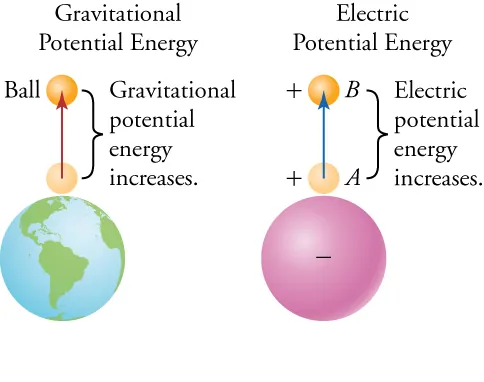
OpenStax’s side-by-side analogy shows gravitational potential energy versus electric potential energy for a two-charge system. It emphasizes that changing the separation of charges changes the system’s electric potential energy, consistent with . Source
Each pair of charges contributes an interaction energy, and the total electric potential energy is the combined result of all those pair contributions.
Total electric potential energy of a system: The combined electric potential energy associated with all distinct pair interactions among the charged objects in the system.
Because electric potential energy is tied to interactions, you cannot fully describe a many-charge system by assigning one separate system energy to each charge independently. If one charge is removed, every pair containing that charge disappears from the total, so the system energy changes in multiple places at once.
This idea matters because adding charges to a system does not replace earlier interactions; it creates additional ones. Every new charge interacts with every charge already present, so the total energy depends on the complete set of pairings.
Pair Interactions Are Added Once
The total is found by algebraic addition of the interaction energies. Algebraic addition means the signs matter: positive contributions and negative contributions must be combined with their signs, not just by magnitude.
For a system of three charges, there are three distinct pairs: 1-2, 1-3, and 2-3.
= total electric potential energy of the system, in joules
= electric potential energy associated with the interaction of charges 1 and 2, in joules
= electric potential energy associated with the interaction of charges 1 and 3, in joules
= electric potential energy associated with the interaction of charges 2 and 3, in joules
This notation shows the central AP Physics 2 idea of superposition for energy: the system’s total electric potential energy is built from separate pair contributions.
Counting Distinct Pairs in a System
A common challenge is deciding how many terms belong in the total.
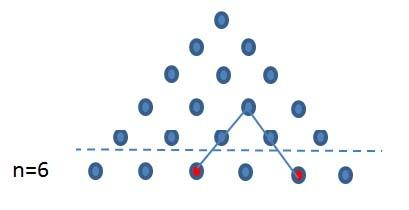
This triangular-dot/connection diagram visualizes how many unique pairs can be formed from objects (the combination ). It matches the bookkeeping idea in multi-charge energy sums: each distinct pair appears exactly once, which is why the number of interaction terms grows quickly with more charges. Source
With 2 charges, there is 1 pair.
With 3 charges, there are 3 pairs.
With 4 charges, there are 6 pairs.
The number grows because each added charge interacts with all previous charges. One useful way to organize the count is to let charge 1 pair with every later label, then charge 2 pair with every later label, and continue that pattern. This avoids repeating the same interaction.
Do not count the same interaction twice. The interaction between charges 1 and 2 is the same pair as 2 and 1, so only one term is included in the total. This is why a many-charge system can become complicated even when the objects are simple point charges: the physics is still pairwise, but the number of pairs increases quickly.
Why the Total May Be Positive, Negative, or Zero
Each pair contribution can have its own sign. In some arrangements, repulsive interactions make positive contributions dominate. In others, attractive interactions make negative contributions dominate. In still others, positive and negative contributions can partially or completely cancel.
A total of zero does not mean there are no charges or no interactions. It means the signed sum of all pair energies is zero for that particular arrangement. Individual pairs may still contribute nonzero amounts.
The total value therefore reflects the overall balance of the system. A large positive total means positive pair contributions dominate the sum, while a large negative total means negative pair contributions dominate.
The Total Energy Depends on Configuration
Because the total is built from pair interactions, it depends on how the charges are arranged in space.
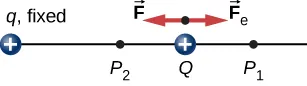
This figure shows two like-signed point charges with the electric force on the test charge as it moves between two radial positions. It visually reinforces that a change in separation changes the interaction energy term for that pair, which is why moving one charge in a multi-charge system can change multiple pair terms at once. Source
Changing the position of one charge can change more than one term at the same time, because that charge may interact with several others.
For example, in a three-charge system, moving charge 3 changes the 1-3 interaction and the 2-3 interaction. The 1-2 interaction stays the same only if charges 1 and 2 do not move. This means the total system energy depends on the overall configuration, not on a single separation by itself.
Two systems can contain the same set of charge values but have different total electric potential energies if their relative positions are different. Symmetry can make some pair terms equal in value, but equal terms still need to be included separately because they belong to different interacting pairs.
Using Pairwise Reasoning Correctly
When analyzing a point-charge system, organize the information before adding terms. Labeling charges clearly, such as 1, 2, 3, and 4, makes the bookkeeping much easier.
List every distinct pair.
Identify the interaction energy for each pair.
Add all pair energies once each.
Keep all signs throughout the addition.
Report the result in joules.
A systematic list helps prevent omissions. In a four-charge system, for instance, the complete set of distinct pairs is 1-2, 1-3, 1-4, 2-3, 2-4, and 3-4. Missing even one pair gives an incorrect total.
Common Mistakes
Several errors appear often in this topic.
Double-counting a pair, such as including both 1-2 and 2-1
Adding only the closest pairs while ignoring others
Dropping the sign of a pair contribution
Treating the total energy as belonging to one charge instead of the full system
Assuming that net charge alone determines the total electric potential energy
That last mistake is especially important. A system can be electrically neutral overall and still have a nonzero total electric potential energy. What matters is the complete set of pair interactions and how those contributions add together.
Practice Questions
A system contains three point charges labeled 1, 2, and 3.
Write an expression for the total electric potential energy of the system in terms of the distinct pair energies, and state how many distinct interaction terms are included.
1 mark for stating that there are 3 distinct interaction terms
1 mark for a correct expression:
A system of four point charges has the following pair interaction energies:
(a) Determine the total electric potential energy of the system. [2 marks]
(b) A student adds an extra term to the expression. Explain why this is incorrect. [2 marks]
(c) State why a system with zero net charge can still have nonzero total electric potential energy. [1 mark]
(a) 1 mark for adding all six distinct pair terms
(a) 1 mark for the correct result:
(b) 1 mark for recognizing that represents the same interaction as
(b) 1 mark for explaining that including both terms would double-count one pair
(c) 1 mark for stating that total electric potential energy depends on all pair interactions and their signs, not on net charge alone
FAQ
Each charge can pair with every other charge, so there are many possible combinations.
If you count all pairings directly, you get $n(n-1)$ because each pair appears twice: once as $ij$ and once as $ji$.
Dividing by 2 removes the repeats, giving $n(n-1)/2$ distinct interactions.
This is a counting shortcut for bookkeeping; it does not introduce any new physics.
No. For an electrostatic configuration, the final total electric potential energy depends on the final arrangement of charges, not on the order used to assemble them.
Different assembly orders may group intermediate steps differently, but if the initial and final states are the same, the final total is the same.
This is why the pair-sum method works reliably: it depends only on the completed configuration.
Not in a unique physical way.
The energy is fundamentally associated with interactions between pairs, so it belongs most naturally to the system. Any attempt to divide the total among individual charges is a bookkeeping choice, not a unique physical requirement.
That is why expressions are written using pair terms such as $U_{12}$ and $U_{23}$ rather than giving each charge its own separate system energy.
Symmetry can reveal that multiple pair terms are equal.
For example:
equal charges at equal separations produce equal pair contributions
mirrored parts of a configuration often repeat the same interaction pattern
You still count each distinct pair, but symmetry lets you write repeated terms more efficiently, such as “three equal pair terms” instead of rewriting the same value several times.
This reduces algebra mistakes without changing the physical meaning.
Index notation keeps the pair structure clear.
It helps you:
identify exactly which two charges are interacting
check whether every distinct pair has been included
avoid double-counting
organize large systems without writing long descriptions
For a system with many charges, symbols like $U_{12}$, $U_{13}$, and $U_{24}$ are much easier to track than full verbal labels. This is especially useful when the number of pair terms becomes large.
