

A deep understanding of the exponential function and the natural logarithm is essential. These functions are not only foundational in calculus but also have significant applications in various scientific and mathematical contexts.
Definitions and Properties
Exponential Function
The exponential function, denoted as , is defined for all real numbers . It represents the constant (approximately 2.71828) raised to the power of .
Natural Logarithm
The natural logarithm, denoted as , is the inverse function of the exponential function . It is defined for all positive real numbers and represents the power to which must be raised to obtain .
Graphical Representations
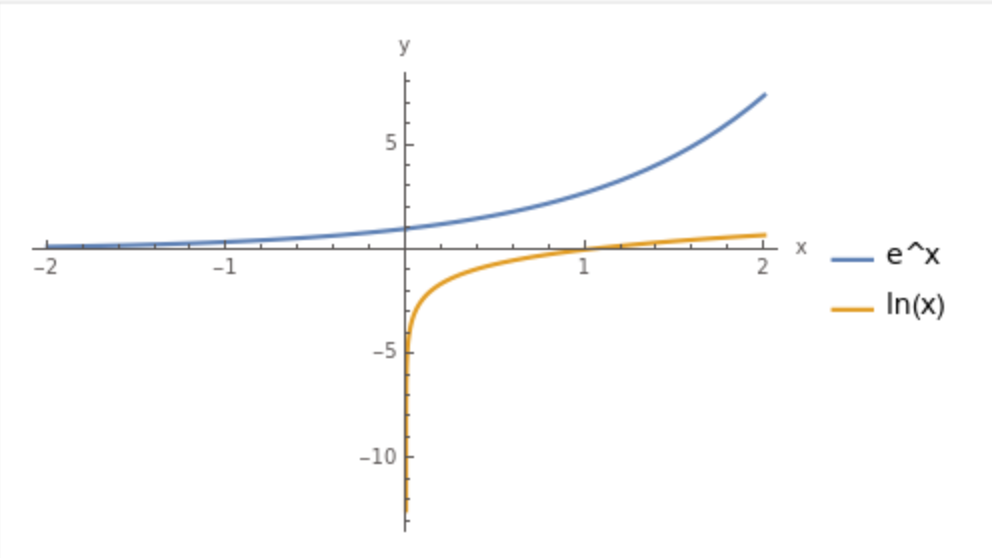
Graph of
- The graph of is a continuously increasing curve.
- It never touches the x-axis, asymptotic to it, indicating that is always positive.
- The curve passes through the point (0,1), as .
Graph of
- The graph of is a curve that increases slowly and is undefined for non-positive values of .
- It passes through the point (1,0), since .
Application Examples
Example 1:
Graph and .
Solution:
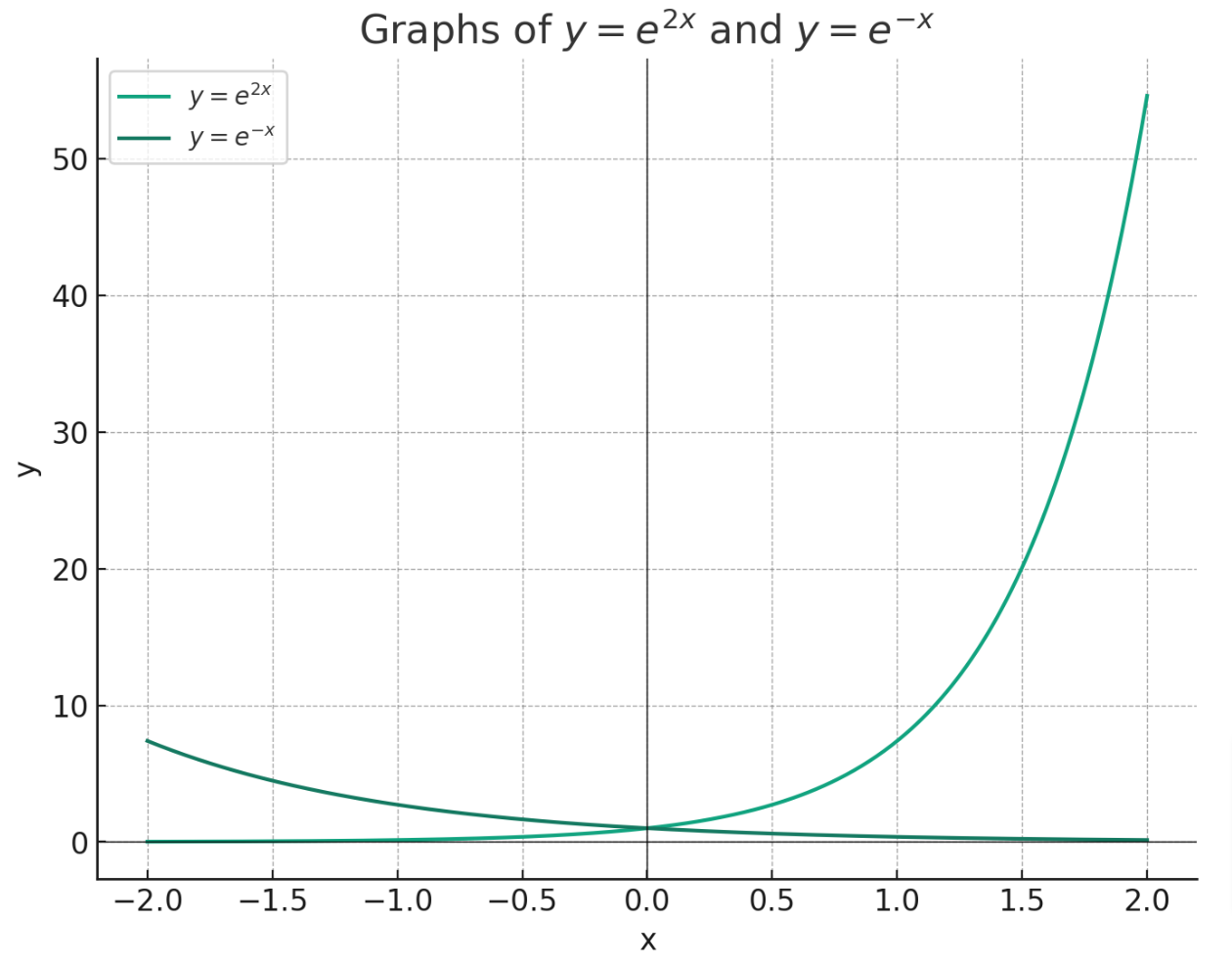
Summary of their characteristics:
- : This is an exponential growth function. The graph is a steeply increasing curve, reflecting the rapid increase of as becomes larger. The function grows faster than due to the doubling effect of the exponent.
- : This is an exponential decay function. The graph is a decreasing curve, approaching the x-axis as increases, but never actually touching the x-axis. This reflects the property of exponential decay, where the function values become increasingly small as increases, but never reach zero.
Example 2:
Solve .
Solution:
1. Apply the natural logarithm to both sides of the equation to utilize the property that :
2. Simplify the left side by using the property of logarithms that :
3. Solve for by dividing both sides by 2:
The precise solution for is approximately 0.9729550745276566.
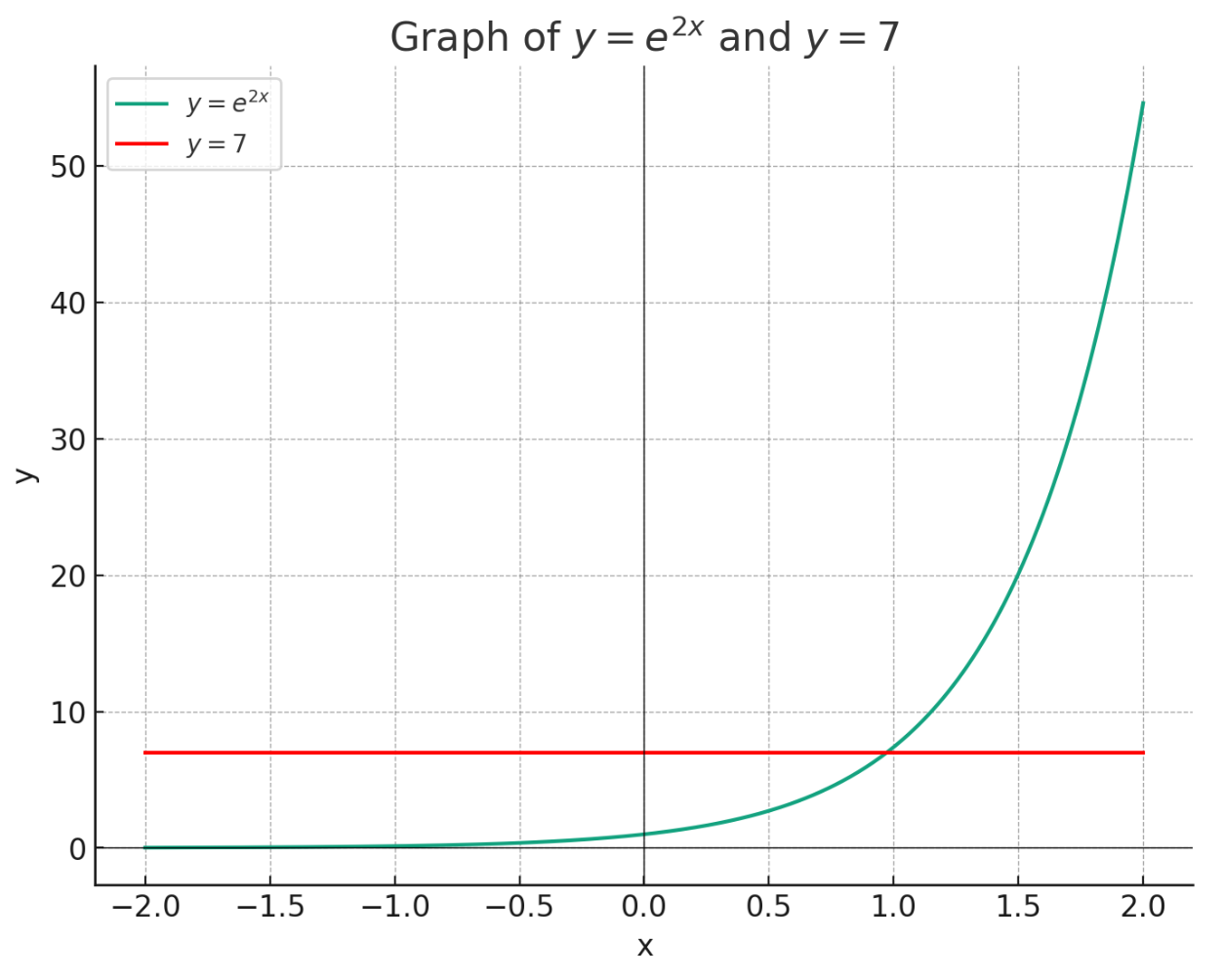
The graph shows the function along with the line . The point where the curve intersects the line represents the solution to the equation, which corresponds to the x-value we calculated.
