IB Syllabus focus:
- Basics of in-groups and out-groups
- Self-categorization and self-esteem
- Real-world implications: prejudice, discrimination
Social Identity Theory explores how individuals categorise themselves and others, influencing their behaviour and perceptions. It provides insight into in-groups, out-groups, and the resultant consequences such as prejudice and discrimination.
Basics of In-Groups and Out-Groups
In the context of Social Identity Theory, in-groups are the social groups to which an individual feels they belong, whilst out-groups are those they do not belong to.
Formation of In-Groups and Out-Groups
Individuals categorise themselves into specific groups based on shared characteristics like ethnicity, nationality, or interests, forming an in-group.
Those who do not share these characteristics are placed in out-groups.
The categorisation is a cognitive tool that simplifies the social environment but can lead to stereotyping.
In-Group Bias
People tend to favour members of their in-group over those in out-groups.
This bias is a fundamental aspect of group dynamics, promoting self-esteem and a positive social identity.
Understanding how conformity impacts social identity can be further explored through Asch's Conformity Study.
Self-Categorisation and Self-Esteem
Individuals, motivated by a need for positive self-esteem, classify themselves as members of specific social categories or groups.
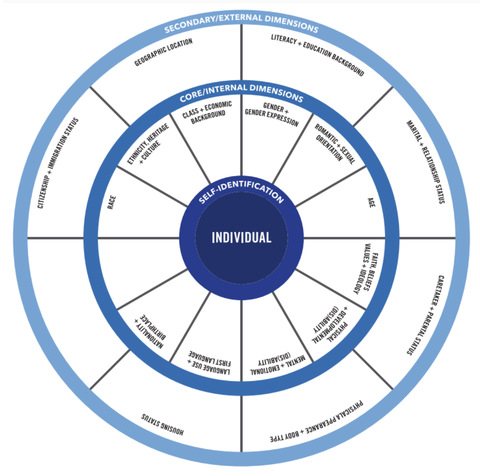
This wheel maps common social identity categories (e.g., race, gender, language, class) that people use to self-categorise, which then inform ingroup and outgroup boundaries central to Social Identity Theory. The diagram illustrates how multiple identities can be salient at once, shaping perception and behaviour. Note: the wheel includes broader identity categories than typically required for SIT case studies (extra detail). Source.
Self-Categorisation Process
People allocate themselves to distinct groups, emphasising similarities with in-group members and differences from out-group members.
This process can enhance social identity and foster group cohesion.
However, overemphasis on group differences can heighten intergroup conflict.
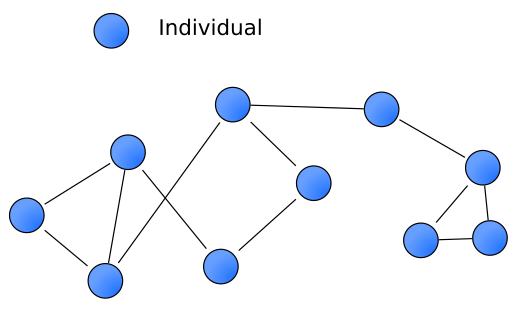
This sociogram shows people as nodes and ties as relationships, illustrating how ingroups cluster tightly while ties to other groups are sparser—a pattern that fosters cohesion within groups and sharper boundaries with outgroups. Although not created specifically for SIT, the structure mirrors the social segmentation described by the theory (partial relevance). Source.
Impact on Self-Esteem
Affiliation with successful or esteemed groups can boost an individual’s self-esteem.
Conversely, association with devalued or stigmatised groups can impair self-esteem.
The enhancement or diminishment of self-esteem can influence intergroup behaviours, such as discrimination or cooperation.
IB Psychology Tutor Tip: Understanding Social Identity Theory highlights the power of group affiliations in shaping attitudes and behaviours, underscoring the importance of promoting inclusivity to mitigate prejudice and enhance societal harmony.
Real-World Implications: Prejudice, Discrimination
The concepts within Social Identity Theory have profound implications in real-world scenarios, particularly relating to prejudice and discrimination.
Development of Prejudice
Prejudice emerges from the favouritism shown to in-group members and the negative attitudes and beliefs held about out-group members.
The desire to maintain a positive social identity can lead to the devaluation of out-groups, fuelling prejudicial attitudes. For deeper understanding, the Origins of Stereotypes provide further insight into how these perceptions form.
Stereotyping, a byproduct of categorisation, can further embed prejudice by propagating oversimplified and often inaccurate portrayals of out-group members.
Manifestation of Discrimination
Discrimination arises when prejudiced attitudes translate into actions, causing harm or disadvantage to out-group members.
It may manifest in various forms, such as exclusion, verbal abuse, or systemic inequalities.
Discriminatory practices reinforce in-group superiority and out-group inferiority, perpetuating a cycle of Prejudice and Discrimination.
Addressing Prejudice and Discrimination
Awareness and understanding of in-group bias and the dynamics of prejudice can foster more inclusive and equitable attitudes and behaviours.
Interventions, such as intergroup contact and cooperative learning, can reduce prejudice and improve relations between different social groups.
Encouraging critical reflection on stereotypes and biases can challenge and transform prejudiced beliefs and attitudes.
Effects on Society
The impacts of Social Identity Theory extend to various societal domains, affecting the relationships, attitudes, and norms within communities.
Social Cohesion and Conflict
The bonding within in-groups can contribute to social cohesion and solidarity.
However, intense in-group loyalty can intensify conflicts with out-groups, potentially leading to hostility and violence.
The dynamics between in-groups and out-groups shape social norms, moral values, and cultural practices within societies.
The influence of Globalization on Cultural Identity illustrates the complex interplay between social identity and global cultural trends.
Impact on Policy and Legislation
The biases and prejudices stemming from social identity can influence policy-making and legislation.
Laws and policies may reflect the interests and values of dominant in-groups, potentially marginalising out-groups.
Efforts to combat discrimination and promote equality often focus on addressing the underlying social identities and prejudices shaping societal structures and norms.
Role in Organisational Behaviour
Social Identity Theory illuminates the group processes within organisations.
It helps explain the development of organisational culture, employee loyalty, and intergroup relations in the workplace.
The theory provides insights for enhancing cooperation, managing diversity, and resolving conflicts within organisational settings.
Exploring how cultures adapt and blend, through studies on Enculturation and Acculturation, can offer further understanding of social identity in a multicultural context.
IB Tutor Advice: For exam success, analyse real-world examples to illustrate how Social Identity Theory operates, focusing on the effects of in-group bias and strategies to counteract prejudice and discrimination.
This comprehensive examination of Social Identity Theory illuminates its pivotal role in shaping individual perceptions, behaviours, and interactions. By understanding the dynamics of in-groups, out-groups, and the associated biases, it is possible to forge more inclusive, equitable, and harmonious societies.
Practice Questions
Social Identity Theory posits that individuals categorise themselves into in-groups to which they feel a sense of belonging, often leading to in-group bias, where members favour their own group over out-groups. This categorisation emerges from a need to bolster self-esteem and establish a positive social identity, through emphasising shared characteristics and values within in-groups and delineating differences with out-groups. For instance, sports fans may exhibit in-group bias by unequivocally supporting their chosen teams (in-groups) and disparaging rival teams (out-groups), reflecting a quest for a positive and distinct social identity.
Social Identity Theory illuminates how in-group favouritism and out-group derogation can fuel prejudice and discrimination. Prejudice arises from negative attitudes towards out-groups, seeking to enhance one's social identity, and can manifest as discriminatory actions, causing detrimental effects on marginalised groups. For instance, racial prejudices can lead to discriminatory practices and policies, perpetuating inequalities. Mitigation strategies include promoting intergroup contact to foster mutual understanding and dismantling stereotypes, and implementing inclusive educational interventions and policies, aiming to cultivate equitable attitudes and challenge ingrained biases, thereby promoting social harmony and equity.
FAQ
Social Identity Theory posits that intergroup conflict arises from the categorisation of oneself into specific in-groups, leading to in-group bias and out-group derogation. When in-group members perceive their group’s status, norms, or values as threatened by out-groups, it can result in increased hostility and conflict between groups. This intergroup rivalry can be intensified by competition over limited resources, differing goals, or contrasting values, fostering a climate where groups are pitted against each other, with each aiming to secure their interests, status, and values.
Indeed, Social Identity Theory provides valuable insights into strategies for reducing intergroup bias and promoting harmony. One effective approach is fostering positive intergroup contact, which can help in mitigating stereotypes and prejudices by enhancing mutual understanding and highlighting commonalities. Creating superordinate goals that necessitate cooperation between conflicting groups can also alleviate tensions and forge unity. Additionally, inclusive education and awareness-raising can play a pivotal role in challenging entrenched biases and nurturing equitable and inclusive attitudes, ultimately contributing to social cohesion and harmony.
Social Identity Theory contributes to understanding social mobility by illustrating how individuals may disassociate from their in-groups and align with other groups perceived to be of higher status. This shift in allegiance stems from a desire to improve one’s social standing and self-esteem. Social mobility can be seen as a cognitive and behavioural adaptation, where individuals navigate through different social strata, aligning their social identity with the group that provides the most positive value, thereby having implications on one’s aspirations, access to opportunities, and societal interactions.
Social Identity Theory elucidates that one motivation for conformity and compliance is the aspiration to maintain or enhance one’s social identity and self-esteem. By aligning one's attitudes, behaviours, and beliefs with the in-group norms, individuals attain social approval and avoid social rejection, reinforcing their social identity. Conforming to in-group norms can also bolster the perceived positivity and distinctiveness of the group, thereby enhancing members’ self-esteem. Hence, the desire to uphold a favourable social identity is a significant factor driving individuals to adhere to group norms and expectations.
Social Identity Theory and self-categorisation theory are interconnected. Social Identity Theory suggests that people classify themselves into in-groups to bolster self-esteem and create a positive social identity. Self-categorisation theory extends this idea, proposing that this self-classification is part of a broader system of cognitive categorisation, where individuals assign meanings based on their knowledge and identifying features, further solidifying their affiliation with certain social groups and contributing to the differentiation between in-groups and out-groups, which in turn can influence behaviours and attitudes.