

IB Syllabus focus:
'- Egocentrism, animism, and symbolic play
- Conservation tasks and challenges
- Role of language development'
The preoperational stage is a key period of cognitive growth in early childhood, marked by emerging symbolic thinking, language expansion, and limitations in logic.
Understanding Piaget’s Preoperational Stage
Jean Piaget, a Swiss developmental psychologist, proposed that children move through a series of cognitive stages as they grow. The preoperational stage is the second of four stages and generally occurs between the ages of 2 and 7 years. During this stage, children begin to use symbols to represent objects, events, and relationships. However, they still lack the ability to perform operations, which are reversible mental processes such as addition and subtraction.
Children in the preoperational stage develop the ability to mentally represent things that are not present, engage in pretend play, and use language more effectively. However, their thinking is still dominated by egocentrism, perceptual cues, and intuitive logic rather than rational analysis.
Key features of this stage include:
Egocentric thought
Animistic beliefs
Symbolic play
Difficulty with conservation
Expanding but still immature language abilities
These features are not signs of deficiency but reflect the natural progression of children’s cognitive development as they transition from sensorimotor understanding to more logical thought processes.
Egocentrism
What is egocentrism?
Egocentrism in the preoperational stage refers to a child’s inability to consider a perspective other than their own. Children believe that everyone sees the world as they do, and they struggle to comprehend that others might have different thoughts, knowledge, or viewpoints.
This is not selfishness; rather, it is a developmental limitation. Egocentrism reflects how young children’s thought processes are centered on their own experiences and awareness.
The three mountains task
Jean Piaget developed the three mountains task to study egocentrism in young children. In this experiment:
Children were shown a model of three mountains with various features (e.g., snow, trees, a red cross).
A doll was placed at a different viewpoint on the other side of the model.
Children were asked to choose from a set of pictures the one that showed the view from the doll’s perspective.
Preoperational children typically selected the picture that matched their own view, not the doll’s. This indicated that they were unable to mentally take the perspective of another person.
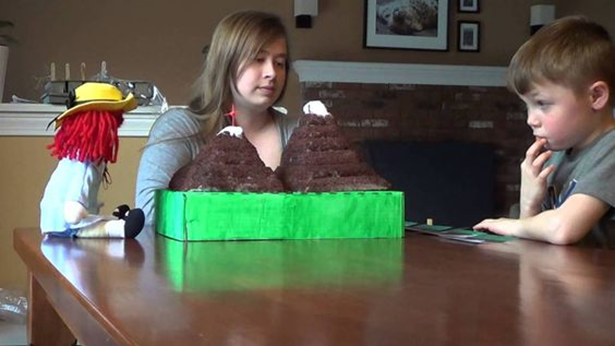
Piaget and Inhelder’s Three-Mountains task assesses egocentrism by asking children to choose what a doll sees from a different vantage point. Preoperational children often select the view matching their own perspective, revealing limits in perspective-taking that improve by the concrete operational stage. Source.
Implications of egocentric thinking
Egocentrism can impact:
Communication: Children may assume listeners know what they’re thinking.
Social interaction: Difficulty understanding others’ feelings or intentions can lead to misunderstandings.
Learning processes: Group work and cooperation may be challenging because of their inability to fully appreciate others’ viewpoints.
As children mature, especially around age 6 or 7, egocentric thought begins to diminish, leading to more socially aware and empathetic behavior.
Animism
Definition and expression of animism
Animism is the belief that inanimate objects possess consciousness, feelings, or intentions. It is a hallmark of preoperational thought, reflecting a child’s tendency to attribute human-like characteristics to non-living things.
Examples include:
Saying “the sun is happy today” when it’s sunny.
Believing that a favorite toy feels sad when left behind.
Claiming the clouds are angry because it’s raining.
Children may genuinely believe these objects have desires or emotions, demonstrating how imaginative and symbolic their thinking has become.
Why animism occurs
Animism is a result of:
Egocentric thinking: Children project their own emotions and experiences onto objects.
Limited understanding of cause and effect: They struggle to distinguish between intentional actions and physical events.
Symbolic capacity: Their ability to imagine and represent concepts fosters these beliefs.
This way of thinking helps children make sense of the world around them, even though it lacks scientific accuracy.
Developmental trajectory of animism
Younger preoperational children (ages 2–4) tend to believe that almost all objects are alive or sentient.
Older preoperational children (ages 5–7) begin to limit these beliefs to things that move or resemble living beings (e.g., cars, dolls).
By the time children enter the concrete operational stage, animistic thinking generally fades as they gain a better understanding of biology, physics, and non-living systems.
Symbolic Play
What is symbolic play?
Symbolic play (also called pretend play or imaginative play) is when children use one object to stand for another or engage in make-believe scenarios. This is one of the most notable behaviors during the preoperational stage and illustrates the child’s growing capacity for representation and abstract thinking.
Examples of symbolic play include:
Pretending a stick is a magic wand or a sword.
Using a box as a spaceship or car.
Role-playing as a parent, doctor, teacher, or superhero.
Symbolic play typically becomes more elaborate and socially interactive as children grow, often involving storytelling, cooperation with peers, and role differentiation.
Benefits of symbolic play
Symbolic play contributes to various aspects of development:
Cognitive development: Enhances memory, problem-solving, and abstract thinking skills.
Social development: Encourages turn-taking, sharing, empathy, and understanding of social roles.
Emotional development: Offers a safe space to express fears, frustrations, or wishes.
Linguistic development: Promotes vocabulary expansion and grammatical skills through dialogue and narration.
Stages of pretend play
Early pretense (around age 2): Simple substitution (e.g., using a spoon as a microphone).
Complex sequences (ages 3–5): Multi-step scenarios with plots, such as running a restaurant or going on an adventure.
Collaborative play (ages 5–7): Involves coordination with others and sustained storylines.
Pretend play reflects the child’s increasing mastery of symbolic representation, a core feature of this cognitive stage.
Conservation Tasks and Challenges
Understanding conservation
Conservation refers to the understanding that a quantity remains the same despite changes in its shape, form, or appearance. Piaget found that preoperational children typically fail to grasp conservation because their reasoning is based on perception rather than logic.
For instance, if water is poured from a short, wide glass into a tall, narrow glass, children may say there is more water in the tall glass because it looks “higher.”
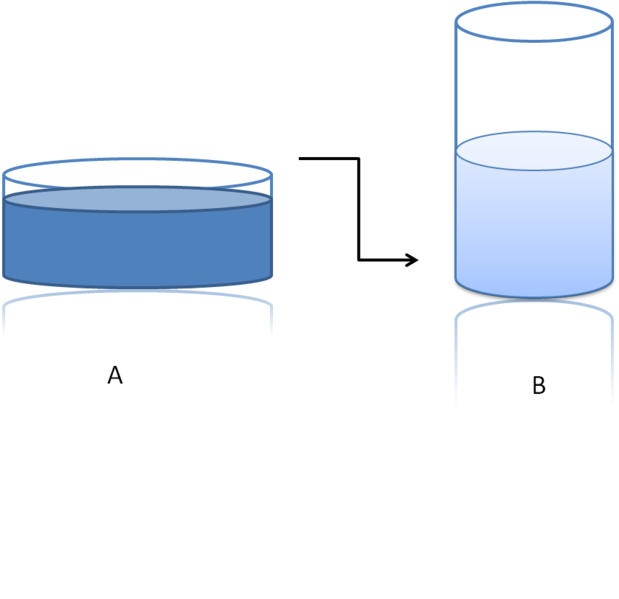
Diagram of Piaget’s liquid conservation task: the same volume is poured from an identical beaker into a taller, narrower one, producing a misleading “more” appearance. This figure helps illustrate centration (focus on height) and difficulty reversing the transformation—typical of preoperational reasoning. Note: this diagram includes only the liquid-volume variant; other conservation tasks (number, mass, area) are not pictured. Source.
Key conservation tasks used by Piaget
Conservation of liquid: Same volume of liquid poured into containers of different shapes.
Conservation of number: Identical rows of objects are rearranged to appear longer or shorter.
Conservation of mass: A ball of clay is reshaped into a sausage—children may think the sausage has more clay.
Conservation of area: Equal areas are rearranged to look different in layout.
In each case, children in the preoperational stage usually fail to recognize that the core quantity is unchanged.
Why children fail conservation tasks
Piaget identified several reasons:
Centration: Children focus on one salient feature, such as height or length, ignoring others like width or spacing.
Irreversibility: They cannot mentally reverse a transformation to understand the initial state.
Perceptual dominance: Appearances dominate logical reasoning. If something looks bigger, they believe it has more.
Static thinking: Children see situations as fixed rather than dynamic; they don’t understand the transformation process.
These limitations make conservation a significant challenge until around age 6 or 7, when children transition to the concrete operational stage and develop more logical thinking skills.
Role of Language Development
Cognitive significance of language
Language is a critical tool for thinking, reasoning, and communication. Piaget believed that while language supports cognition, it is a byproduct of underlying cognitive structures. As such, children’s cognitive development drives their language abilities—not the other way around.
During the preoperational stage, children experience rapid language growth, expanding both their vocabulary and ability to express ideas. This linguistic progress enables children to represent mental images, talk about past and future events, and engage in more complex social exchanges.
Characteristics of language in this stage
Rapid vocabulary expansion: Children may learn thousands of words between ages 2 and 7.
Improved grammar: Sentences become longer and more complex, though errors in verb conjugation (e.g., “runned” instead of “ran”) are common.
Increased use of pronouns: Reflects developing awareness of self and others.
Narrative skills: Children begin to tell stories, sequence events, and explain their thoughts.
Despite these improvements, their use of language may still be egocentric, meaning they often speak without adjusting their message for others’ perspectives.
Private speech
One prominent feature is private speech, in which children talk aloud to themselves during tasks or play. Piaget saw this as egocentric speech—a reflection of their limited awareness of others.
Example: A child building a block tower might say, “Now I put the red one here… don’t fall!”
Piaget believed this type of speech would diminish with age as children developed more socialized forms of communication.
Alternative view: Vygotsky’s interpretation
Though not part of Piaget’s theory, Lev Vygotsky offered a contrasting view. He argued that:
Language is central to cognitive development.
Private speech is a form of self-guidance and plays a role in thinking and problem-solving.
Over time, private speech becomes internalized as inner speech, aiding in self-regulation.
Vygotsky’s perspective suggests that language is not just a reflection of thought but a tool for structuring and developing it.
Limitations in language use
Even with advances in vocabulary and grammar, preoperational children face challenges:
Pragmatic errors: They may struggle with social rules of language, such as turn-taking or adjusting speech for listeners.
Literal interpretations: Difficulty understanding jokes, sarcasm, or metaphors.
Limited meta-linguistic awareness: They are often unaware of how language functions or how their words might be misinterpreted.
Nevertheless, the preoperational stage is a time of immense linguistic progress, providing a foundation for more advanced cognitive and social development in later years.
Practice Questions
Explain how egocentrism affects a child’s thinking during the preoperational stage.
Egocentrism in the preoperational stage, as described by Piaget, limits a child’s ability to understand perspectives other than their own. Children assume others see, think, and feel the same way they do. This impacts communication, as they often fail to consider the listener’s viewpoint. In Piaget’s three mountains task, children could not identify what a doll saw from another position, highlighting their self-centered reasoning. Egocentrism also affects social interactions, making empathy and cooperation more difficult. As children develop toward the concrete operational stage, they begin to decenter and appreciate different perspectives, improving social and cognitive understanding.
Describe one conservation task and explain why preoperational children typically fail it.
One common conservation task is the conservation of liquid volume. In this task, equal amounts of liquid are poured into two identical glasses, and then one is poured into a taller, thinner glass. Preoperational children often say the taller glass holds more liquid because it looks fuller. They focus on one dimension—height—while ignoring width, demonstrating centration. Their thinking is based on immediate perception rather than logical reasoning. Additionally, they struggle with reversibility and cannot mentally undo the transformation to realize the amount remains the same. This failure highlights the cognitive limitations typical of the preoperational stage.
FAQ
During the preoperational stage, a child’s understanding of time is limited and largely subjective. They often perceive time in terms of familiar routines, events, or sequences rather than precise measurements. For example, they might understand that lunch comes after playtime but struggle to grasp the abstract concept of “an hour” or “yesterday.” This is because their thinking is still intuitive and tied closely to immediate experiences. They may also confuse duration and sequence—believing something that happened later took longer, simply because it occurred last. Without an internalized framework for measuring time, they rely on external cues such as the sun’s position or daily rituals. Abstract concepts like days of the week, months, or clocks are difficult to understand until they develop more logical and reversible thinking during the concrete operational stage. Teaching time to preoperational children usually involves using visual aids, concrete examples, and consistent routines to help them build foundational time concepts.
Culture significantly influences the expression and interpretation of cognitive features like animism and egocentrism in preoperational children. While Piaget considered these traits as universal stages of development, more recent research suggests that cultural context can either reinforce or reduce such tendencies. In cultures that emphasize communal living and interdependence, children may show earlier awareness of others’ perspectives, potentially reducing egocentric behaviors. Conversely, in more individualistic cultures, egocentrism may be more pronounced or persist longer. Regarding animism, cultural stories, traditions, and belief systems can normalize or encourage attributing human qualities to non-human entities. For instance, cultures with rich traditions in storytelling often include animals or natural elements with human emotions and motivations, which may sustain or reinforce animistic thinking. Therefore, while the capacity for egocentrism and animism may be biologically based, the extent and duration of these tendencies can vary across cultures depending on the values, practices, and social structures to which children are exposed.
Symbolic play is typically limited or delayed in children with autism spectrum disorder (ASD), especially when compared to typically developing peers in the preoperational stage. Children with ASD often show reduced interest in imaginative or pretend play and may prefer repetitive or functional use of objects (e.g., spinning wheels or lining up toys) rather than transforming them symbolically. For example, rather than pretending a block is a phone, a child with ASD might focus solely on its shape or texture. This reduced use of symbolic play is often linked to difficulties in theory of mind—the ability to understand others’ mental states—which also underlies limitations in social imagination and communication. Symbolic play is a critical marker in early childhood development and is often used diagnostically to assess developmental progress. While some children with ASD may eventually engage in symbolic play, it usually emerges later and may require targeted interventions such as play therapy or guided modeling to foster imaginative engagement.
Centration and egocentrism are both cognitive limitations in preoperational children, but they refer to different aspects of thought. Centration is the tendency to focus on one single aspect of a situation or object while ignoring other relevant features. For instance, in a conservation of liquid task, a child might focus only on the height of the liquid in a glass, ignoring the width, leading them to incorrectly conclude that the taller glass has more. This reflects a limitation in multi-dimensional thinking. In contrast, egocentrism is the inability to see a situation from another person’s point of view. It is more about perspective-taking than focusing attention. A classic example is the three mountains task, where the child assumes the other person sees exactly what they see. While both limitations result from immature cognitive processes, centration relates to perceptual focus on physical characteristics, whereas egocentrism pertains to social and cognitive perspective-taking abilities.
Reversibility is the mental ability to understand that actions or changes can be undone, returning to their original state. It is a key concept that preoperational children generally lack but which becomes more prominent in the concrete operational stage (around age 7). Without reversibility, children struggle with tasks like conservation because they cannot mentally imagine reversing the transformation. For example, when water is poured from one glass to another, they cannot comprehend that pouring it back would result in the same amount. Reversibility allows children to mentally retrace steps, compare before-and-after states, and grasp the logical consistency of physical operations. This is critical for developing logical thinking, problem-solving, and mathematical reasoning. Piaget viewed the emergence of reversibility as a hallmark of the transition from intuitive thought to operational thought. It underpins concepts such as subtraction being the inverse of addition and enables children to move beyond appearance-based judgments to reasoned conclusions based on principles.