
Nucleic Acids and Nucleotides
DNA stores genetic information in all living cells.
RNA transfers genetic information from DNA to the ribosomes.
Ribosomes are formed from RNA and proteins.
Both nucleic acids are polymers of nucleotides.
Each nucleotide contains a pentose sugar, nitrogen-containing organic base and phosphate group.
A condensation reaction between nucleotides forms a phosphodiester bond.
DNA’s relative chemical simplicity initially caused scientists to doubt that it carried the genetic code.
DNA Double Helix and Base Calculations
The two DNA polynucleotide chains are held together by hydrogen bonds.
Hydrogen bonds form between specific complementary base pairs.
Adenine pairs with thymine, while cytosine pairs with guanine.
Complementary pairing allows either strand to determine the base sequence of the other strand.
In double-stranded DNA, %A = %T and %C = %G.
All four base percentages must total 100%.
If adenine is 30%, thymine is 30%; the remaining 40% gives cytosine and guanine at 20% each.
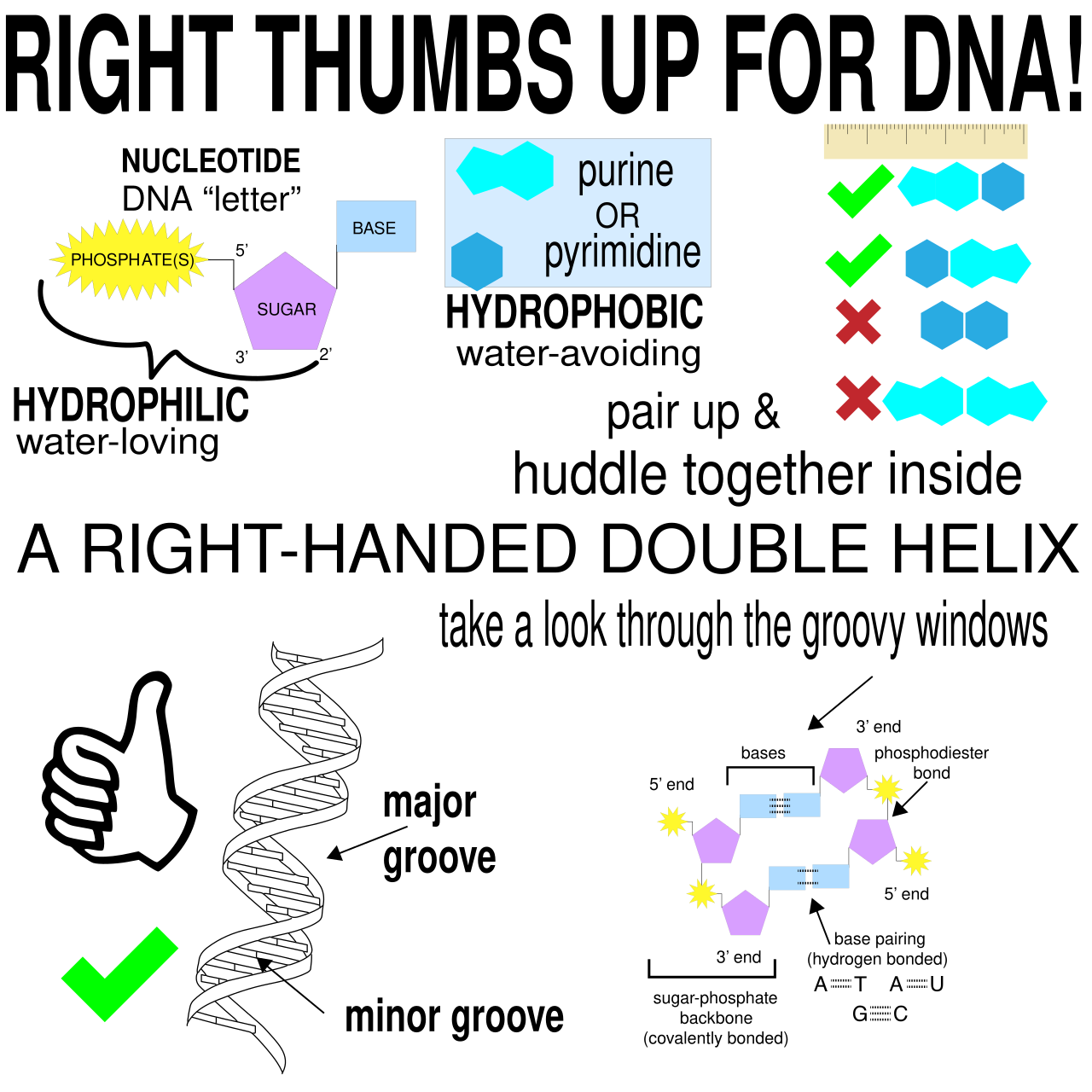
The two polynucleotide strands form a double helix and are joined by complementary base pairs. Base pairing explains why the proportions of adenine and thymine are equal, as are cytosine and guanine. Source
Evidence for Semi-Conservative Replication
The Watson–Crick model predicted that each daughter DNA molecule would contain one parental strand and one new strand.
The Meselson–Stahl experiment used isotope-labelled nitrogen to distinguish DNA molecules of different densities.
After one replication, one intermediate-density DNA band was observed.
This result rejected the conservative model, which predicted separate heavy and light bands.
After two replications, intermediate-density and light DNA bands were observed.
This rejected the dispersive model and supported semi-conservative replication.
Strong evaluation links each model’s prediction to the observed evidence before drawing a conclusion.
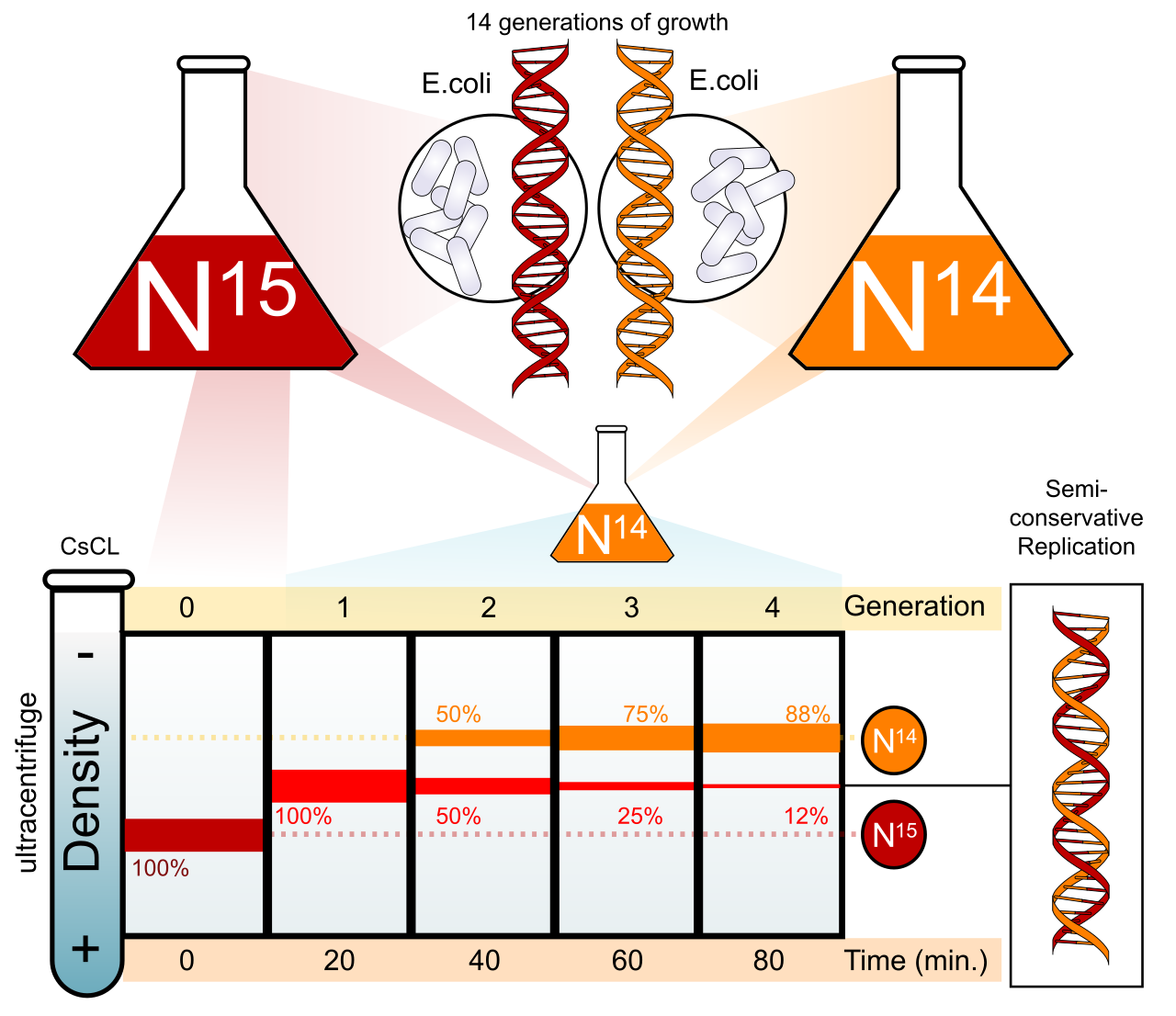
The first generation produced intermediate-density DNA, rejecting conservative replication. The second generation produced both intermediate and light DNA, supporting the semi-conservative model. Source
Checklist: can you do this?
Can you distinguish the structures and roles of DNA and RNA?
Can you calculate missing DNA base percentages using complementary base pairing?
Can you explain each stage of semi-conservative DNA replication?
Can you evaluate evidence supporting the Watson–Crick replication model?
Can you link the properties of ATP, water and inorganic ions to their biological roles?
DNA and RNA Compared
A DNA nucleotide contains deoxyribose, phosphate and adenine, cytosine, guanine or thymine.
An RNA nucleotide contains ribose, phosphate and adenine, cytosine, guanine or uracil.
DNA forms a double helix containing two polynucleotide chains.
RNA is a relatively short polynucleotide chain.
Distinguish deoxyribose and thymine in DNA from ribose and uracil in RNA.
Do not state that RNA contains thymine or that DNA contains uracil.
Semi-Conservative DNA Replication
Semi-conservative replication produces DNA molecules containing one original strand and one newly synthesised strand.
DNA helicase unwinds the double helix and breaks the hydrogen bonds between complementary bases.
Each exposed original strand acts as a template.
Free DNA nucleotides are attracted to exposed bases and pair by complementary base pairing.
DNA polymerase catalyses condensation reactions joining adjacent nucleotides.
New phosphodiester bonds form the sugar–phosphate backbone of each new strand.
The process produces two DNA molecules with the same genetic information, ensuring genetic continuity between cell generations.
ATP Structure and Recycling
ATP is a nucleotide derivative containing adenine, ribose and three phosphate groups.
ATP hydrolase catalyses ATP hydrolysis.
ATP + H₂O → ADP + Pi
Hydrolysis releases an inorganic phosphate group and energy that can be transferred to cellular reactions.
ATP synthase catalyses the condensation of ADP and Pi to resynthesise ATP.
ATP is resynthesised during photosynthesis or respiration.
Biological Importance of Water
Water is a metabolite in reactions including hydrolysis and condensation.
Water is an important solvent in which metabolic reactions occur.
Its relatively high heat capacity buffers organisms and environments against rapid temperature changes.
Its large latent heat of vaporisation allows evaporation to provide cooling with relatively little water loss.
Strong cohesion between water molecules supports continuous water columns in plant transport cells.
Cohesion also produces surface tension where water meets air.
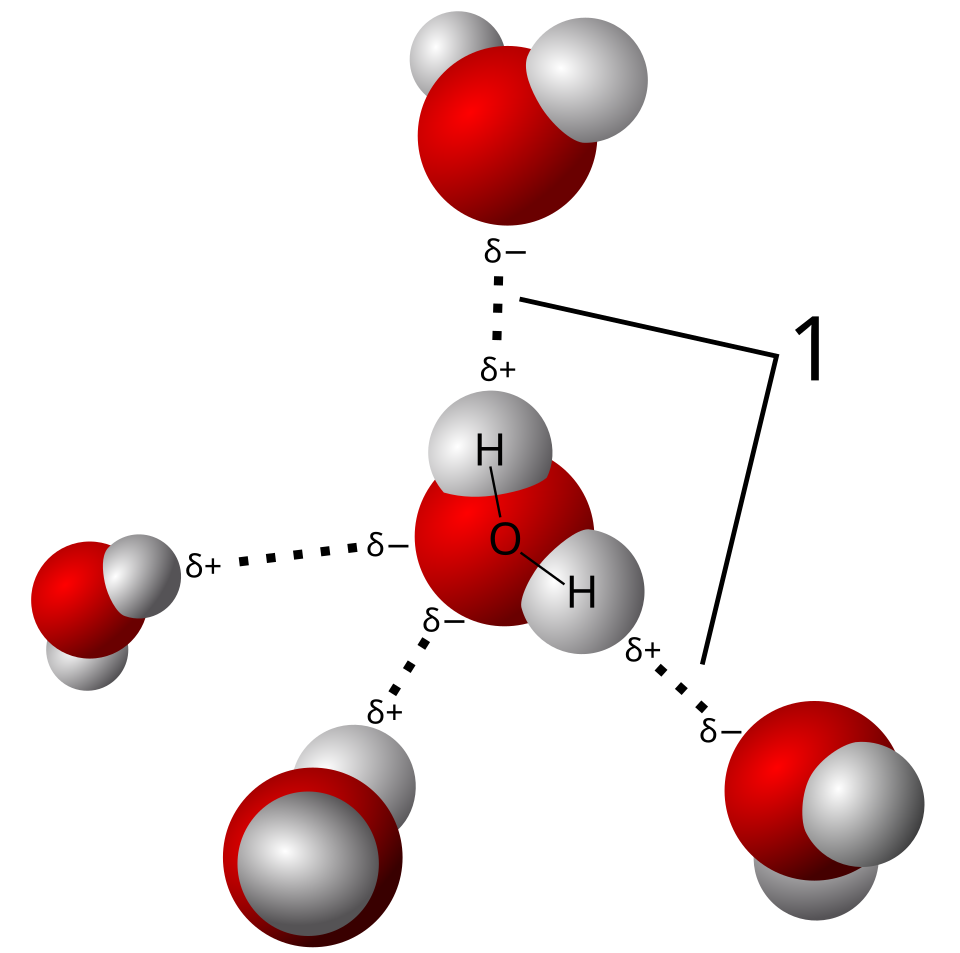
Attractions between water molecules produce cohesion. Cohesion helps maintain columns of water in plant transport tissue and contributes to surface tension. Source
Roles of Inorganic Ions
Inorganic ions occur in solution within the cytoplasm and body fluids.
Some ions occur at high concentrations, while others are required only at very low concentrations.
Each ion has a specific role determined by its properties.
Hydrogen ions influence pH.
Iron ions form part of haemoglobin.
Sodium ions are involved in the co-transport of glucose and amino acids.
Phosphate ions are components of DNA and ATP.