
SI base units you must know
Mass uses the kilogram, symbol ; length uses the metre, symbol ; time uses the second, symbol .
Electric current uses the ampere, symbol ; temperature uses the kelvin, symbol ; amount of substance uses the mole, symbol .
These are the six fundamental quantities and associated SI base units required for AQA.
The SI also includes the candela, symbol , but AQA explicitly excludes it from this subtopic.
Students are not expected to recall formal definitions of the fundamental quantities.
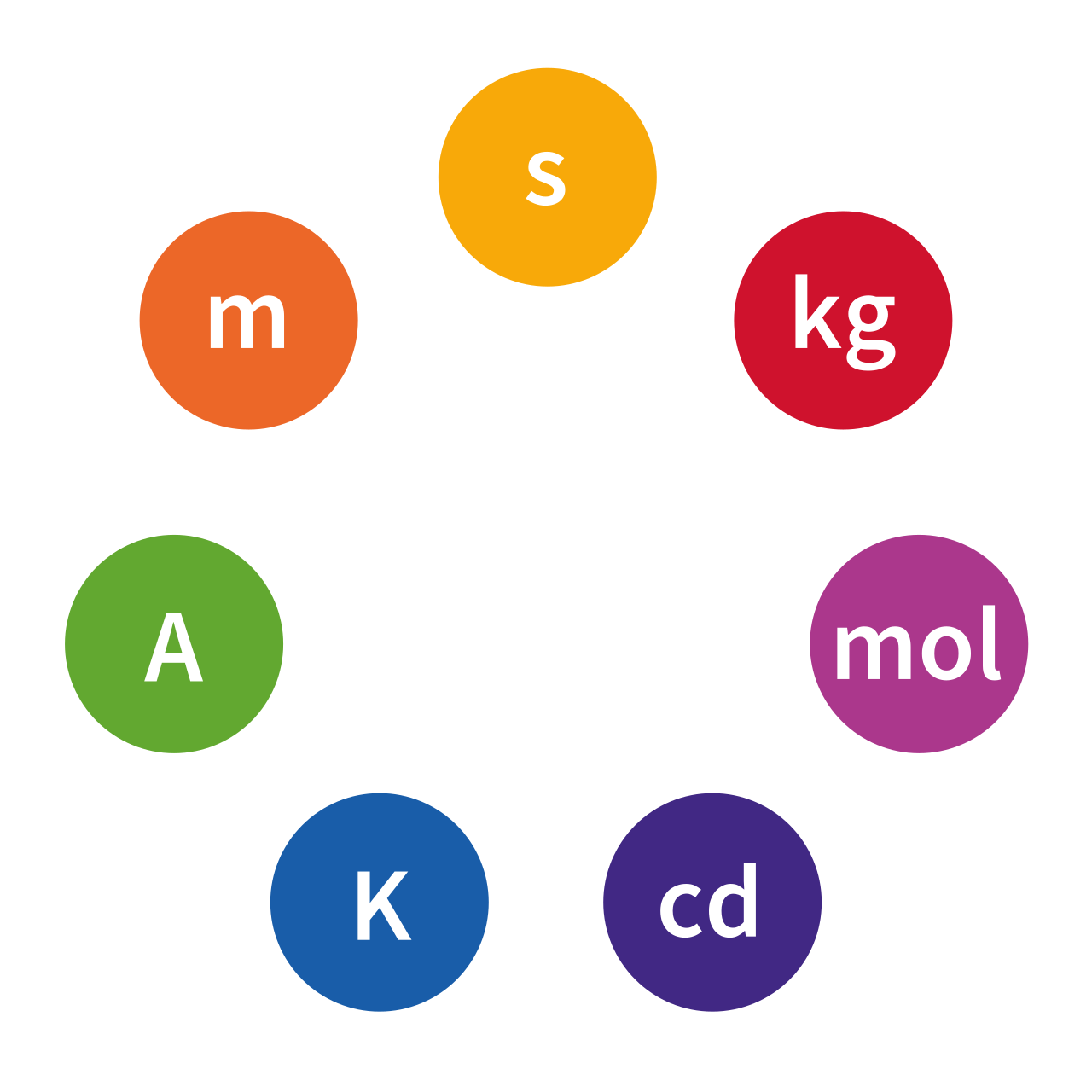
The diagram shows all seven SI base-unit symbols. For AQA, learn , , , , and ; is excluded. Source
How derived SI units are formed
A derived SI unit is formed from products or powers of SI base units.
Speed may be written as and acceleration as .
The newton is a derived unit: .
The joule is a derived unit: .
The watt is a derived unit: .
Recognise that named derived units can be rewritten using base units.
Prefixes and standard form
An SI prefix represents a multiplying factor expressed as a power of ten.
To remove a prefix, replace it by its corresponding power of ten.
For example, .
Similarly, .
To introduce a prefix, reverse the process: .
Always check the sign of the exponent and the case of the prefix symbol.
Joule and electronvolt conversions
The joule and electronvolt are both units used for energy, so AQA may require conversion between them.
Use .
For examination calculations, this is commonly used as approximately .
To convert from to , multiply by .
To convert from to , divide by .
For example, .
What AQA excludes
The candela, symbol , is not required for this subtopic.
Formal definitions of the fundamental quantities do not need to be recalled.
Dimensional analysis is not required.
Focus instead on using the required units, prefixes, standard form and unit conversions accurately.
Large SI prefixes
Tera, symbol , represents .
Giga, symbol , represents .
Mega, symbol , represents .
Kilo, symbol , represents .
Prefix symbols are case-sensitive; for example, and represent completely different factors.Large SI prefixes
Tera, symbol , represents .
Giga, symbol , represents .
Mega, symbol , represents .
Kilo, symbol , represents .
Prefix symbols are case-sensitive; for example, and represent completely different factors.
Small SI prefixes
Centi, symbol , represents .
Milli, symbol , represents .
Micro, symbol , represents .
Nano, symbol , represents .
Pico, symbol , represents .
Femto, symbol , represents .
Same-quantity unit conversions
Convert between different units only when they describe the same physical quantity.
For example, .
Also, .
A smaller unit gives a larger numerical value; a larger unit gives a smaller numerical value.
Use standard form to reduce errors when very large or very small factors are involved.
Checklist: can you do this?
Can you match the six required fundamental quantities to their correct SI base units and symbols?
Can you recall the factors and symbols for , , , , , , , , and ?
Can you convert between a prefixed unit, its base unit and standard form without changing the physical quantity?
Can you recognise and use derived SI units formed from combinations of base units?
Can you convert energy between and , and between and ?