
Eukaryotic Cell Organelles: Structure and Function
· Cell surface membrane = selectively permeable boundary controlling movement of substances into and out of the cell.
· Nucleus = contains DNA; controls cell activities by regulating gene expression and protein synthesis.
· Nuclear envelope = double membrane with pores; controls exchange between nucleus and cytoplasm.
· Nucleolus = makes ribosomes.
· Rough endoplasmic reticulum (RER) = membrane network with ribosomes; synthesises and transports proteins.
· Smooth endoplasmic reticulum (SER) = membrane network without ribosomes; synthesises lipids and carries out detoxification.
· Golgi body / Golgi apparatus / Golgi complex = modifies, sorts and packages proteins into vesicles.
· Mitochondria = site of aerobic respiration and ATP production; contain small circular DNA and 70S ribosomes.
· Ribosomes = site of protein synthesis; 80S in cytoplasm, 70S in chloroplasts and mitochondria.
· Lysosomes = contain digestive enzymes; break down unwanted cell components and ingested material.
· Centrioles = involved in spindle formation during cell division in animal cells.
· Microtubules = part of the cytoskeleton; maintain cell shape and help movement of organelles.
· Cilia = hair-like extensions; move substances across the cell surface or move cells.
· Microvilli = small folds of the cell surface membrane; increase surface area for absorption.
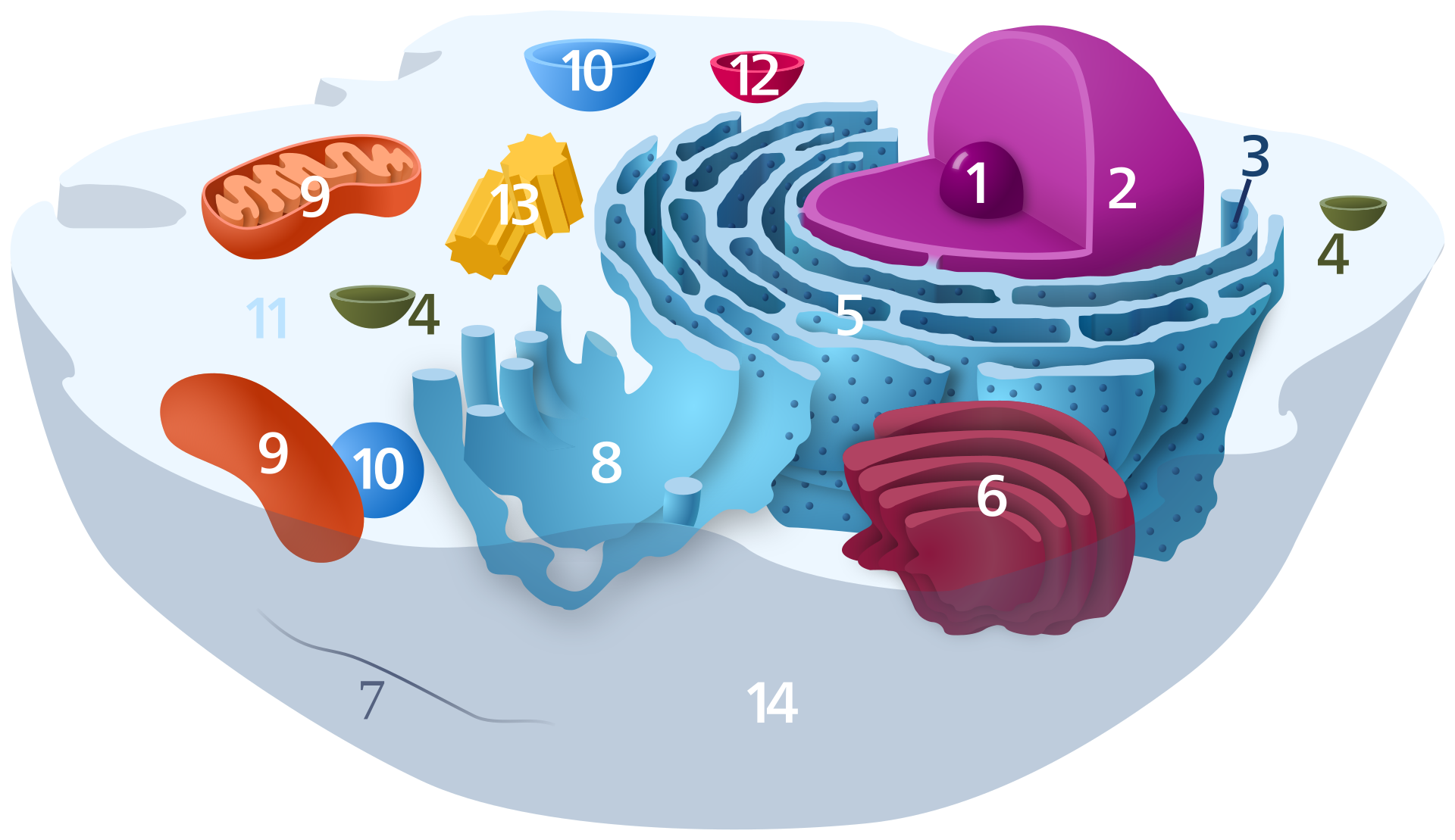
This diagram shows the main organelles in a typical animal eukaryotic cell. Use it to practise identifying organelles and linking each structure to its function. Source
Plant Cell Structures
· Chloroplasts = site of photosynthesis; contain chlorophyll, small circular DNA and 70S ribosomes.
· Cell wall = made mainly of cellulose; provides support, maintains shape and prevents bursting by osmosis.
· Plasmodesmata = cytoplasmic channels through plant cell walls; allow communication and transport between adjacent cells.
· Large permanent vacuole = stores cell sap and maintains turgor pressure.
· Tonoplast = membrane surrounding the permanent vacuole; controls movement of substances into and out of the vacuole.
· Plant cells also contain common eukaryotic organelles such as nucleus, mitochondria, RER, SER, Golgi body and ribosomes.
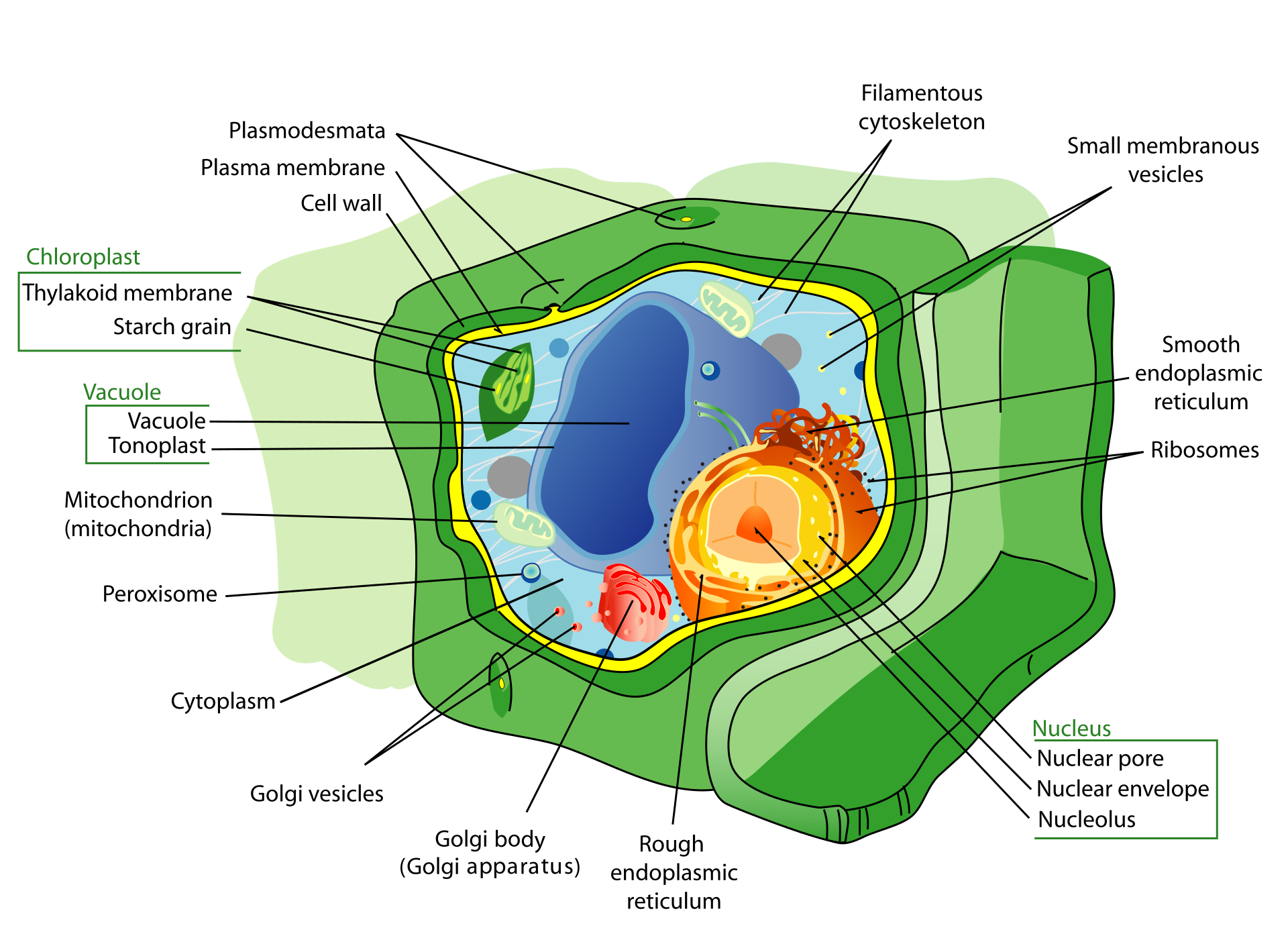
This diagram shows the typical structures of a plant eukaryotic cell. It is useful for comparing plant and animal cells and for identifying plant-only structures such as the cell wall, chloroplasts and large permanent vacuole. Source
Interpreting Plant and Animal Cell Images
· In photomicrographs, electron micrographs and drawings, identify structures by shape, position, size and membrane arrangement.
· Nucleus is usually large and often visible in light micrographs.
· Mitochondria are small oval structures; internal membranes may be visible in electron micrographs.
· RER appears as flattened membranes with ribosomes attached; SER lacks ribosomes.
· Golgi body appears as stacks of curved flattened sacs with vesicles nearby.
· Chloroplasts are recognised by their oval shape and internal membrane stacks.
· Plant cells often appear more regular in shape because of the cell wall.
· Animal cells often appear more flexible or irregular because they lack a cell wall.
Comparing Typical Plant and Animal Cells
· Both plant and animal cells are eukaryotic and contain a nucleus, cell surface membrane, cytoplasm, mitochondria, RER, SER, Golgi body and 80S ribosomes.
· Plant cells only: cellulose cell wall, chloroplasts, plasmodesmata, large permanent vacuole and tonoplast.
· Animal cells only / mainly: centrioles, cilia and microvilli are commonly associated with animal cells.
· Plant cells usually have a fixed shape; animal cells usually have a more flexible shape.
· Plant cells may carry out photosynthesis if they contain chloroplasts; animal cells do not photosynthesise.
ATP and Cell Activity
· Cells use ATP from respiration as an immediate source of energy.
· ATP is needed for energy-requiring processes, including active transport, movement, biosynthesis and cell division.
· Mitochondria are important because they produce ATP during aerobic respiration.
· High-energy-demand cells often contain many mitochondria.
Prokaryotic Cells: Typical Bacterium
· Prokaryotic cells are unicellular and much simpler than eukaryotic cells.
· Typical bacterial cells are generally 1–5 µm in diameter.
· Bacteria have peptidoglycan cell walls.
· Bacteria contain circular DNA, not DNA enclosed in a nucleus.
· Bacteria have 70S ribosomes for protein synthesis.
· Bacteria lack organelles surrounded by double membranes, such as nuclei, mitochondria and chloroplasts.
· Some bacteria may also have structures such as plasmids, flagella or capsules, but these are not the main required syllabus features for this subtopic.
Comparing Prokaryotic and Eukaryotic Cells
· Eukaryotic cells have a nucleus; prokaryotic cells do not.
· Eukaryotic DNA is found inside a nucleus; prokaryotic DNA is circular and found free in the cytoplasm.
· Eukaryotic cells contain membrane-bound organelles; prokaryotic cells lack organelles surrounded by double membranes.
· Eukaryotic cytoplasmic ribosomes are 80S; prokaryotic ribosomes are 70S.
· Plant cell walls contain cellulose; bacterial cell walls contain peptidoglycan.
· Prokaryotic cells are usually smaller, typically 1–5 µm, while eukaryotic cells are usually larger.
· Both prokaryotic and eukaryotic cells have cell surface membranes, cytoplasm, DNA and ribosomes.
Viruses as Non-Cellular Structures
· Viruses are non-cellular and are not made of cells.
· All viruses have a nucleic acid core, containing either DNA or RNA.
· The nucleic acid is surrounded by a capsid made of protein.
· Some viruses have an outer envelope made of phospholipids.
· Viruses do not have cytoplasm, ribosomes or organelles, so they cannot carry out normal cell activities independently.
· Viruses help show why cells are considered the basic units of living organisms.
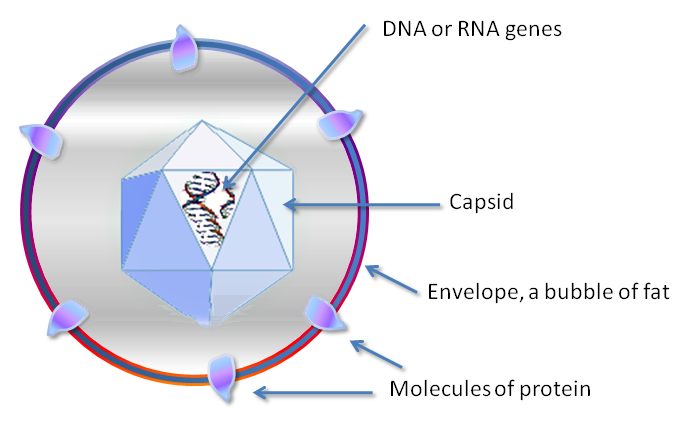
This diagram shows the basic structure of a virus, including genetic material and a protein capsid. Use it to remember that viruses are non-cellular and may contain either DNA or RNA. Source
Checklist: can you do this?
· Recognise and state the function of key organelles in plant and animal eukaryotic cells.
· Describe and interpret photomicrographs, electron micrographs and drawings of typical plant and animal cells.
· Compare plant, animal and bacterial cells using nucleus, DNA, ribosomes, cell wall and membrane-bound organelles.
· State that cells use ATP from respiration for energy-requiring processes.
· Describe virus structure as non-cellular, with DNA or RNA, a protein capsid and sometimes a phospholipid envelope.